
Asking what a repair will cost is a fair question, but the honest answer depends on several variables working together. These asko repair cost factors will not give you a fixed number — no page should, since every unit and every problem is different — but they explain what actually moves the price from one repair to the next.
Parts sourcing for a European-engineered brand
Asko is engineered in Sweden and built by Gorenje in Slovenia, which means genuine parts for some components travel a longer supply chain than parts for higher-volume domestic appliance brands. Current-generation dishwasher and laundry parts are generally well stocked through trusted parts suppliers, but parts for older units, discontinued series, or imported ovens and cooktops can take longer to locate. Longer sourcing time itself is not usually a cost driver on the part price, but it is one of the asko repair cost factors that affects how the overall job is scheduled and quoted.
Diagnostic complexity
A dishwasher that will not fill and shows a clear error code is a faster, more contained diagnosis than one with an intermittent problem that only shows up mid-cycle, or a washer with a vague vibration complaint that could originate in the suspension, the drum bearing, or an unbalanced load sensor. Because Asko’s error codes are platform-dependent rather than universal, a technician sometimes needs extra time up front just to confirm which control-board generation and code family they are working with before diagnosis can even begin.
What actually failed, and how much labor it takes
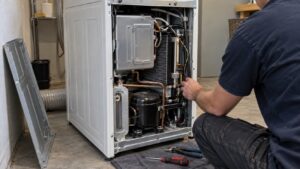
Some repairs are quick: clearing a blocked filter, replacing a door seal, or resetting a tripped safety switch. Others require significant disassembly — reaching a drain pump buried behind the tub, replacing a main control board, or accessing components on a stacked washer-and-dryer installation. Labor time scales with how deep into the appliance a technician has to go, and that is usually the single largest asko repair cost factor in any given job.
Diagnostic fees and how they fit in
Most repair visits start with a diagnostic fee that covers the technician’s time identifying the problem, whether or not you proceed with the repair afterward. This is standard across the appliance repair industry and reflects the real time and expertise involved in tracing a problem correctly the first time, rather than guessing and replacing parts until something works. We quote repair cost only as “from” a starting figure once the diagnosis is complete — never a fixed number sight unseen, because the factors above genuinely change the total from one job to the next.
Getting an accurate number for your situation
The only way to get a real number instead of a guess is a diagnostic visit. Our experienced technicians will identify the problem, check current parts availability using your appliance’s Art. No., and walk you through what the repair actually involves before any work begins. You can schedule a diagnostic directly, and our washer and dryer repair pages outline what each service typically covers.
How asko repair cost factors compare with buying new
Checking current pricing on Asko’s US site gives you a useful reference point when weighing repair against replacement, since understanding what a comparable new unit costs puts any repair estimate into real context. None of the asko repair cost factors described above are fixed the way a retail price tag is — they shift with parts availability at the moment you call, with how quickly a problem can be isolated, and with how deep into the appliance the repair has to go. This is exactly why we never publish a flat number for any repair category on this site; doing so would either understate simple jobs or, more often, understate complex ones in a way that sets the wrong expectation. A diagnostic visit remains the only accurate way to get a number that reflects your specific appliance and problem.
A realistic way to think about asko repair cost factors ahead of time
Rather than trying to estimate a number yourself before a technician has even looked at the appliance, focus your planning on the factors themselves — how old the unit is, how available parts for that specific model tend to be, and how contained or how sprawling the problem seems from the symptoms you are seeing. That framing keeps expectations realistic without requiring a number nobody can honestly give you until the diagnosis is complete.