
Common Asko dishwasher problems
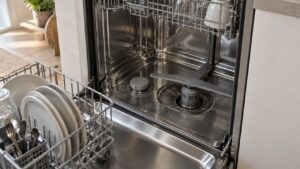
Thorough asko dishwasher repair starts with a fact that trips up most repair shops: Asko runs three separate, mutually incompatible F-code schemes across its dishwasher lineup, and the same number can mean two different problems depending on which generation of control board is fitted. The legacy blink-code generation, read through LED flash patterns on older units, uses F1 through F9 plus FA and FB. The current text-display generation used on panel-ready DFI, built-in DBI, and sliding-door DSD models shows F10 through F68. The Outdoor series, built for the freestanding stainless DOD561TXXLS, runs a third scheme entirely, displayed in colon format as F:10 and so on, whose meanings directly clash with the current-generation numbers. The problems we see most often are overfilling, water not draining, dishes coming out spotty despite Turbo Combi Drying or Turbo Drying being fitted, a circulation pump that has lost pressure, and a spray-arm divider stuck in one position. None of these are guessed at from a generic “dishwasher code list” scraped off a parts site — each is confirmed against the correct scheme for the exact model in front of us. Current-generation panel-ready and built-in models also carry Aqua Safe leak-detection and a Kid Safe child lock as standard, and both occasionally throw their own nuisance alerts that owners mistake for a genuine drain or fill problem before a technician sorts out which system actually triggered.
Our Asko dishwasher repair process
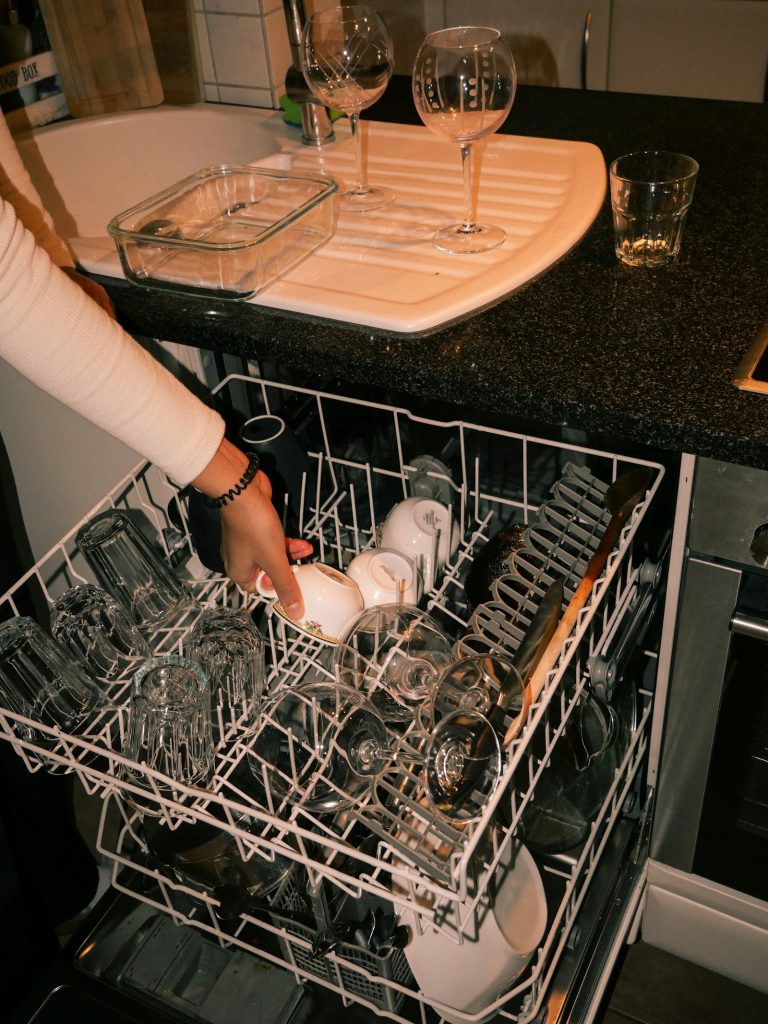
As an independent, third-party repair service with no affiliation to Asko, Gorenje, or Hisense, we begin every asko dishwasher repair by identifying which of the three F-code generations the unit is running, because reading a code against the wrong scheme leads straight to the wrong part. On current-generation DFI, DBI, and DSD units, an F10 or F54 points to overfilling, an F11 or F67 to a water-outlet problem, and an F56 to the circulation pump; on the legacy blink-code generation, the same numbers mean something else entirely, and on the Outdoor series the colon-format codes are read against a third table altogether. Alongside the model number, we also record the Art. No. printed on the same data plate as the Model and Serial fields — Asko’s parts catalogs are keyed to that Article Number specifically, not just the model number, so having it in hand before ordering a spray arm, pump, or sensor avoids a second visit for the wrong part. Our experienced technicians fit genuine OEM or trusted third-party replacement parts, and every repair carries a 30-day labor warranty on our workmanship. Most dishwasher repairs are completed in a single visit; schedule an appointment and get a clear diagnosis before any work begins.
Asko dishwasher models we service
We service the current US Asko dishwasher lineup across every series. Outdoor: DOD561TXXLS. 60+ series: DFI786XXLSOF and DBI786IXXLSSOF. 60 series: DFI776XXLSOF and DBI776IXXLSSOF. 50 series: DBI565PXXLS, DBI565TXXLS, DFI565XXLSOF, the sliding-door DSD565, DFI565XXL, the ADA-compliant DFI565, and DBI565IXXLS. Older 30- and 40-series units with the legacy blink-code display are also within scope, since their spray arms, pumps, and heating elements wear the same way regardless of how the problem is displayed. Full model records, including which F-code generation each unit runs, live in our model directory. If your Asko kitchen also includes a built-in oven or cooktop needing attention, see our oven repair and cooktop repair pages as well.
Error codes and diagnostics
Because three separate schemes exist, never assume a code means the same thing across a whole fleet of Asko dishwashers. On the legacy blink-code generation, F2 is overfilling, F4 is a water-intake problem, and F8 is a blocked filter. On the current display generation, F10 and F54 both relate to overfilling at different stages, F11 and F67 both point to a water-outlet problem, F45 is a diverter problem, F52 is a water-level problem often traced to a clogged filter, and F68 is a BLDC drain-pump failure. On the Outdoor series, F:41 means the door is open — a condition with no equivalent code on either of the other two schemes — while F:44 on that same platform reads as a pressure-sensor failure, a meaning it does not share with any current-generation number. See our full dishwasher error code guide for the complete breakdown by generation, and browse our repair guides for step-by-step troubleshooting on specific symptoms like drying performance or drain issues.
Service areas
Our specialist technicians cover all 50 states and the District of Columbia plus dozens of metro areas, with prompt scheduling and same-day visits where availability allows for asko dishwasher repair. Because Asko’s dishwasher F-codes genuinely differ by generation, a technician who checks the display type before quoting a problem saves a customer a wasted trip and a wrong part order. Every visit is handled by an experienced technician who carries the diagnostic tools and genuine OEM or trusted replacement parts most likely needed for that specific model. Full current specifications for the Asko dishwasher lineup are published at us.asko.com. Find your area on our service locations page, or book any visit through the scheduling page.