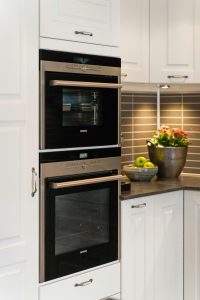
Asko telescopic oven runners let a shelf slide most or all of the way out of the cavity while still supporting the full weight of what is on it, which makes pulling out a heavy roasting pan or a full sheet of cookies dramatically easier and safer than lifting a shelf out on fixed rails. Asko fits different levels of this feature across its oven range: some models, like OCM64BSH and OCM64GSH, ship with partially extendable telescopic guides on a single level, while pyrolytic models like OTP66BSH offer fully extendable telescopic guides across two levels, letting two shelves both slide fully clear at once.
How the mechanism works
A telescopic runner is built from nested rail sections that extend in sequence, similar in principle to a drawer slide, with the shelf itself riding on the innermost section. That means there are more moving joints and more surfaces for grease and food residue to collect on than a simple fixed wire rack has, particularly at the point where the rail attaches to the cavity wall. Over time, grease buildup at those pivot points can make the slide feel stiff or catch partway through its travel rather than gliding smoothly.
Cleaning the rails without damaging them
The rails themselves generally should not go through a pyrolytic self-clean cycle at the same intensity as the cavity, since the extreme heat can affect the plating and the grease packed into the pivot joints in ways that plain cavity surfaces are not affected by. Removing the rails for a separate wipe-down with warm water and mild dish soap, following any release mechanism your specific model uses, keeps them sliding smoothly without exposing them to unnecessary heat cycling. A soft brush can help work grease out of the joints between rail sections where a cloth cannot reach.
Removing the oven door for a deeper clean
Behind the telescopic rails, the underside of the door glass is one of the areas that collects the most stubborn grease film over time, since it sits directly above whatever is cooking and rarely gets wiped during routine cleaning. Most built-in Asko ovens allow the door to be removed for a proper clean by releasing a hinge lock or catch on each side, usually accessible once the door is opened to a specific angle, often close to fully open or at a marked stop position. Because hinge mechanisms differ across models and generations, and a mishandled door hinge can pinch fingers or drop the door unexpectedly, this is a step worth doing carefully and slowly rather than forcing it if it does not release the way you expect.
What to check once the door is off
With the door removed, it is a good opportunity to inspect the door seal gasket for any cracking, flattening, or gaps, since a compromised seal lets heat and, on a combi-steam model, moisture escape during cooking. It is also a chance to clean between the inner and outer glass panels if your model’s design allows access, since grease film trapped between the layers is otherwise very difficult to reach.
For hinge, rail, or seal replacement, browse our full library of Asko oven guides, or book a service visit at /schedule/. Asko’s own oven specifications are published at global.asko.com.