
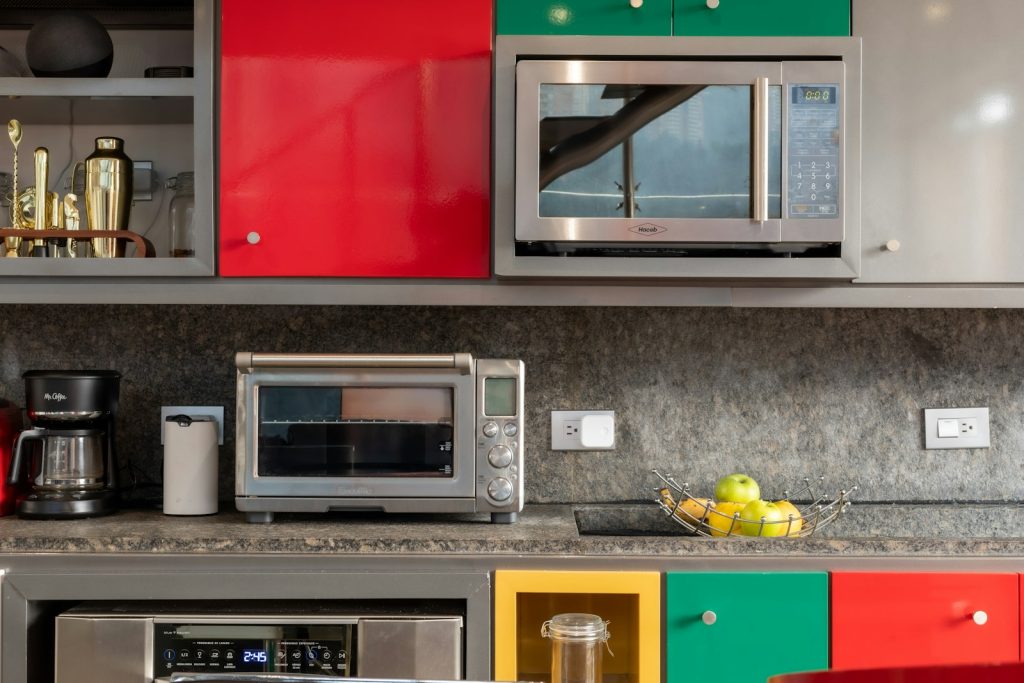
Because Asko has never sold a countertop or over-the-range microwave, asko built-in microwave installation almost always means fitting the appliance into a tall cabinetry unit – typically at eye level or slightly below, stacked above or below a built-in wall oven – rather than placing it on an open shelf or counter.
Confirming the cutout dimensions first
Every OM, OCM, or OCSM model has a specific cutout width, height, and depth requirement published in its installation documentation, and because these are European-engineered appliances, the exact measurements do not always match standard US cabinetry conventions the way a domestic countertop unit’s dimensions might. Confirming the cutout against the specific model’s documentation – not a generic “microwave-sized opening” – before the cabinetry is built avoids a mismatch discovered only once the unit arrives on site.
Ventilation clearance around the unit
A built-in microwave, especially a combi unit generating real convection heat, needs air clearance around its cabinet to reject heat safely, similar in principle to the plinth ventilation an integrated refrigerator relies on. Installation documentation specifies minimum clearances at the top, sides, and rear of the appliance within the cabinetry cutout – packing the surrounding cabinetry too tightly against the unit can trap heat and stress the internal components over time, particularly during long convection cycles.
Electrical requirements
A built-in combi microwave, particularly an OCM or OCSM unit running convection and steam functions alongside microwave energy, typically draws more current than a basic countertop microwave and needs a dedicated circuit sized to the model’s specification rather than sharing a circuit with other kitchen appliances. Confirming this before installation avoids a breaker that trips under combined load once the unit is in daily use.
Support and mounting
Because these units are heavier than a countertop microwave and sit recessed into vertical cabinetry rather than resting on a flat surface, the cabinetry itself needs to provide genuine structural support at the mounting points specified in the installation guide, not just a cosmetic surround. A trim kit, where the model calls for one, needs to be fitted correctly to both support the unit’s weight at the front edge and maintain the ventilation clearance the appliance needs behind it.
Coordinating asko built-in microwave installation with a wall oven stack
Because these units are frequently installed stacked above or below a built-in wall oven, coordinating asko built-in microwave installation with the oven’s own cutout and clearance requirements at the same time avoids a situation where each appliance individually fits but the combined stack does not leave enough clearance between the two for heat dissipation. Reviewing both appliances’ installation documentation together, rather than one at a time, is worth the extra planning step before the cabinetry is finalised.
Working with an existing tall unit versus building one new for asko built-in microwave installation
Replacing a unit within an existing tall cabinetry opening is usually more constrained than installing into a newly built one, since the existing cutout, trim kit, and electrical run were sized for whatever unit came before and may not automatically suit a different model even within Asko’s own lineup. Confirming that a specific replacement model’s dimensions and clearance requirements match the existing opening – rather than assuming any built-in microwave will simply drop into the same space – avoids discovering a mismatch only after the old unit has already been removed.
Whether an existing outlet can simply be relocated
If an existing kitchen outlet sits near the new cutout location but not in exactly the right spot for the appliance’s power connection point, relocating it is generally straightforward electrical work, but it should be planned and completed before the cabinetry and trim kit are finalised rather than discovered as a problem once the appliance is ready to be wired in.
Getting the installation done correctly
Whether you are installing a new built-in Asko microwave or replacing one in an existing tall cabinetry unit, our experienced, independent technicians can confirm cutout, clearance, and circuit requirements before the appliance ever goes in. See our guide on the OM, OCM, and OCSM lineup, browse installing a European appliance in a US kitchen for the wider picture, or book a visit at /schedule/. Asko’s own installation documentation is at global.asko.com.