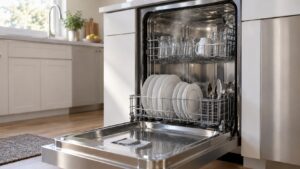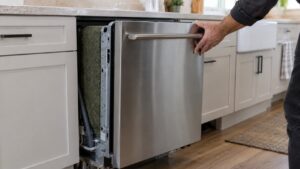
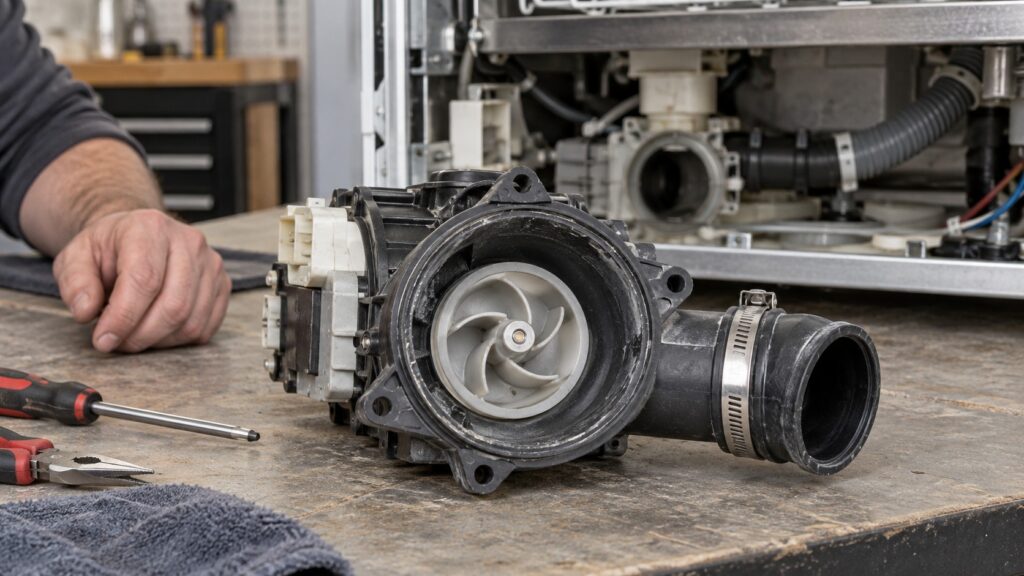
An Asko dishwasher drain pump problem shows up under three different numbers on current display machines, and the numbers are not interchangeable. F11 is a water outlet problem — drainage was asked for and did not happen. F56 is a circulation pump failure, which is the other pump entirely, the one that drives the spray arms. F68, on the DSD746 display generation, is specifically a BLDC drain pump failure, meaning the brushless motor in the drain pump is the reported subject rather than a blockage in front of it. Getting the pair the right way round saves an evening: one of them leaves standing water in the tub, the other leaves a tub that empties perfectly and washes badly.
What does F11 mean on an Asko dishwasher?
F11 on a current display machine is a water outlet problem: the control ran the drain step, watched the water level, and did not see the tub empty within the time it allows. It is a description of an outcome, not of a part. Everything between the sump and the point where the hose joins your plumbing is inside the accusation — the pump itself, the hose, an air gap on the counter, and a disposer inlet with the knockout plug still in place after an installation.
That is why F11 is the code most often cleared without a part. A dishwasher that has never drained properly since the day it was installed is describing a plumbing problem the machine cannot distinguish from a pump problem. A dishwasher that drained fine for four years and now shows F11 after a heavy load is usually describing debris.
The detail page for this label, our Asko dishwasher F11 page, lists the three components in the order a technician works through them, and that order is deliberate: hose and air gap before pump, every time.
How is F68 different from F11?
F68 names the motor. It appears on the DSD746 display generation, where the drain pump is a BLDC unit — a brushless motor whose control electronics watch its own speed. That feedback is the difference. An ordinary drain pump either runs or does not; a BLDC pump reports back how it is running, so the control can tell a motor that is stalled from a motor that is spinning freely against a blockage.
In practice, F68 pushes the suspicion further toward the pump and its wiring than F11 does, and it makes the control board a real candidate rather than a last resort. It is also the code least worth guessing at from a general dishwasher article written for another brand, because the pump type it refers to is specific to this generation of machine.
Is my Asko dishwasher failing to drain or failing to circulate?
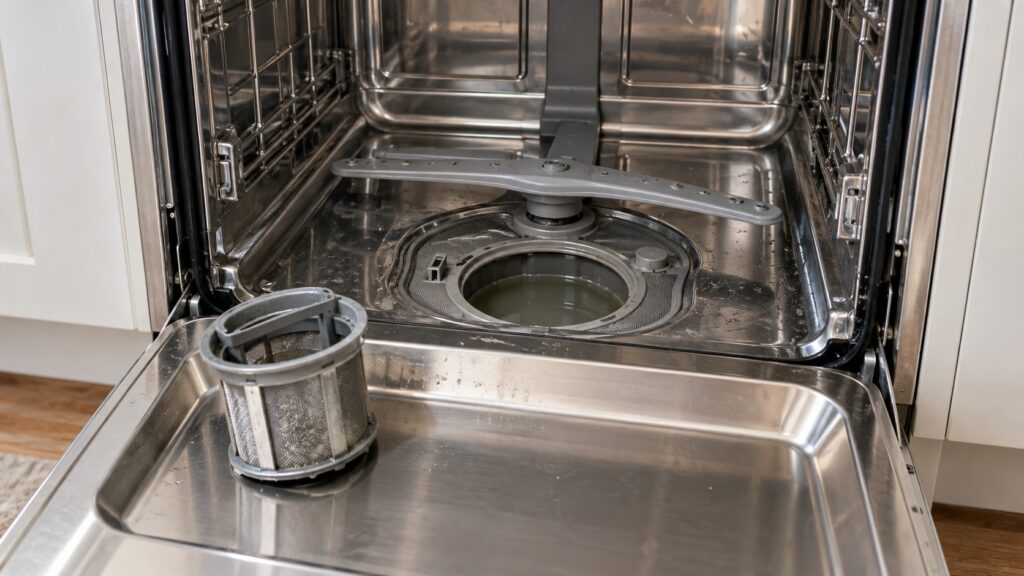
This is the split that decides everything, and you can make it without tools. Open the door at the end of a cycle and look at the bottom of the tub.
Standing water in the sump means the outlet side: F11, F68, or F7 on a legacy machine. The dishes may even be clean, because the wash happened and only the emptying failed. No standing water but poor results — grit left on plates, a cloudy film, dishes on the upper rack noticeably worse than the lower — points at the circulation side: F56, or F9 on a legacy machine. The tub emptied, so the drain pump is fine; what failed is the pump that was supposed to push water up to the arms.
A third pattern belongs to neither. If the machine is loud in a way it never used to be, a pump is moving something it should not be moving — a fruit pit, a shard of glass, a bone fragment past a filter that was not seated. That noise usually arrives before any code does, and it is the cheapest moment to act.
Why do older Asko dishwashers blink instead of showing a number?
Because the legacy DW20.1 platform, used on the 3000-series machines, has no display to show a number on. Its faults are read back as blink patterns on the program lights, and the service documentation maps those patterns to F-numbers: F7 is L1 plus L2, F9 is L1 plus L4, F8 is L1 plus L3. On the panel itself some of these give no indication at all until the service menu is entered.
This matters because the same F-numbers exist on the current generation with different meanings, and the current numbering does not even start until F10. An F7 read from a blink pattern and an F7 typed into a search box are not the same fault. Our guide on why Asko error codes differ by control board covers the full split, and the rating plate is what tells you which side of it you are on.
What can I safely check before calling a technician?
- Clear the filters first. On a current machine a blocked filter has its own code, F52, but a partly blocked filter throws drainage and circulation faults without ever reaching that threshold. Our filter cleaning guide covers removing and reseating it correctly, and reseating is the half people skip.
- Bail out the standing water. A cup and a towel. Nothing below can be assessed with water in the tub.
- Check the air gap on the counter. Unscrew the cap and look for debris in the chamber. This single check clears a meaningful share of drainage codes and needs no tools.
- Check the disposer connection. If the dishwasher drains into a food waste disposer that was fitted after the dishwasher, confirm the knockout plug was removed. A machine that has never drained since a kitchen change is describing this.
- Spin the spray arms by hand. If they are stiff or an arm does not turn freely, poor results may be mechanical rather than a pump fault at all; our guide to Asko dishwasher spray arms covers clearing them.
Stop before reaching into the sump beyond the filter housing, and before disconnecting the drain hose at the machine end. Broken glass finds its way into a sump, the drain hose holds water that will empty onto the floor, and the pump housing sits next to low-clearance mains wiring in the base of the cabinet.
When does an Asko dishwasher drain pump need a technician?
Call when the code returns after a clean filter, a clear air gap and a verified hose run; when the machine hums during the drain step without moving water; or when a pump has become loud. F56 and F68 in particular name components rather than conditions, and neither has an owner-level fix behind it.
We are an independent repair company, not a factory service arm, and both pumps on these machines are replaceable parts rather than a reason to replace a dishwasher. Book Asko dishwasher repair or schedule a visit with the code, whether the tub was holding water, and the model and Art. No. from the rating plate — that combination is usually enough to bring the right pump on the first trip.