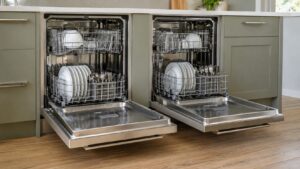
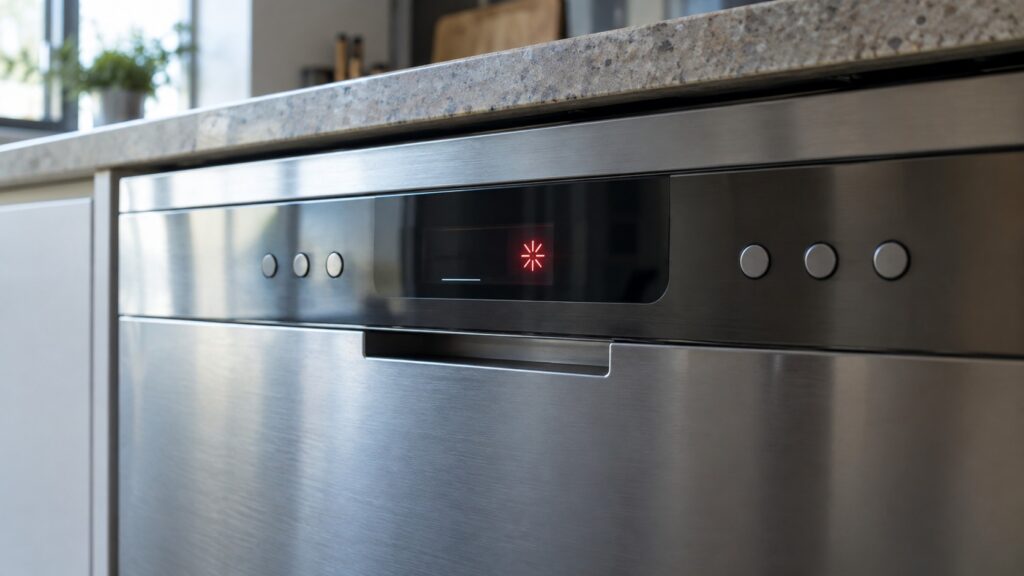
An Asko dishwasher F52 or F54 code both belong to the water-level group on the current display generation, but they point in opposite directions. F52 reads out as “Clean the filters (Water level problem)” — the pressure sensor is seeing less water than expected and suspects a restriction on the way in. F54 reads out as “Overfilling water 2” — the machine has taken on more water than the cycle called for. One is a shortage, the other is an excess, and treating them as the same fault wastes a cycle.
What does F52 mean on an Asko dishwasher?
F52 is triggered when the pressure sensor at the bottom of the tub reads a water level lower than the control expects part-way through a fill or wash step. The dishwasher’s own display text names the likely cause directly: “Clean the filters.” That instruction is worth taking literally before anything else, because a partially blocked filter changes how quickly water reaches the sensor without changing how much water actually enters the machine — the sensor reports what it sees at its own location, and a clogged path in front of it reads as a shortage even when the inlet valve is working correctly.
This is one of the more owner-friendly current-display faults for exactly that reason. Asko’s own wording tells you what to check first, rather than leaving you to guess between a valve, a sensor, and a hose. It is not, however, a guarantee that the filter is the only possible cause — a weak inlet valve or a partially blocked inlet screen can produce the identical reading.
What does F54 mean, and how is it different from F10?
F54 reads out as “Overfilling water 2.” Asko documents a second overfilling code, F10 (“Overfilling water 1”), on the same generation of control board. The two numbers most likely reflect the control checking for excess water at two different points in the fill-and-level sequence rather than two unrelated causes — one check runs earlier in the cycle, the other later. Whichever number shows, the practical response is identical: the tub has more water in it than the program intended, and running another cycle before checking why wastes water and time.
An overfilling code is mechanically the opposite problem from F52. F52 suspects a restriction limiting how much water reaches the sensor; F54 and F10 report that too much water reached the tub. Confusing the two sends a technician looking for a blockage on a machine that actually has a stuck-open inlet valve, or vice versa.
Why does my dishwasher show F52 but the filter looks clean?
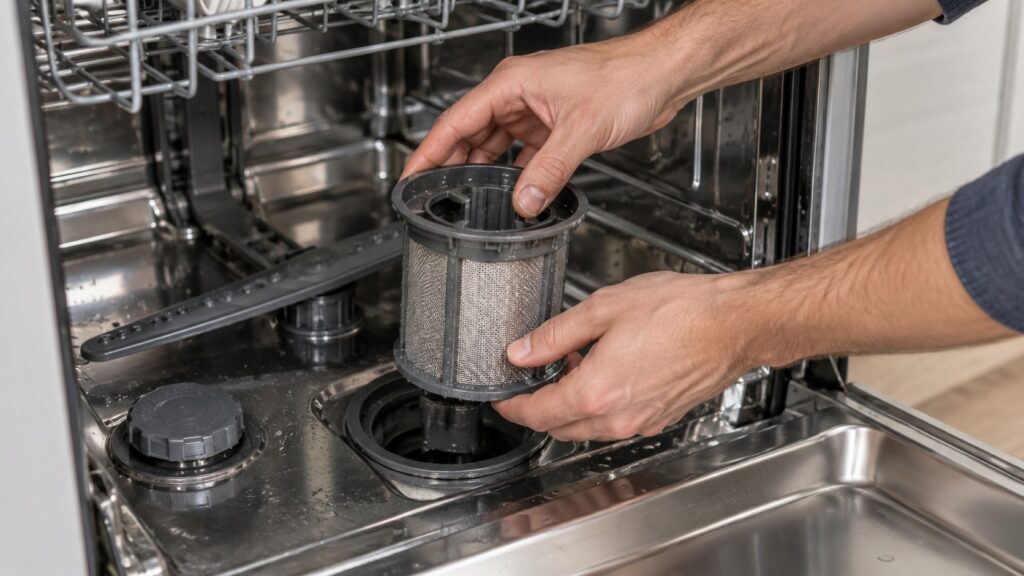
A filter that looks clean from above can still be seated incorrectly. The triple filter assembly on Asko’s current dishwashers stacks a coarse filter, a fine filter, and a micro filter, and the fine filter has to twist and lock into the coarse housing to seal properly. A filter that sits loosely lets larger debris bypass the fine mesh and settle lower in the sump, where it is not visible without lifting the assembly fully out. Our dishwasher filter cleaning guide covers removing and reseating all three pieces correctly, and reseating is the step people skip.
If the filter has been checked and reseated and F52 returns within one or two cycles, the more likely candidates are the inlet screen — a small mesh disc inside the water connection at the back of the machine — or a partially failing inlet valve that opens but does not pass its full rated flow.
What should I check before calling for F54 or F10?
- Cut power for two minutes. Both overfilling codes are triggered by a live reading; if the fault does not return immediately after restart, the control may have cleared a momentary condition rather than a persistent one.
- Check the door seal and float switch. An overfilling condition on some Asko current-display machines is monitored by a physical float in the base of the tub as a backup to the pressure sensor. A float stuck in the raised position can register as overfilling even at a normal water level.
- Look for a slow or continuous drip from the inlet valve between cycles. A valve that does not fully close lets water into the tub outside of the fill step, and by the time the cycle checks the level, it reads high.
- Note whether F54 or F10 appears, and at what point in the cycle. The distinction between the two matters less for the fix than for how quickly a technician narrows down which stage of the fill logic is involved.
Stop before disconnecting the inlet valve or opening the sump beyond the filter housing. Both sit close to the water connection and the tub’s electrical harness, and a dishwasher holding excess water will spill when the door is opened without bailing it out first.
Is F52 or F54 a sign the dishwasher needs to be replaced?
Neither code by itself indicates a failing machine. F52 is usually a filter or inlet-screen restriction, and both are owner-serviceable in minutes. F54 and F10 more often point at an inlet valve or a float switch, both replaceable parts rather than a reason to replace the appliance. The pattern worth watching is a code that returns within one cycle of a filter clean and a power cycle — that consistency is what separates a blocked filter from a valve or sensor that has genuinely drifted out of range.
We are an independent repair company, not a factory service arm, and we will tell you plainly when a part is worth replacing and when it is not. Pricing starts from a diagnostic visit and we confirm the estimate before any work begins. If F52 or F54 keeps returning after the checks above, book Asko dishwasher repair or schedule a visit with the exact code, the model and Art. No. from the rating plate, and whether the tub held standing water or excess water — that combination usually settles which part is involved before a technician arrives.
For the drain and circulation side of Asko’s current-display codes — a different group entirely — see our guide to F11, F56, and F68, and for the full map of how dishwasher fault numbers differ across Asko’s control generations, see our dishwasher error code families overview.
In short, an asko dishwasher f52 f54 pair of codes both belong to the water-level family, but one is a shortage and the other is an excess.