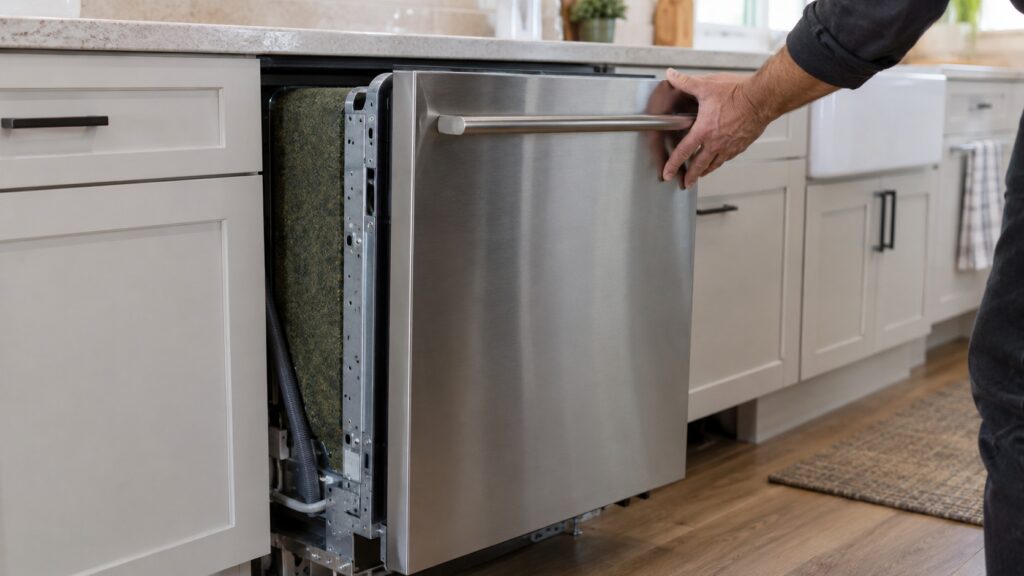
An Asko dishwasher mounting bracket is the part that holds a built-in dishwasher in place so that it cannot tip forward or slide when you open the door and pull out a heavy rack. In most installations the bracket fastens the unit to the underside of the countertop or to the neighboring cabinets, and the exact bracket, fixings and positions come with the dishwasher and are shown in its installation manual. This guide explains why the securing step matters and what to check, and it leaves the details to the manual because they depend on your model and your countertop.
Why does a built-in dishwasher need a mounting bracket?
A dishwasher is deep, heavy when loaded and fitted into a narrow opening. When you open the door and pull the lower rack out, a good part of the weight moves toward the front. If the unit is free to move, it can tilt, scrape the floor or push against its connections. A mounting bracket fixes the dishwasher to something solid so the door can be opened and loaded safely, and so the machine stays aligned with the cabinets around it.
There is a second job as well. The bracket takes the twisting load when the door is opened and closed, which would otherwise be carried by the water and power connections. Connections that are never asked to hold the machine in place last far longer.
The bracket also helps keep the front straight, which matters most on a panel-ready model with a custom front, where the door has to line up with the cabinetry. Our guide on Asko dishwasher panel-ready installation covers what changes with a custom panel.
Where does the bracket attach?
Most built-in dishwashers can be secured in one of two ways: to the underside of the countertop with brackets at the top, or to the sides of the adjoining cabinets. Which one is correct for your Asko depends on the model, the countertop material and the kitchen. The installation manual shows the fixing points and the parts that are included. If the kit is missing, ask for the correct one for your model rather than improvising with whatever is in the toolbox.
The unit must also be level and at the correct height for the opening. Adjustable feet usually handle that. The idea matches what our guide on Asko washer Quattro construction says about washers: a machine that is not level does not perform as designed.
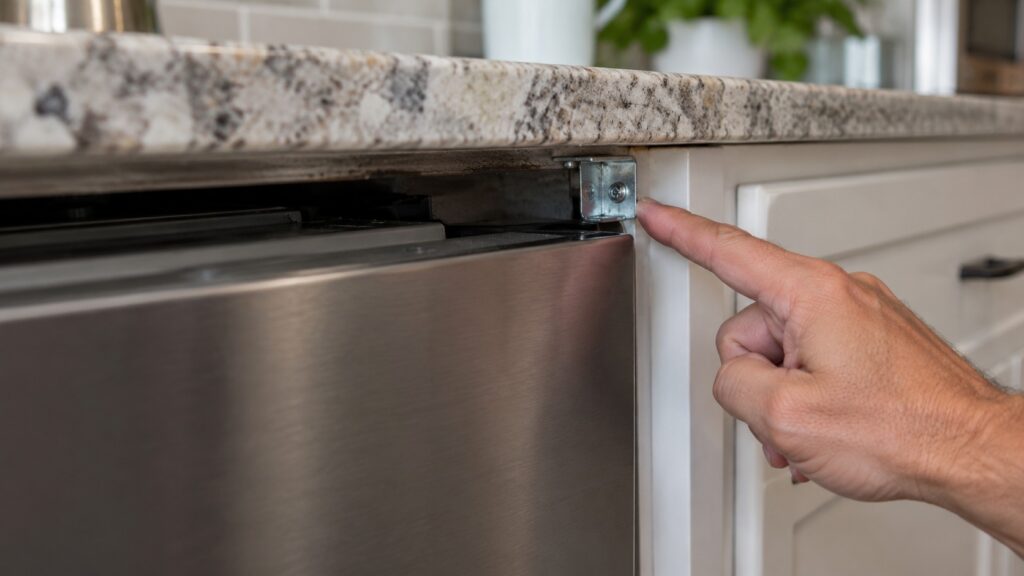
What about a stone or solid-surface countertop?
This is the point where installations most often go wrong. A countertop made from stone, quartz or another solid surface cannot simply be screwed into. Drilling into one can crack it, and a cracked countertop costs far more than the dishwasher. If the countertop is stone or solid surface, do not drill into it yourself. Ask the installer or a countertop fabricator how the dishwasher should be fixed, or use the side-mounting method if the manual allows it for your model.
If you are replacing an old dishwasher in the same opening, look at how the old one was fixed before you remove it, and take a photograph. The existing screw holes, the position of the bracket and any supports under the countertop tell you a lot about what the opening expects.
Plan this before the countertop is installed whenever possible, because bracket positions and any supports are much easier to arrange before the stone goes on. If the countertop is already there, ask for a solution that does not require drilling into it.
What should you check once the dishwasher is secured?
Open and close the door several times and pull out the loaded lower rack; the unit should not move. Check that the door closes squarely and the gasket sits evenly. Check that the dishwasher is not pressing on the hoses or the power cord behind it, because a crushed hose or a pinched cord is a hazard. Run the first cycle and watch the connections for drips.
Be careful about sliding the dishwasher in and out. Pulling a unit by its door can bend the hinges, so use the cabinet opening and the sides of the cabinet, and take the weight with two people if the unit is heavy.
Look at the water protection too. Some Asko models have a system that cuts off the water if it detects a leak in the base, and our guide to Asko Aqua Safe explains what it does. A protective system does not replace a properly made connection.
What should you leave to a professional?
The water supply, the drain connection and the electrical connection are separate jobs from mounting, and each has its own requirements. If you are not experienced with plumbing or wiring, hire a licensed tradesperson. Do not work on the electrical connection with the power on, and never use a damaged cord or a connection you are not sure about. Our guide on European appliance installation explains why European-built units sometimes need a closer look at fit and connections in a US kitchen.
If you find water under the dishwasher after installation, switch off the breaker at the panel while standing on a dry floor, close the water valve and call. Our Asko dishwasher repair page explains how a visit works.