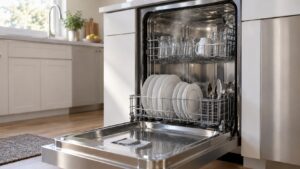
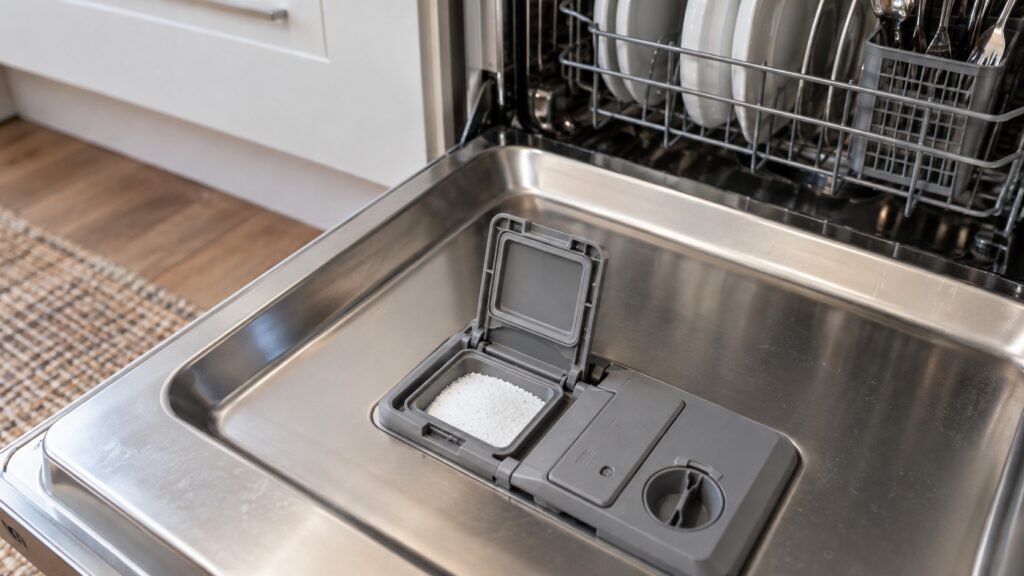
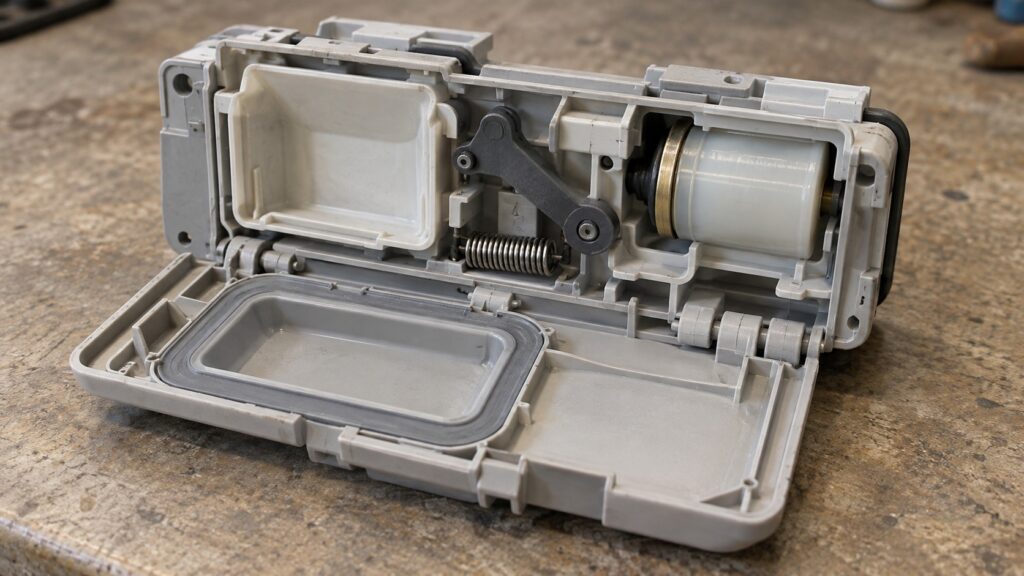
The Asko dishwasher detergent dispenser is a spring-loaded flap held shut by a small latch, and the latch is released electrically at the moment in the program when the main wash begins. Nothing about that is obvious from the outside, which is why a dispenser that stays closed feels like a mystery. It also has no error code: this is one of the few failures on these machines that none of Asko’s three code schemes report at all. The machine finishes the cycle, announces nothing, and leaves a cup of dry powder behind a closed door.
How does an Asko dishwasher detergent dispenser actually open?
A wax motor does the work. Inside a sealed cylinder is a wax pellet and a small heating element; when the control sends current to it, the wax warms, expands, and pushes a plunger out by a few thousandths of an inch. That movement trips the latch, the spring behind the flap does the rest, and the detergent drops into water that is already circulating.
The reason for choosing such a slow actuator is timing. Detergent released too early is diluted through the pre-wash and rinsed away before it can do anything; released at the right moment it meets hot water at the start of the main wash. A wax motor takes several seconds to move, which is exactly the kind of unhurried, quiet, low-current action the job wants.
It also explains the failure pattern. Wax motors rarely fail suddenly. They get slower, then weaker, and for a while they still open the flap on a hot program and no longer manage it on a short cool one. An owner reading that behavior concludes the machine is fussy about programs, when the actuator is simply running out of travel.
Why does the flap stay shut when the detergent is right there?
Four things hold it, and they are worth checking in this order.
The simplest is physical obstruction. A large plate, a cutting board or a baking sheet loaded in the lower basket directly in front of the door blocks the flap from swinging open. The latch released, the spring pushed, and the flap hit a plate. Nothing is broken, and nothing will report anything.
The second is residue. Powder detergent left in a damp cup sets like grout, and the film that collects around the rim can hold the flap closed with surprising force. This is the one that builds slowly and then appears to happen overnight.
The third is the spring or the latch itself: a spring that has lost tension, a latch worn round at the edge so it no longer releases cleanly, or a flap hinge stiffened by the same residue. The fourth is the wax motor, above.
Does the dispenser have an error code on an Asko dishwasher?
No, and that is a practical fact rather than an oversight. The dispenser has no sensor. The control sends current to the wax motor at the scheduled moment and continues with the program; it has no way of knowing whether anything moved. That is why our page for this symptom, the Asko dishwasher dispenser will not open, records it as a symptom Asko assigns no code to on any of its three schemes.
The consequence is that you have to catch it yourself. A dishwasher with a stuck dispenser produces a completely normal cycle with poor results — grit left on plates, a cloudy film on glassware, a faint smell — and every one of those symptoms has other explanations. Anyone chasing poor cleaning results on these machines should open the door at the end of a cycle and look in the dispenser cup before doing anything else. It is a two-second check that rules out or confirms the whole subject.
Why is the detergent still in the cup at the end of a cycle?
Sometimes the flap did open and the detergent did not leave. A tablet sitting in a cup that was wet when it was loaded can swell and wedge in place; powder packed down hard does the same. Rinse aid overflowing from its neighboring reservoir will glue either one in.
Loading matters here more than people expect, and it is different from the obstruction problem above: this is about where the water goes rather than where the flap swings. If the lower spray arm cannot turn freely, the cup never gets a proper wash of water across it even with the flap wide open. Our guides to loading these tall tubs and to salt and rinse aid cover both halves of that.
One more habit is worth changing if it applies: loading detergent into a cup that is still wet from the previous cycle. Dry the cup with a cloth before filling it and a whole category of this problem disappears.
What can I check myself?
- Look in the cup at the end of every cycle for a week. Full, partly full, or clean tells you which failure you have.
- Open and close the flap by hand with the door open. It should latch with a definite click and release freely. A sticky or vague action is residue.
- Clean the cup and the flap edge. Warm water, an old toothbrush, and patience around the hinge and the latch. Dry it afterward.
- Reload with the lower basket kept clear in front of the door. Then run a normal hot program and check the cup again.
- Compare a hot program with a short cool one. If the flap opens on hot cycles only, the actuator is weakening rather than blocked.
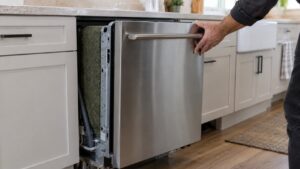
Stop before taking the inner door panel off. The dispenser assembly is mounted between the two skins of the door alongside low-voltage wiring and the door harness, and the panel carries the door balance mechanism.
When does the dispenser need a technician?
Book service when a clean, freely moving flap still fails to open, when it opens on some programs and not others, or when the flap opens but the latch no longer holds it shut while you load. The parts involved are small and the repair is contained, which makes it worth doing properly rather than working around it by throwing a tablet loose into the tub — that puts detergent into the pre-wash, where most of it is rinsed away before the main wash even starts.
We are an independent repair company, not a factory service arm, and a dispenser assembly is an ordinary part on these machines. Book Asko dishwasher repair or schedule a visit, and mention whether the cup comes out full or empty — that alone tells a technician whether to bring a dispenser assembly or to look at the wash side instead.