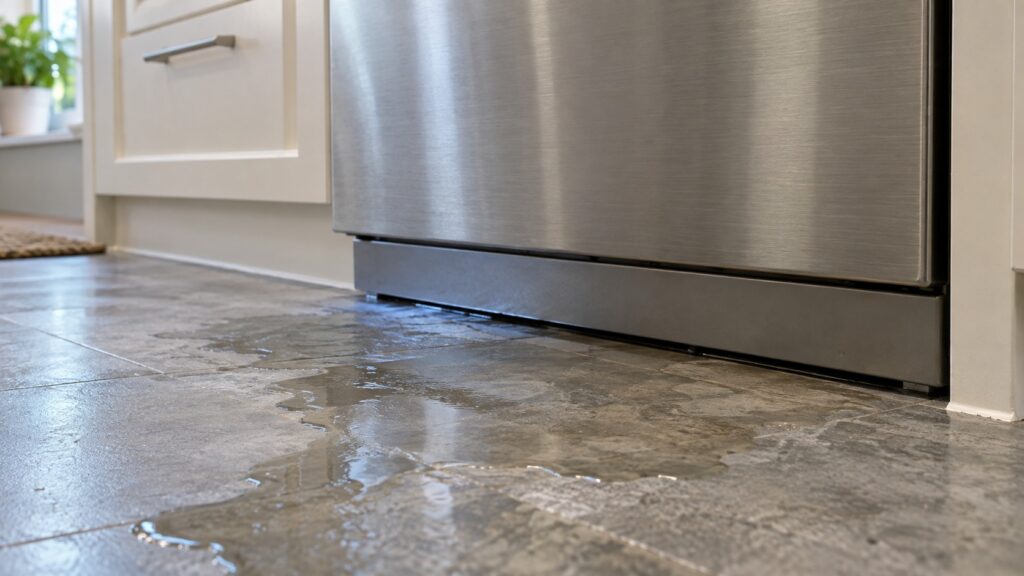
An Asko dishwasher leaking from door is the one leak an owner can actually localize, because water that runs down the front of the machine and pools on the floor in front of it has come over or past the door seal rather than out of the base. The useful question is not where the water is but why it reached the door line at all. Three answers cover almost every case: the seal is no longer sealing, the tub is being filled past the level it was designed to hold, or an inlet valve is passing water when the machine is not even running. The last two have codes of their own, and they are worth ruling out before anyone orders a gasket.
Why is my Asko dishwasher leaking from the door?
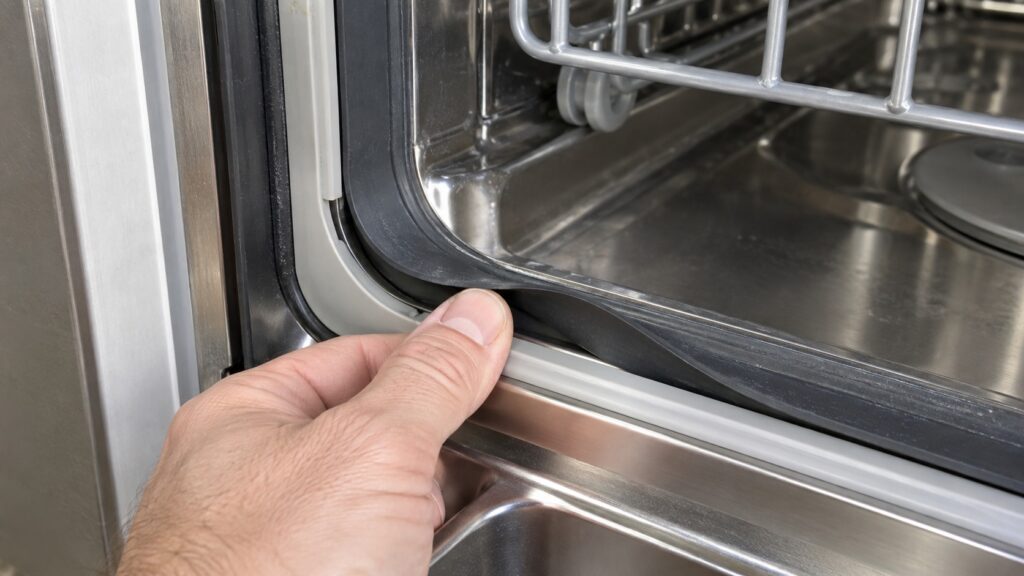
Work outward from the cheapest explanation. The door gasket on these machines runs around the tub opening and depends on even pressure along its whole length; anything that holds it away from the tub face at one point gives water a path. Food debris stuck in the gasket channel, a gasket that has taken a set after years of heat, a corner that has pulled out of its groove — all three are visible in thirty seconds with the door open and a flashlight.
If the seal looks right, look at what is being thrown at it. A tall item leaning against the door, a sheet pan loaded on edge in the lower basket, or a plastic lid resting over the lower spray arm can redirect a jet straight at the door line for the whole wash. The evidence is that the leak follows the load rather than the cycle: it happens with some loads and never with others.
Then look at detergent. Too much detergent, or any hand dish soap at all, produces foam that rises above the water level and creeps out at the door. This leak appears with an unchanged machine right after a change of product, and it usually leaves suds on the floor rather than clear water.
What do F40 and F5 mean on an Asko dishwasher?
Both mean valve leakage: the water inlet valve is passing water when the control has not asked it to. F40 is how the current display generation reports it; F5 is how the legacy DW20.1 platform reports the same territory, read back as blink pattern L11 rather than shown on a display.
The symptom that identifies this one is water appearing when the machine is idle. A valve that weeps slowly fills the tub over hours, and the first the owner knows about it is a puddle in front of a dishwasher that has not run since yesterday. That is a different problem from a leak during a cycle, and the parts are different too — the valve, its solenoid and the seat it closes against, all on the supply side before the tub.
A slow valve leak is also the case where the machine’s own leak protection matters most, because it is the failure mode that runs unattended. Our guide to Asko dishwasher Aqua Safe covers what that system monitors and what it does not.
Can overfilling make an Asko dishwasher leak at the door?
Yes, and this is the connection owners most often miss. F10 on a current display machine means the water level rose past the allowed point, and F54 is a second, separately reported overfilling condition. Raise the level in a tub far enough and the door seal is simply below the waterline in places it was never meant to be.
Overfilling has two families of cause. Either too much water is coming in — an inlet valve that does not close fully, which is the F40 story again — or the level is being misread by the pressure sensor that reports it. The parts list for F54 names the inlet valve, the pressure sensor and the water level control together for exactly that reason.
There is a third route that produces a wet floor with no overfill code at all: a drain that is slow rather than blocked. The tub never gets emptied between fills, the level creeps up over the course of a long program, and the door line gets reached at the end of a cycle rather than the beginning. If the leak is always late in the program, read our guide to the Asko dishwasher drain pump codes before suspecting the seal.
What can I safely check myself?
- Dry the floor and run a short cycle with the machine empty. A leak that does not repeat with an empty tub is a loading or detergent problem, not a hardware one.
- Wipe the whole gasket with a damp cloth and run a finger along its groove. Look for debris, splits, flat spots and any section standing proud of the tub face.
- Close the door and look along the gap at eye level. An even gap top to bottom on both sides is what you want; a door that sits low on its hinges shows a wider gap at the top.
- Halve the detergent for two cycles. If the suds go away, so does the leak, and nothing needs replacing.
- Note when the water appears. During the wash, at the end, or while the machine is idle. Idle means the supply valve; during the wash means the seal or the load; at the end means drainage or overfilling.
Stop before removing the door panel or the base panel, and before working on the supply line. The water inlet valve carries household supply pressure and sits alongside mains wiring, and the door assembly on these machines holds spring tension that is released in a specific order.
When does a door leak need a technician?
Book service when water appears while the machine is idle, when an overfill code accompanies the leak, when the gasket looks sound and the leak repeats on an empty cycle, or when water has already reached flooring or cabinet sides. Water damage compounds faster than the repair does, and a valve that has started weeping does not stop.
We are an independent repair company, not a factory service arm, and a seal or an inlet valve is a small part rather than a reason to replace a machine. Book Asko dishwasher repair or schedule a visit, and say whether the leak happens during a cycle or at rest — that one sentence decides which parts come along.