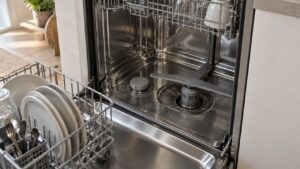
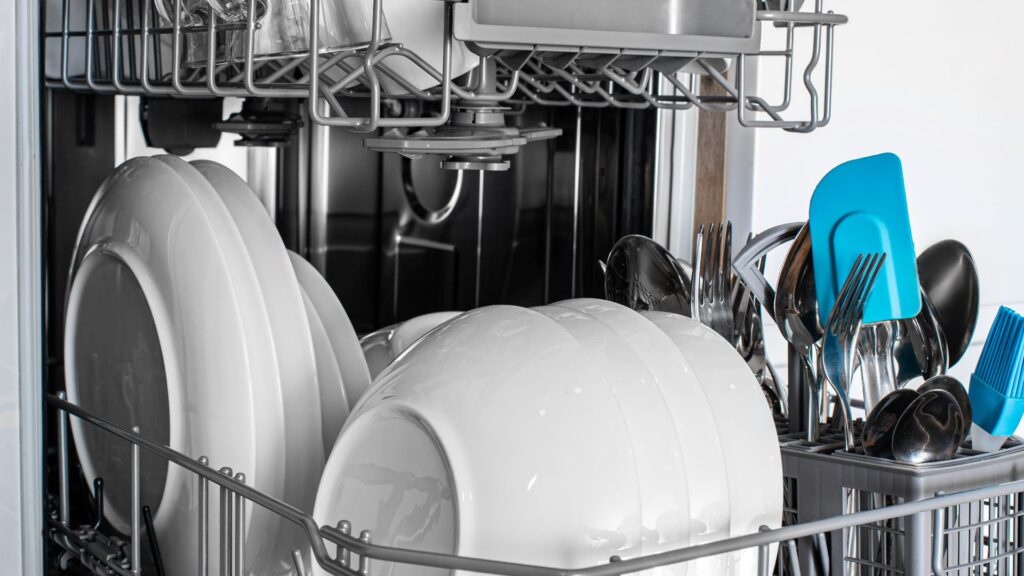
Asko dishwasher drying is not a heated process, and that single fact explains almost every complaint about it. There is no drying element in the tub. The machine finishes with water hot enough that the load carries its own heat, then uses the temperature difference between hot dishes and a cooler stainless tub to pull moisture out of the air. Understand that exchange and you can predict, before you open the door, exactly which items will come out dry.
What actually happens after the final rinse
The final rinse is hot on purpose. Its job is not cleaning — the load is already clean — but loading the dishes with heat. When the water drains, the tub contains hot, saturated air and a lot of hot ceramic and glass.
From that moment the tub is a condenser. The steel walls, which were never in direct contact with the heated water for long, are the coolest large surface available. Water vapor migrates to them, condenses into a film, runs down and leaves through the drain. The dishes lose their moisture to the air, and the air loses it to the wall. Nothing is blown, nothing is heated, and the whole process is silent — which is why people assume it is not happening.
Why this design was chosen
Condensation drying has three practical advantages that matter in a kitchen:
- Plastics survive. A heated element can distort thin plastic. There is no element here, so the tub never exceeds the temperature of the rinse.
- Energy use is low. The only energy spent on drying was already spent heating the rinse water.
- The cabinet stays dry. Nothing vents steam into the kitchen during the cycle, which matters in an integrated installation where a wooden panel is inches from the door.
The trade-off is that it depends entirely on thermal mass, and thermal mass is decided by how you load the machine. The design does not compensate for a bad load; it simply reports it.
The five things that decide how dry the load is
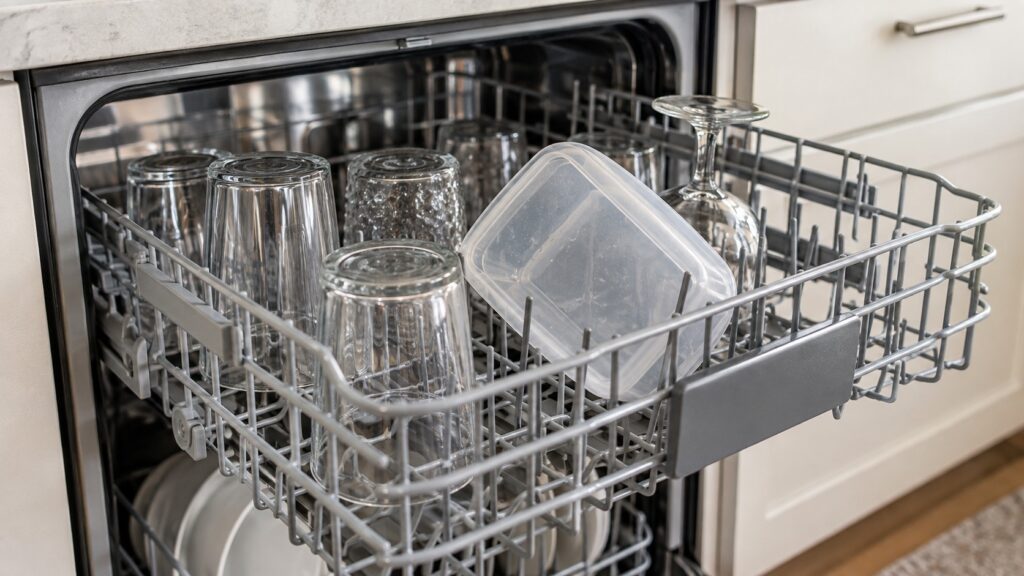
Material. Glass and ceramic hold heat and come out dry. Stainless items come out dry. Plastic tubs and lids come out wet almost every time, on every dishwasher of this type. That is physics, not a fault.
Rinse aid. Without it, water beads and each bead has to evaporate individually. With it, water sheets off while it is still hot and most of it never becomes vapor at all. If the reservoir has been empty for months, that alone explains the complaint. Our guide on salt and rinse aid covers the settings.
Angle. Anything with a concave base — cup bottoms, upturned bowls, the rim of a mug — holds a puddle no drying system can remove. Tilt them.
Program temperature. Eco and short programs use cooler final rinses. Less heat into the load means less drying. Choosing the shortest program and then judging the drying is not a fair test.
Timing. Opening the door at the beep interrupts the exchange at the point where the largest temperature difference still exists. Waiting twenty to thirty minutes after the cycle ends is the single most effective change most people can make.
When it is a fault rather than a load
Condensation drying can fail for real reasons, and they are all upstream of the drying itself:
- The rinse is not getting hot. If the load is barely warm when the cycle ends, the heater or its control is the problem, not drying.
- Water is not draining fully. A tub with standing water in the sump keeps the air saturated indefinitely. See our guide on the filter and sump.
- The door seal is leaking air. An integrated door that has dropped slightly lets warm, wet air escape into the cabinet instead of condensing on the wall.
- Scale on the tub walls. A heavy mineral film insulates the steel and reduces the exchange. Our descaling guide covers this.
What people compare it against, and why the comparison misleads
Most complaints about condensation drying come from a household that previously had a machine with a heated drying element, often an older American model. Those machines finish by running an element in the base for twenty minutes or more. Plastics come out dry because they were baked dry, and the kitchen gets a cloud of steam when the door opens.
Judged against that, a condensation machine looks like it has failed. Judged against its own design, it has not: the load is clean, the glass is dry and clear, nothing has been distorted by heat, and the energy label reflects the difference. The two designs are answering different questions, and the newer answer assumes the door will stay closed for a while after the beep.
There is one more habit worth changing. Unloading from the bottom basket first means the drips left on upturned cup bases fall onto dishes that were already dry. Take the top basket out first and the load reads as considerably drier, without anything mechanical having changed.
A fair test, if you want to settle it
Run a normal program — not eco, not the fastest — with rinse aid filled, all plastics removed, and nothing upturned with a flat base. Leave the door shut for thirty minutes after the end. Then open it. If the glass and ceramic are dry, the machine is working exactly as designed and the complaint was a loading and timing question. If they are wet, something upstream is wrong and it is worth a technician’s time.
When to call
Call when dishes are cool at the end of the cycle, when water stands in the tub after the cycle, when the door seal is visibly deformed or the integrated door has dropped, or when a fair test still leaves glass and ceramic wet.
We are an independent repair company and not a factory service arm. Pricing starts from a diagnostic visit and we confirm the estimate before any work begins. Asko dishwasher repair covers heaters, pumps, sensors, seals and controls, and you can schedule a visit online.