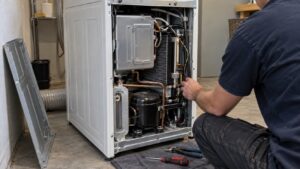
What F30 means on your Asko dryer (asko dryer f30)
An asko dryer f30 problem is the TD70.1 Type B panel’s alert for poor condensation caused specifically by blocked external air, distinguishing it from the more general high-ambient-temperature condition its Type A predecessor labels L2. Condenser dryers do not vent outside, but they still rely on room air being drawn through the cabinet to cool and condense moisture out of the exhaust air; if that intake or exhaust path around the unit is obstructed, condensation efficiency drops and F30 appears. Pushing the dryer flush against a wall or storing items directly against its air intake grille is the most common trigger.
Symptoms
Use these symptoms to confirm your Asko dryer really has this particular problem rather than a different one that behaves the same way. A dryer can display a single sign or a whole cluster, and they often turn up right after a power event, a demanding cycle, water getting somewhere it should not, or recent service.
- The display shows F30 partway through or after a cycle
- Clothes come out damper than expected for the program run
- The area around and behind the dryer feels warmer than usual after a cycle
- Cycle times run longer than the program guide suggests
Common causes
Your Asko dryer could be reacting to any of the causes listed here, which is why we start with the most frequent. Working through them methodically keeps an easy dryer check apart from a problem that needs an experienced technician and the right components.
- Dryer pushed too close to a wall or cabinet — blocks the air intake or exhaust path the unit needs for condensation
- Items stored against the dryer’s air vents — boxes or laundry baskets pressed against the cabinet restrict airflow
- Lint or dust accumulation around the intake grille — builds up over time and narrows the air path
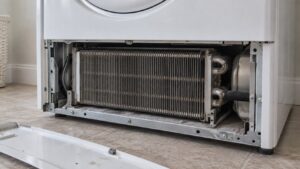
- Condenser unit itself clogged — reduces the surface area available to cool and condense the exhaust air
Troubleshooting steps you can try
Handle these checks on your Asko dryer in order, starting with the easiest, before you decide you need help. Break off at once if a step on the dryer exposes you to live wiring, gas, a hot oven, standing water, or a sealed system, and leave it to a professional.
- Pull the dryer out enough to leave a few inches of clearance on all sides.
- Remove anything stored against the cabinet’s air intake or exhaust grilles.
- Vacuum visible dust or lint from the intake grille.
- Clean the condenser unit per the owner manual if it has not been serviced recently.
- Run a cycle with the clearance restored and confirm F30 clears.
Parts a technician may replace
Depending on what the diagnosis turns up, a technician working on your Asko dryer may inspect, test, or replace the external vent/exhaust path, condenser unit, and cabinet air intake. The correct part for your dryer is matched from its model, serial, and Art. No., and genuine OEM or trusted-supplier components go back in rather than generic substitutes, so the dryer keeps its performance and its long service life.
When to call a technician
F30 that persists after clearance and condenser cleaning needs an experienced technician to inspect the internal air path on your TD70.1 Type B dryer. At Medium severity this is nothing urgent for your Asko dryer, though F30 returning on the dryer despite the checks above is worth having a technician diagnose before parts are ordered. Work on your Asko dryer is independent of Asko, Gorenje, and Hisense; experienced technicians fit genuine OEM or trusted-supplier parts, and the labor on the dryer is covered by a 30-day warranty. Reading the model, serial, and Art. No. from your Asko dryer before you book lets us match the right part for your dryer ahead of time and resolve F30 in the fewest trips we can.
Related help and Asko resources
If F30 has not cleared on your Asko dryer, you can book Asko dryer repair, browse our dryer error-code guides, put our step-by-step repair guides to use, schedule service for service, or locate help on our locations page. There is a related write-up for your Asko dryer at L2 high ambient, poor condensation. The maker publishes complete specifications and model information for your Asko dryer at us.asko.com.