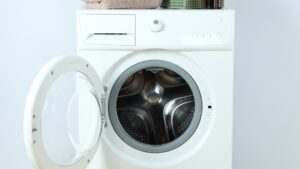
Asko washers: series and lineup
Asko washers are sold in the US as Classic (1/3-series), Logic (5-series), and Style/Style+ (7-series) front-loaders, all freestanding. The current 7-series flagship is the W7XLW; the 5-series runs the W5XLT, W5XLG, and W5XLW alongside the Logic-branded W4114C.W; the 3-series covers the W3LW and W3W; and the Classic entry point is the W2084.W. Every model in the lineup is a front-loader — Asko does not sell a top-load washer in the US. Full specs and matched parts live in our model directory.
Moving up the tiers buys spin speed, program count, and finish rather than a fundamentally different washing mechanism — the Classic W2084.W spins to 1400 rpm across 15 programs, while the 3-series W3LW steps up to 1600 rpm with 21 programs, and the 7-series W7XLW tops the range at 29 programs with an ADA-compliant pedestal drawer option most competing brands do not offer at any price point. Because the W4114C.W sits on a genuinely different control platform from the rest of the numbered-series lineup, a repair on it draws from a separate parts and diagnostic path even though it is marketed alongside the 5-series on price and capacity.
Technologies and features
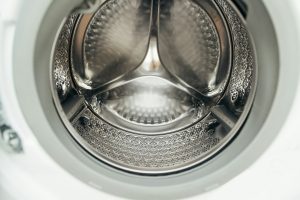
Steel Seal replaces the rubber door bellows found on most washers with a rigid door-seal construction designed to resist bacterial growth, and Quattro Construction is Asko’s four-point suspension system, aimed at keeping the machine stable and quiet through a 1400 or 1600 rpm spin. Auto Dose meters detergent automatically based on load size and water hardness on equipped models, and Pro Wash cycle tuning is referenced across Asko’s current washer feature copy. The parts that wear across every series are the water inlet valve, the drain pump, the door lock assembly, and the drive components behind the drum — the same list whether the panel above them shows a numeric code or a plain-text label.
Steel Seal is worth a closer look precisely because it changes what a worn door seal looks like in practice — instead of a cracked rubber bellows, a Steel Seal washer more often shows a compression surface that has simply lost its grip over years of daily cycles, which can be less visually obvious during a quick inspection than a torn bellows would be on a conventional machine, so we test seal integrity directly rather than relying on appearance alone.
Common issues and maintenance
Asko washers do not share one error-code table across the lineup — five genuinely distinct families exist. Newer W6xxx-style display panels show F10/F11/F12; the W4114C and its PMCU-platform siblings run a completely separate E0 through E37 scheme; numbered-LED panels use F1/F3/F4/F6; older analog-LED panels use L1 through L6 with meanings that differ by model; and Asko’s premium Allergy and Eco-line panels print a plain-text description instead of any code at all. Overfilling, a drain that will not clear, and a door-lock failure under an unbalanced load are the complaints we see most, and an imbalance alert on any panel usually resolves on its own once the load is redistributed. For code meanings by family, see our washer error codes, and browse repair guides for asko washers troubleshooting. A washer that will not spin at all is worth separating from one that spins but leaves clothes too wet, since the first usually points to the door lock circuit or a drive-belt failure, while the second more often traces to a partially clogged drain pump impeller that is still moving water, just not fast enough to hit a full spin speed. Routine care matters more on a front-loader than most owners assume — leaving the door and detergent drawer open between loads, running an empty hot-water maintenance cycle monthly, and not overloading the drum past its rated capacity all measurably extend the life of the door seal and drive components. It is also worth washing at a slightly higher temperature setting on an occasional cycle even if most loads run cool or cold, since a wash that never gets hot enough to fully dissolve detergent residue and biofilm inside the drum and hoses is a common, and easily prevented, contributor to the musty odor complaints we see on machines that are otherwise mechanically sound.
When to call for repair
A failed inlet valve, a blocked drain pump, a door-lock assembly that will not release, or a worn Steel Seal gasket are best handled by experienced technicians who confirm which of the five code families a given panel belongs to before diagnosing anything. As an independent, third-party repair service, our technicians hold no affiliation with, authorization from, or endorsement by Asko, Gorenje, or Hisense, and every visit is backed by a 30-day labor warranty on the workmanship performed. Schedule Asko washer repair or book an appointment online, and you can review current listings at us.asko.com.