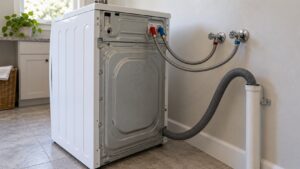
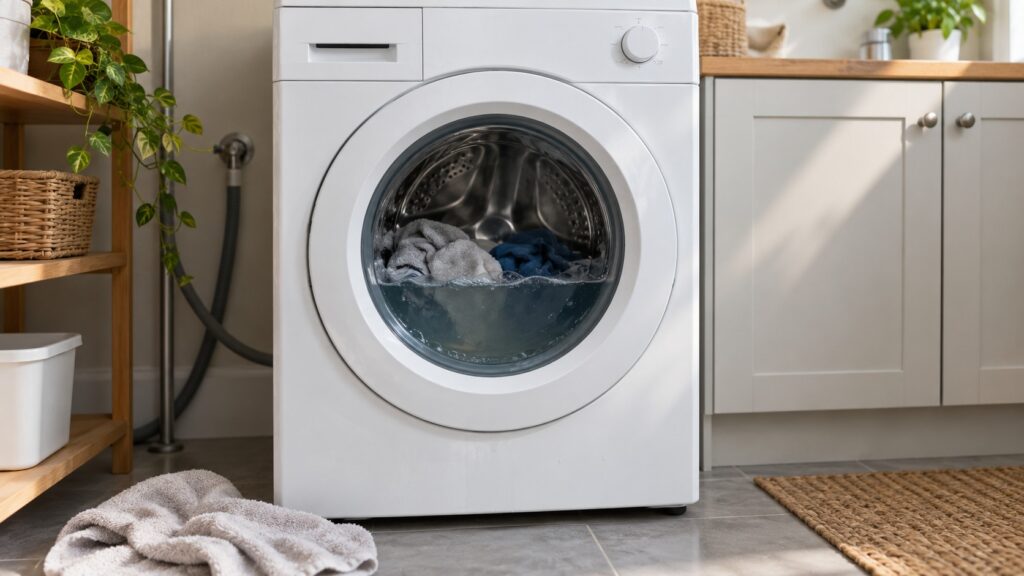
An Asko washing machine not draining is most often caused by a blocked drain filter, a kinked or badly positioned drain hose, a clogged household drain or too many suds. Work through them in that order: look at the display for a drainage message, check the hose, then the filter, then the drain it empties into. If the pump hums but moves no water, or a drainage code returns after you have cleared the obvious causes, the pump or its wiring needs a technician and the rest is not an owner job.
What does the display say?
Most Asko washers show a message when the drain does not clear, but the message depends on the control platform. Some show a code, some show a short text such as a water outlet message and some show nothing at all. Our guide to the Asko washer code families explains how to tell which family yours belongs to, and our page on a washer that will not drain lists the mechanical checks that apply whether or not a code is showing.
Write the message down exactly before you do anything else, and do not rely on memory. If it returns later, the exact text tells the technician where to start.
Is the drain hose kinked, crushed or set wrongly?
Look behind the washer. A hose squeezed between the machine and the wall, or bent into a sharp kink, restricts the flow, and a hose that is set too low can drain by itself while the washer fills. Straighten the hose gently, and check that the end is held in a curve over the standpipe or sink as the installation manual describes. If you have to pull the washer out to see, close the water valves first and move it carefully with a helper, then check that you have not stretched any hose.
The hose height you need is a figure for your model, so take it from the installation manual rather than from a rule of thumb.
Is the drain filter blocked?
The filter traps lint, coins, buttons and small bits of tissue before they reach the pump, and on most Asko front-load washers it sits behind a small panel near the bottom front of the cabinet. Our guide to Asko washer drain filter cleaning describes the procedure. The points to remember are these.
First, expect water. Put a shallow tray and a towel on the floor under the access panel, and if your model has a small emergency drain hose in that compartment, use it to let the water out before touching the filter. Second, turn the filter slowly in the direction your manual shows, because water behind it can flow out faster than you expect. Before you open the small front hatch, switch the washer off at the breaker and stand on a dry floor; if the water in the drum is hot, wait until it has cooled. Third, clear everything that is caught in it, rinse it under running water, and refit it fully, since a filter that is not seated properly can leak. Where your manual describes a different procedure, follow the manual.
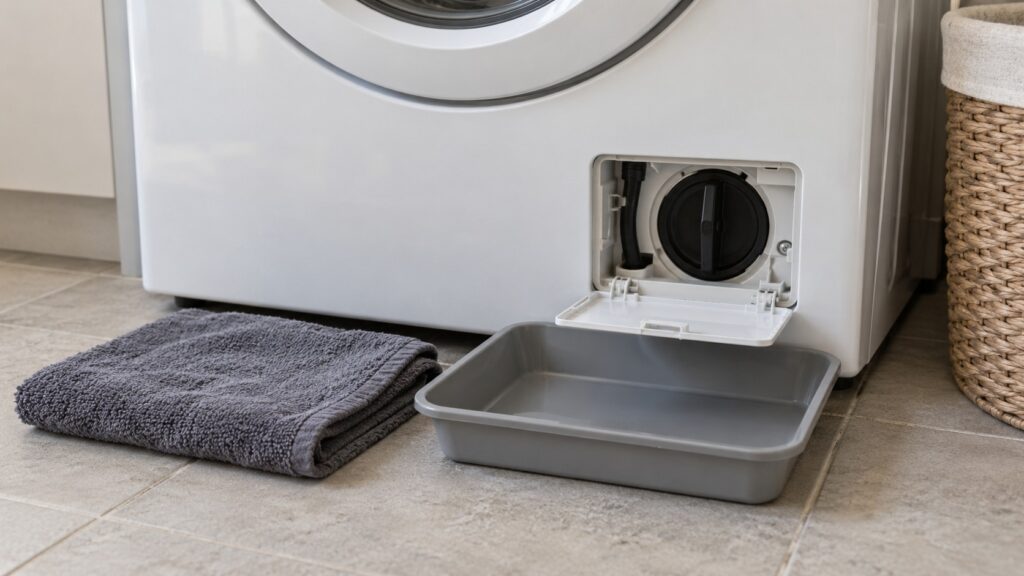
The small front hatch is the only access in the washer that an owner should use. Do not remove the cabinet panels to reach the pump. If water has already spread across the floor and reached an outlet or a power cord, switch off the breaker at the panel while standing on a dry floor, and do not pull a plug from a wet outlet.
Could it be the household drain or too much detergent?
If the filter and the hose are clear and the washer still drains slowly, the problem may be beyond the washer. A standpipe or a sink drain that is partly clogged cannot take the water as fast as the pump delivers it, and the water backs up to the hose. A test is to see whether other drains in the house, or the standpipe on its own, are running slowly. A clogged household drain is a plumber’s job.
Too much detergent is another cause that is easy to overlook. Excess suds fill the drum and the drain path and slow draining, and they can leave a washer looking as though it has a fault when it has not. Use the amount of detergent that your manual and the product recommend, and avoid adding extra for large loads. Our guide on detergent dosing covers the subject.
What if the door will not open?
A washer will usually keep its door locked while there is water in the drum, and that is a safety feature, not a fault. Do not force the door; forcing it can break the lock or the handle. Once the water has drained away, the lock normally releases. Our guide to Asko washer door will not open covers what to do if it does not.
If you must retrieve laundry from a washer that is full of water, the emergency drain hose, where fitted, lets you empty the drum into a container before opening anything. Do it slowly and keep towels ready.
When should you call a technician?
Call if the filter and the hose are clear and the water still does not leave, if the pump hums or makes a grinding noise without moving water, if a drainage message returns, or if the washer trips a breaker. Our Asko washer repair page explains how a visit works, and you can book it online. Tell the technician which messages appeared and what you have already cleaned, so no time is lost.