Asko dryers: series and lineup
Asko dryers are sold in three configurations — vented, condenser, and heat-pump condenser — across the Classic (3-series), Logic (5-series), and Style/Style+ (7-series) lines. The 7-series pairs the heat-pump T7HXLW with the vented T7VXLW; the 5-series runs heat-pump T5HXLT, T5HXLG, and T5HXLW alongside vented T5VXLG, T5VXLT, and T5VXLW, plus the Logic-branded heat-pump T411HS.W; the Style-branded vented T611VU.W and the 3-series heat-pump T3HW and vented T3VW round out the range. Full specs and matched parts live in our model directory.
Pairing a dryer to its matching washer by series makes sense for stacking and finish, but the dryer’s own configuration — vented versus condenser versus heat-pump — is really the decision that determines installation requirements: a vented T7VXLW needs an exterior duct run, while a heat-pump T7HXLW can sit in an interior laundry closet with no ducting at all, at the cost of a longer typical cycle time. That distinction matters as much to a service visit as it does to the original installation, since a vented dryer’s most common problem traces straight back to the duct run in a way a heat-pump model’s never will.
Technologies and features
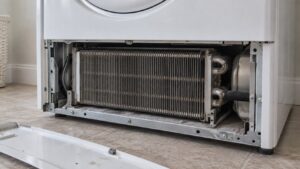
Heat-pump dryers in the 5- and 7-series add an auto condenser filter cleaning system that keeps the condenser clear without owner intervention on most cycles, at a higher purchase cost than a vented dryer but with a lower ongoing energy draw. Vented models exhaust hot moist air directly outside through a duct, the simplest and generally most serviceable configuration Asko sells. Across every format, the parts that wear are the drum belt and rollers, the door switch and seal, the thermistor and high-limit thermostat, and — on condenser and heat-pump models specifically — the condenser unit itself, which needs periodic lint clearing regardless of whether the auto-clean feature is fitted.
The auto condenser filter cleaning feature is a genuine convenience but not a maintenance-free guarantee — it clears fine lint from the condenser surface automatically, but larger debris and the mechanism’s own moving parts still benefit from an occasional manual check, particularly on units that have run several years of continuous heavy use without ever having the condenser pulled and inspected by hand.
Common issues and maintenance
Asko’s dryer problem display genuinely changes form across four separate control-board revisions on the TD70 service platform — the same underlying condition shows as an L-code on early panels, then an F-code, then an S-code, and finally a J1 or LCD-prefixed code on the newest revision. The T411VD heat-pump and steam platform instead runs its own ERROR_0 through ERROR_5 scheme. Simple analog condenser dryers in the T208V family publish no code at all — a verified absence, not a documentation gap — and are diagnosed purely by symptom. Excessive drying time is the earliest warning sign on any format and almost always traces to lint restriction somewhere in the airflow path, well before an error code or a burning smell would appear. Cleaning the lint screen after every load and having the exhaust duct professionally cleared annually prevents the large majority of service calls. For code meanings by platform, see our dryer error codes, and browse repair guides for asko dryers troubleshooting. A condenser dryer that suddenly seems louder than usual is often just a condensate tank close to full, since the extra water sloshing inside the tank during tumble genuinely changes the sound the machine makes well before any problem display appears; emptying the tank and rerunning the cycle rules this out before any part is ever suspected. On heat-pump models specifically, a cycle that runs noticeably longer without any accompanying error code is frequently the first sign of a condenser needing a manual clean beyond what the auto-clean feature reaches, and checking it there before assuming a refrigerant-circuit failure saves a needless service call. A vented dryer that has recently started taking noticeably longer to finish a load, without any other change in behavior, is worth checking at the exterior vent hood first — a flap that has become stuck shut, whether from lint buildup, a bird’s nest, or simple corrosion, restricts airflow just as effectively as a clogged duct further inside the wall and is a far simpler fix once identified.
When to call for repair
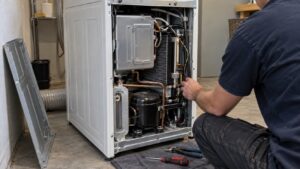
A failed thermistor, a jammed condensate pump, a worn drum belt, or a genuinely blocked exhaust vent are best handled by experienced technicians who confirm the control platform before recommending a part. As an independent, third-party repair service, we carry no affiliation with, authorization from, or endorsement by Asko, Gorenje, or Hisense, and every repair visit is backed by a 30-day labor warranty covering the workmanship. Schedule Asko dryer repair or book an appointment online, and you can review current listings at us.asko.com.