Asko dishwashers have used three separate numbering schemes across their production history, and a single two-digit number can mean three different things depending on which one your machine runs. The legacy DW20.1 platform reports faults as blinking lights rather than numbers. The current display generation shows F-codes starting at F10. A separate Outdoor-series line reuses the same numbers in a colon format — and reassigns several of them to the opposite meaning. Reading a code without knowing which scheme it belongs to is a guess, not a diagnosis.
Why does the same Asko dishwasher code number mean different things?
Three separate control-board generations were never designed to share one numbering table. The legacy DW20.1 boards, used on the 3000-series machines, had no display capable of showing a number at all — every fault surfaces as a pattern of blinking program lights, and Asko’s own service documentation maps those patterns onto F-numbers for reference: F7 is read as L1 plus L2, F8 as L1 plus L3, F9 as L1 plus L4. The current display generation replaced that entirely with its own F-code table that starts at F10, so an F7 or F8 you see written up for a legacy machine has no relationship at all to F10 through F68 on a current-display model.
The Outdoor-series line complicates it a third time. It uses a colon-format code — F:10, F:12, F:40 — that looks similar to a current-display F-number but runs its own independent table, reassigned rather than extended. Our guide on why Asko error codes are not universal covers this split at the level of the whole brand; this page is the dishwasher-specific map.
How do I know which scheme my Asko dishwasher uses?
The model and Art. No. fields on the rating plate settle it, not the shape of the code. A machine with no display and only program lights is on the legacy DW20.1 platform. A machine with a text or numeric display showing plain F-numbers starting at F10 or higher is on the current-display generation. A machine built for outdoor or built-in outdoor kitchen installation and showing a colon in the code — F:12 rather than F12 — is on the separate Outdoor-series scheme. Our rating plate guide shows where to find both fields on a dishwasher.
What is the most confusing conflict between the schemes?
F12 versus F:12. On the current display generation, F12 means “Water inlet problem 1” — the machine is not receiving enough water. On the Outdoor-series scheme, F:12 means overfilling — the exact opposite condition. A technician who reads “F12” over the phone without confirming which platform the customer has is working from a fifty-fifty guess on whether the fault is a shortage or an excess of water, and the two point at different parts entirely: an inlet valve or screen for the shortage, a stuck valve or float switch for the excess.
A similar reversal happens with F40 and F:40. Current-display F40 is an inlet valve leaking when it should be shut. Outdoor-series F:40 is a thermistor failure — a temperature sensor, unrelated to the water valve. Ordering a valve for an Outdoor-series machine showing F:40 replaces a part that was never at fault.
Which current-display codes are confirmed only on specific models?
F41 (“Heater failure 1”) and F45 (“Diverter problem”) are documented on the DSD746U current-display model specifically. Neither has been confirmed on the DFI5558 or DBI675 manuals reviewed for this guide, so treat both as specific to the DSD746 platform until another current-display manual is checked and adds them elsewhere. This matters because a code that exists on one model and not another is easy to mistake for a typo or a display glitch on a different machine, when in practice it may simply not apply there at all.
The overfilling and inlet-shortfall groups follow a similar pattern of doubling: Asko documents two separate overfilling codes on the current-display generation, F10 and F54, and two separate inlet-shortfall codes, F12 and F67. Each pair most likely reflects the control checking for the same condition at two different points in the fill-and-level sequence, rather than two unrelated faults.
What is the safest way to read a code before troubleshooting?
- Confirm the platform from the rating plate before searching a bare number — model and Art. No. decide it, not the code’s format alone.
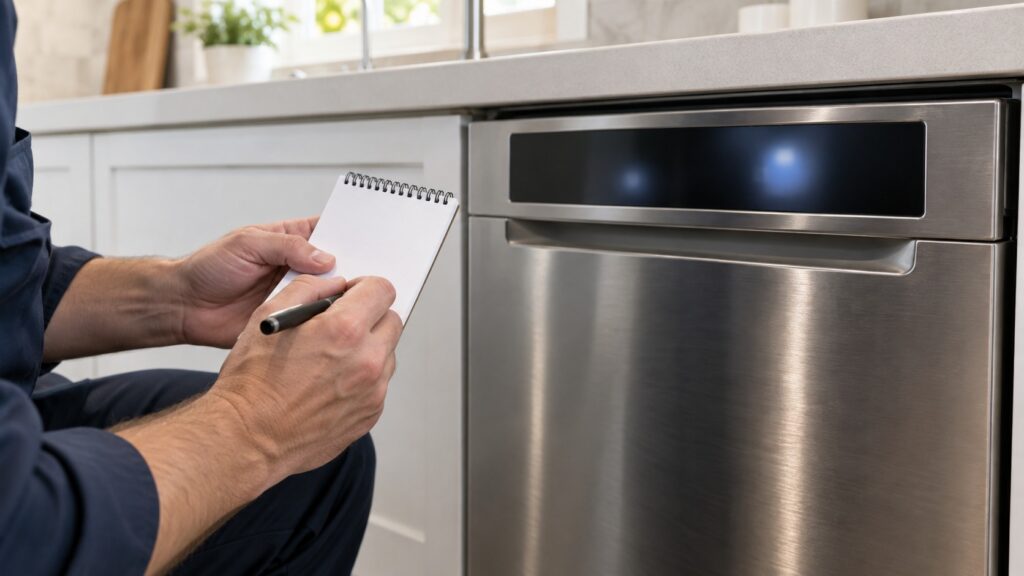
- Write down the exact code as displayed, including whether it carries a colon. F12 and F:12 look nearly identical typed into a search box and mean opposite things.
- Check the detail page for that exact code on the confirmed platform. Our F52 and F54 guide and our F11, F56, and F68 guide cover the two current-display groups most often searched.
- Do not assume a legacy blink pattern and a current F-number share a cause just because both eventually get written as “F” followed by a digit.
When should an Asko dishwasher code go to a technician?
Any code that returns after a filter check, a power cycle, and confirming the platform is worth a professional look, and having the exact code plus the model and Art. No. ready cuts real time off a visit. We are an independent repair company, not a factory service arm, and we price a diagnostic visit before assuming which of the three schemes — or which part within it — is involved. Book Asko dishwasher repair or schedule a visit with the code exactly as displayed, colon or no colon.
Keeping this asko dishwasher error codes map at hand before searching a bare number is the single habit that prevents most of the wrong-part guesses described above.