
Asko washer water temperature control is simple in principle: a temperature sensor, called a thermistor, reports how warm the wash water is, the control compares that reading with the program you chose, and a heating element warms the water until the two match. Two separate parts are involved, the sensor and the heater, and when a warm program ends with cold laundry, the first question is which of the two is at fault.
How does an Asko washer measure the temperature of the water?
A small temperature sensor sits in the wash water, where it changes its electrical resistance as the water warms or cools. The control reads that resistance many times during a cycle and converts it into a temperature. This kind of sensor is called a thermistor, and it is the washer’s only way to know how warm the water really is. Without a valid reading, the control cannot decide when to switch the heater on or off.
On the WM75/PMCU control platform used on models such as the W4114C, a sensor that is not reporting correctly shows as E1. The model’s manual lists E1 as a thermistor error, meaning the washer is not getting a valid temperature reading from the wash-water sensor. Our page for Asko washer E1 describes the code in detail, and the broader Asko washer code families overview explains that other Asko washer panels use different schemes.
What does the heating element do?
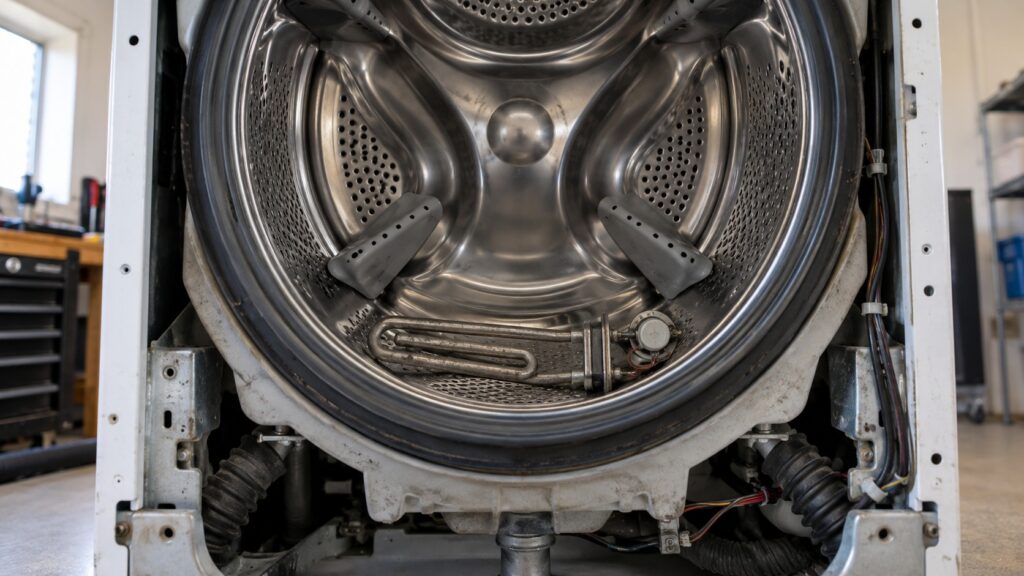
The heating element is an electric heater in the base of the tub. When a program calls for warm or hot water, the control switches the element on, the water warms and the sensor reports each step back. When the water reaches the target for that program, the control switches the element off and holds the temperature as the wash continues. Cold programs skip the heater entirely, which is why a washer with a failed element can seem fine on cold cycles.
The manual for the W4114C lists E6 as the heating error, distinct from the E1 sensor error further up the same table. E1 points to a sensor that is not reporting temperature correctly. E6 points to the element or its control circuit failing to raise the water temperature at all, even when the sensor reads accurately. A wash that finishes cold on a program that should have been warm or hot is the clearest sign to look at E6 specifically, as described on our Asko washer E6 page.
How does the control decide what to do?
The control follows the program’s temperature target the way a thermostat does. It reads the sensor, compares that reading with the target and switches the heater on if the water is below it. As the water approaches the target, the control switches the heater off, and it may cycle the heater to hold the temperature. The cycle time on a heated program is partly the time needed to warm the water, which is why a hot program takes noticeably longer than a cold one.
The control also checks the circuit as a safety measure. If it asks for heat and the sensor does not show the water warming within the expected time, it flags a heating error instead of running a long cycle with cold water. If the sensor reading looks impossible, such as a sudden jump or no reading at all, it flags a sensor error. That is why E1 and E6 are separate codes: they report two different failures in the same loop.
What does each symptom point to?
A washer that shows E1 on startup or during a heated program points to the sensor, its wiring or the control board. A washer that completes a warm cycle with cold water, perhaps with E6, points to the element or its circuit. A washer that is slow on warm programs but eventually reaches temperature can have a tired element or a scale-coated heater, especially in hard water. And a washer that works only on cold cycles may have either failure.
If your washer is not heating, our symptom page for the washer water not heating problem lists the checks. Also confirm that you are using the correct program and temperature selection, because the lowest-stakes code in the same table, E0, means an incorrect setting was selected rather than a hardware failure. A quick look at the program choice can save a visit.
What can you check, and what needs a technician?
Owners can confirm the program and temperature setting, check that the washer is not in a cold-only mode, and run a warm cycle while noting what the display shows. Descaling in hard water areas can help an element that is coated, following the manual’s guidance. Note the exact code, the program and whether the water felt warm at all.
The element, the sensor and the control board sit behind panels with live power and a water circuit, so they are technician jobs. A technician measures the sensor’s resistance and the element’s continuity to decide which part has failed. A part swap is usually far cheaper than replacing a washer, but only after the right part has been identified. Our Asko washer repair page explains the visit.