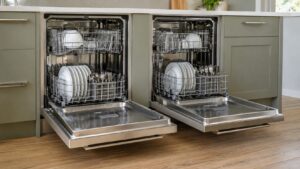

When an Asko dishwasher cycle takes too long, the cause is usually one of four things: a program that is long by design, water that is slow to heat, a fill or drain that is slow, or a drying phase that has no heater to speed it up. Asko dishwashers dry by condensation, with no drying element, and the eco programs are built to run for hours at lower temperatures. A cycle that runs far longer than it used to is worth chasing, and the checks below tell you which of the four you have.
How long should an Asko dishwasher cycle take?
Longer than many owners expect. The eco program runs at a lower temperature for much longer to clean as well as a hotter, shorter one, so a cycle measured in hours is normal. Programs with intensive washing or extra drying are longer again. Your manual lists the typical time for each program, and that, not an old habit from another dishwasher, is the number to compare with. If the time on the display matches the manual, nothing is wrong.
What matters is a change. A program that used to finish in a given time and now takes far longer points to a cause worth finding. Keep a note of the program, the load and roughly when the change began, because the pattern helps separate a water problem from a heater or a drain problem.
Is it the drying phase?
Possibly. An Asko dishwasher has no drying element. It finishes with a hot final rinse so the load carries its own heat, and then it uses the temperature difference between the hot dishes and the cooler stainless tub to pull moisture out of the air, and the water condenses on the walls and drains away. That takes time, and the last twenty minutes or so do most of the work, so do not open the door early. Our explanation of Asko condensation drying covers it in more detail.
This also explains why a cycle seems to continue after the noise stops: it is drying silently. If the machine is quiet but the display still counts down, give it time. The drying phase is not a fault, although it can lengthen a program that you expected to finish quickly.
Is the water heating slowly?
The machine has to bring the wash water up to temperature, and the colder the incoming water, the longer that takes. In winter, with a cold supply, the heating phases stretch. A weak heater or a failing temperature sensor has the same effect, and the cycle may sit in a heating step for a long time. The older DW20.1 platform reads this as code F1, a temperature stop problem, when the wash water does not rise by at least five degrees Celsius, about nine degrees Fahrenheit, within ten minutes. The details are on our page for the dishwasher F1 code.
A simple check is to run a short program and feel the door and the tub at the end of the wash, which should be clearly warm. If the machine never gets warm and the cycle keeps extending, book a diagnosis. A heater or a sensor is a technician job.
Is it filling or draining slowly?
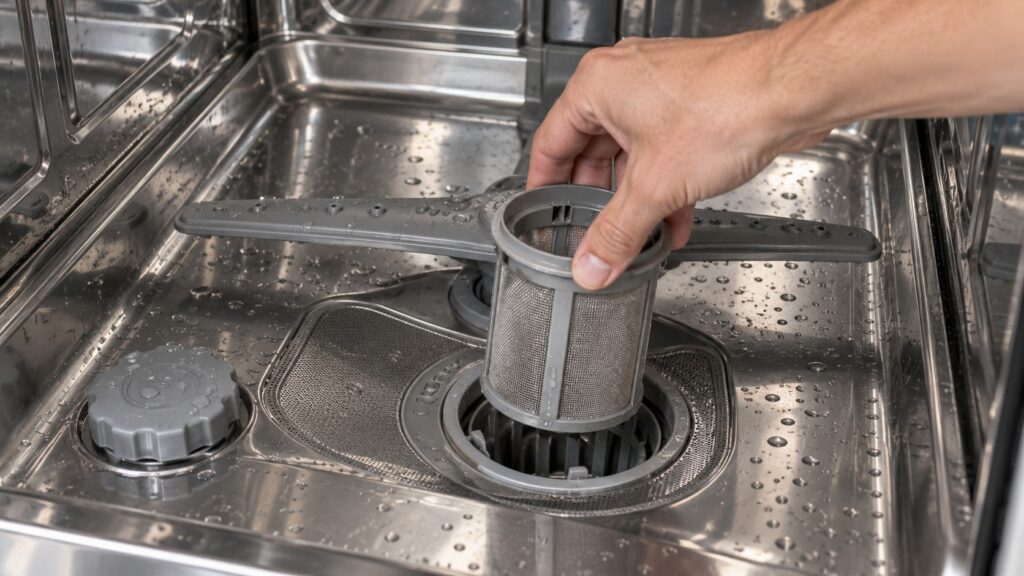
Both add minutes. A fill that is slow comes from a tap that is not fully open, a kinked inlet hose, a clogged inlet screen or low water pressure, and the machine waits until it reaches the level it expects. A slow drain comes from a dirty filter, a kinked or too-low drain hose, a blocked household drain or a weak pump. Code F11 reads as a water outlet problem, meaning the machine could not clear the tub. Start with the filter, which our guide to dishwasher filter cleaning covers, then check the hoses at the back.
If water is standing in the bottom after a cycle, that is a drainage problem more than a long-cycle problem. See our page on a dishwasher not draining, and the guide to the F11, F56 and F68 drain pump codes if a code appears.
What simple things can you try?
Clean the filter and check that the spray arms spin freely. Check the tap and the hoses. Scrape, do not rinse, heavy food off plates, since a very dirty load can lengthen a sensor-controlled program. Use the right detergent and enough rinse aid, and run a descaling cycle if you have hard water, because scale on the heater slows heating. Our descaling guide shows how.
If the cycle is still far longer than the manual says, and you have ruled out the program choice, the water supply and the drain, Asko dishwasher repair can check the heater, the temperature sensor and the pump. Tell the technician which program you use and how the time has changed.
It also helps to know how loading changes timing. A crowded rack or an item that blocks a spray arm can make a sensor-controlled program add rinses or extend the wash. Plastic that stays wet will not change the program time, but it often leads people to rerun a cycle, which feels like a long cycle. Load the machine so water reaches everything, and give the cycle its full time before judging it.