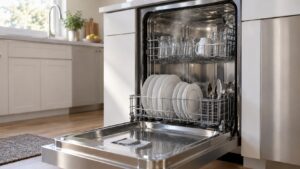
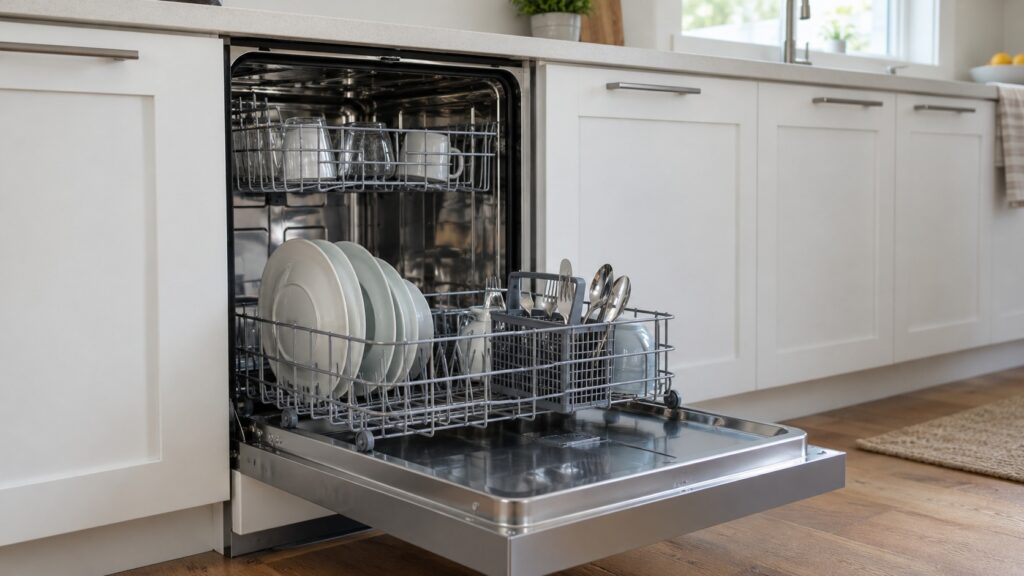
For an Asko dishwasher repair or replace decision, repair is usually the better choice when the fault is a single working part such as the drain pump, an inlet valve, the diverter or a door seal, and replacement deserves a look when the steel tub itself is corroded or leaking, when failures keep coming, or when the machine is very old. The US models on our list, the 50 Series DFI565, DBI565IXXLS and DSD565 and the 60 Series DFI776XXLSOF, are built from stainless steel with replaceable components. A fault code on the display is a repair clue, not a verdict.
Which Asko dishwasher faults are usually worth repairing?
Most dishwasher faults are parts that wear. A drain pump that stops working is common: code F11 reads as a water outlet problem, meaning the machine could not clear the tub, and on current-display machines F68 reads as a BLDC drain pump failure, which is the brushless pump not responding to the control board. An inlet valve that leaks shows as F40, water entering the tub when the valve should be shut. Overfilling shows as F10 or F54, and F45 is a diverter problem, the mechanism that sends water to the spray arms. Each of these is a contained repair with a clear answer.
Door problems are usually repairable as well. A leaking door, a seal past its best or a dispenser that will not open is a part and an adjustment, not a reason to buy a machine. Our guides on the F11, F56 and F68 drain pump codes and on a dishwasher leaking from the door help you see which case you have.
What problems point toward replacing?
Three situations tilt the decision. The first is a tub that is corroded through or leaking at the body, which is structural and not a part. Asko builds its dishwasher tubs from stainless steel, so this is uncommon, but a failed tub is the end of the machine. The second is a pattern of unrelated failures: a pump this year, a control board next year and a valve after that. The third is a machine that no longer suits the household, for example a smaller unit for a larger family, or an older one that is loud and uses a lot of water.
Age alone is not a reason. A well-kept machine at ten years often outlasts a new one with a recurring fault. If you are unsure, our general guide to an Asko repair or replace decision gives the framework, and this guide adds the dishwasher details.
How does the cabinet affect the decision?
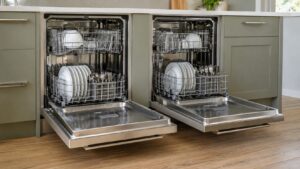
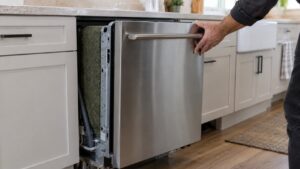
A dishwasher is usually built into a run of cabinets, and a replacement has to fit the opening and the door panel. Panel-ready and built-under models are sized to the cabinetry, and a different brand or generation can mean a mismatched height, a different hinge arrangement or a front that no longer lines up with the neighbors. That cost is easy to forget, because it comes on top of the price of the new machine, and it is a strong reason to repair a unit that fits the kitchen.
If you do replace, choose with care. Our guide to panel-ready installation shows what the front panel and the opening need, and the buying guide on the US product lineup lists what is currently sold.
How do repair and replacement costs compare?
A part swap is usually far cheaper than a new machine, and a new machine brings delivery, installation, water and drain connections and sometimes cabinet or panel work. Compare the repair estimate with that all-in figure, not with the price tag. If the repair is a small share of it and the machine fits the kitchen, repair wins on money and on disruption. If the estimate is a large share, or the machine has needed repeated work, it is time to look at replacement seriously.
Do not forget what a failing dishwasher costs you in water damage risk. An inlet valve that leaks or an overfill is worth fixing quickly, and until it is fixed you should shut off the water supply to the machine. If the machine is already old and the fault is a major one, say so up front, because a technician can tell you whether parts are easy to get.
What should you do before you decide?
Write down the code and the exact words on the display, since the scheme differs between generations and between the standard and Outdoor series, where the same F number can mean something else. Photograph the rating plate, which carries the model, serial and article number. Run through the simple checks: clean the filter, check the drain hose for kinks and make sure the dispenser latch is clear. Our guide to dishwasher filter cleaning covers the first of those.
Then book a diagnosis so that the decision is based on a named part. See Asko dishwasher repair for what we cover.