Asko dishwasher terms turn up on spec sheets, in programs and on service calls, and they are not obvious from the words themselves. This glossary explains the ones that change how you use the machine or how a fault is diagnosed. Where a term affects a repair decision, we say so, because several of these describe construction choices rather than features — and construction is what decides whether a fifteen-year-old machine is worth fixing.
Construction terms
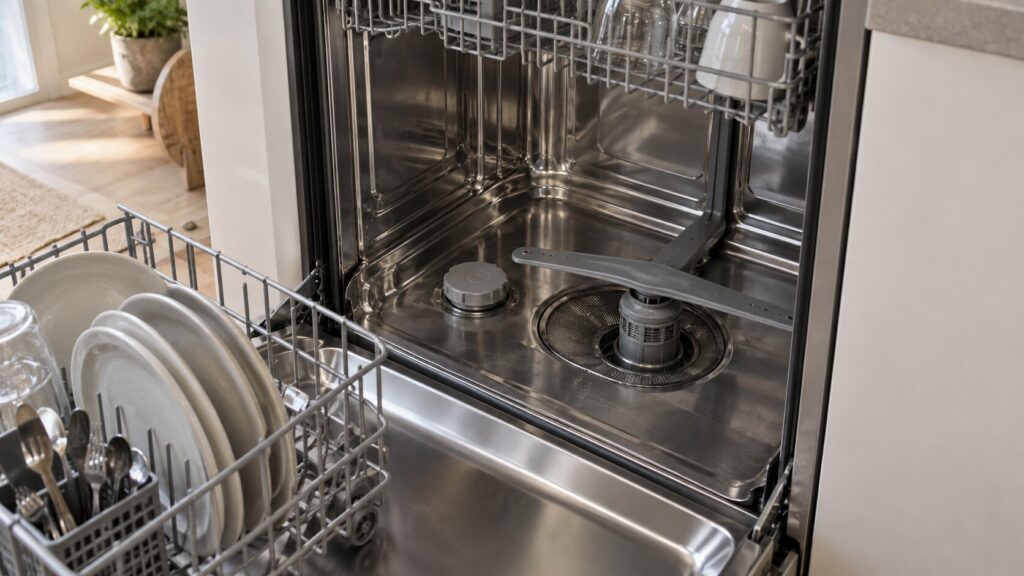
Steel tub. The washing cavity, the door liner and the sump area are stainless. A steel tub resists odor, does not stain, and gives up heat quickly — the property that makes condensation drying work at all, as our guide on how the drying works explains. In service terms it also means an old machine’s cavity is usually sound even when electronics are not, which shifts a repair-or-replace conversation.
Quattro construction. A term used across the laundry range for a four-point frame-and-suspension design, described in our guide to washer construction. It appears here because people meet it while comparing machines from the same maker and assume it refers to the dishwasher too. It does not.
Panel ready, integrated, fully integrated. Three different things. Panel ready means the door accepts a custom panel. Integrated means the machine is designed to disappear into cabinetry. Fully integrated means the controls are on the top edge of the door and are invisible when it is shut — which also means a fault code is invisible until you open it. Our panel-ready installation guide covers what the fitting needs.
Water treatment terms
Built-in water softener. An ion exchange column inside the machine that removes hardness minerals from incoming water. European dishwashers include one because hard water otherwise leaves film on glass and scale on the heater. It is set to your local water hardness once, at installation, and then forgotten — which is the problem: a machine set to the default in a hard-water area produces cloudy glassware for years and gets blamed for it.
Regenerating salt. Coarse sodium chloride that recharges the softener resin. It goes into a dedicated reservoir in the floor of the tub, never into the detergent compartment. Table salt contains anti-caking agents and is not a substitute. Our guide on salt and rinse aid has the filling procedure and the settings.
Hardness setting. A number entered in the machine’s settings that tells the softener how hard the supply is. Worth checking at installation and again if you move, or if a water utility changes source. Cloudy glass and white film are the symptoms of getting it wrong in either direction.
All-in-one tablets. Detergent tablets that include salt and rinse aid functions. They work acceptably in soft and moderate water. In genuinely hard water they do not replace the reservoirs, and machines run on tablets alone in hard areas scale up over years. Our descaling guide deals with what that leaves behind.
Wash and program terms
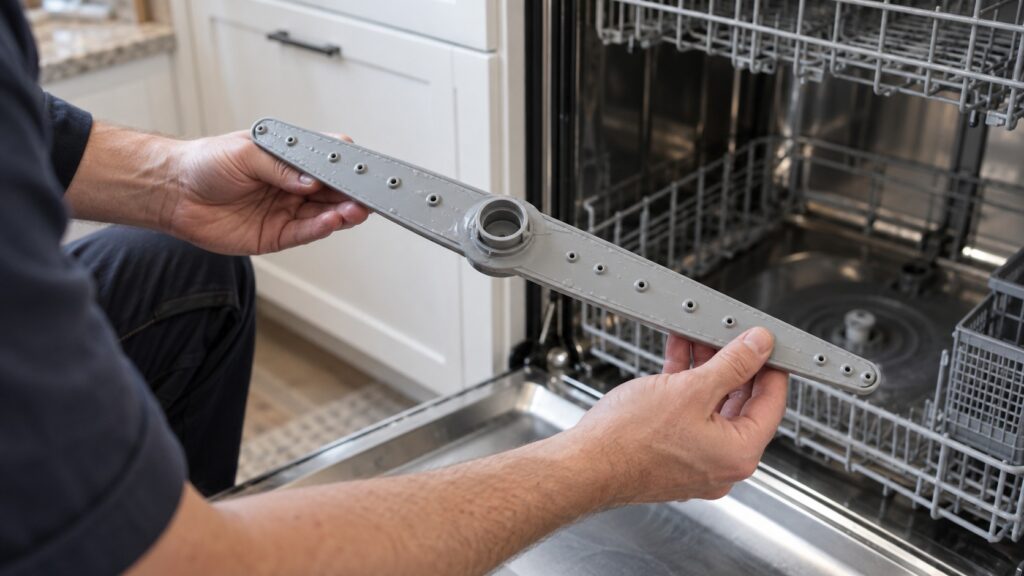
Spray arms. Rotating arms that distribute water. Most machines have two or three; the upper one is fed through the basket rail. Blocked jets are among the commonest causes of poor results, and they are user-serviceable — see our guide to the spray arms.
Filter, sump, coarse filter. The assembly in the floor of the tub: a coarse strainer catching debris and a fine mesh protecting the pump. It is the part that most affects performance and the one most often left uncleaned.
Auto program. A cycle that uses a turbidity sensor — a small optical sensor reading how dirty the water is — to decide length and temperature. It produces variable cycle times by design, which is regularly reported as a fault.
Eco program. The cycle a machine is rated on. It is long and cool because that is the efficient combination. It is not the program to judge drying by.
XXL. A taller tub, designed for oversize items. Related to loading rather than washing, and covered in our XXL loading guide.
Drying terms, which cause the most confusion
Condensation drying. The default on these machines: no element, no fan, just hot dishes giving up moisture to a cooler steel wall. Silent, gentle on plastics, and heavily dependent on how the machine is loaded.
Turbo drying. On models that have it, a fan assists that exchange by moving air across the load at the end of the cycle. It shortens the wait and improves results on plastics. It is still not heated drying, so a plastic container that comes out with drops on it has not revealed a fault.
Auto door opening. Some machines release the door a few inches at the end so moist air leaves and room air enters. If yours does this, it is a feature, not a latch failure — and it needs the clearance in front to swing, which matters in a narrow galley kitchen.
Terms that appear when something is wrong
One caution about codes: the short fault codes on a dishwasher are not the same codes used on other appliances from the same brand, as our guide on codes not being universal explains at length.
When to call
Call when the machine leaves film on glass after the hardness setting and salt are verified, when cycles run far longer than they used to, when water stands in the tub, when the door will not latch, or when a code appears repeatedly.
We are an independent repair company and not a factory service arm. Pricing starts from a diagnostic visit and we confirm the estimate before any work begins. Asko dishwasher repair covers pumps, heaters, sensors, softeners and controls, and you can schedule a visit online.