

Asko washer capacity is quoted in kilograms of dry cotton, and that single fact causes most of the confusion American buyers have with European laundry. A machine rated for nine kilograms is not the same thing as a large-capacity domestic washer sold by drum volume, and spin speed — the second number on every spec sheet — changes how much work the dryer afterward has to do. Choosing well means reading both numbers together, and then checking that the machine physically fits the space you have.
Reading a capacity figure honestly
The rated capacity is measured with dry cotton, packed to the manufacturer’s method, on the reference program. Real laundry is rarely all cotton and is never packed that way. A useful translation:
- Cotton and linen: load to the rating. Drum full but not compressed — a hand’s width at the top.
- Synthetics and mixed: about half. They hold water differently and need room to move.
- Wool and delicates: a third at most. These programs work by gentle movement, which needs space.
- Bedding: one duvet, alone. A king duvet in a nine-kilogram machine is a full load by itself.
Overloading is the most common cause of complaints that get reported as faults: poor rinsing, detergent residue, a machine that will not balance for the final spin, and cycles that run long because the machine keeps redistributing the load. Our guide on detergent dosing covers the other half of that problem.
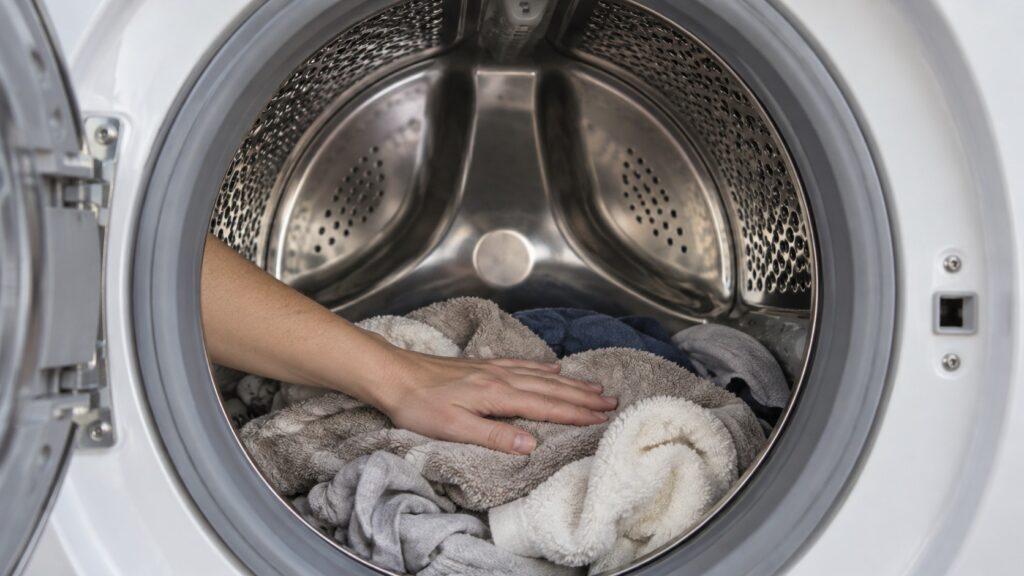
Spin speed, and where the money actually goes
Spin speed decides residual moisture — the weight of water still in the laundry when the cycle ends. That number matters far more than it looks, because the energy to remove the rest of that water in a dryer is larger than the energy the washer used to spin it out.
A high maximum speed is not an instruction to use it. Most programs cap spin below the machine’s maximum on purpose, and a delicate item spun at full speed comes out creased in a way no dryer will fix.
The floor is part of the decision
A washer spinning at 1400 rpm puts real forces into whatever it stands on. On a solid ground floor this is unremarkable. On a suspended timber floor, or upstairs in a frame-built house, the same machine can transmit enough vibration to be heard through the building.
Two practical consequences. First, leveling matters more at higher speeds — a machine that rocks even slightly will walk, and a machine that walks eventually damages its own suspension. Our guide on leveling a freestanding appliance covers the method, which is the same here. Second, if the laundry is upstairs, a 1200 rpm machine that is quiet is often a better household decision than a 1600 rpm machine that is not.
Construction, and why it belongs in a buying decision
Capacity and spin are the numbers on the label; what carries them is the frame, the suspension and the drum mounting. A machine built to spin at high speed for fifteen years is built differently from one that will do it for five, and this is where the cost difference between apparently similar machines sits. Our guide to washer construction describes the four-point arrangement these machines use and why it matters at high spin speeds.
Worth asking about on any machine you are considering: whether the drum bearings are serviceable separately from the drum, and what the parts availability looks like. Those two answers decide what happens in year eight, and they never appear on a spec sheet. Our note on parts lead times covers what to expect.
Programs, and the capacity you actually use
A large drum is only useful if the programs you run can fill it. Households that wash mostly small mixed loads gain little from the largest machine and pay for it twice — in purchase price and in water heated for a drum that is half empty. Households that wash bedding, towels and work clothes gain immediately.
Look at how a week of laundry actually divides. Four small loads on different programs will not become one large load whatever the capacity, because they are different fabrics at different temperatures. The gain from capacity appears where several loads really are the same kind of thing, and that is worth checking honestly before paying for it. Our guide on program selection covers which programs exist to be filled and which are deliberately small.
Fit, which rules out more machines than anything else
- Depth. European machines are often shallower than American ones. Good in a tight utility space, but check the door swing clearance, not just the cabinet depth.
- Stacking. If a dryer will sit on top, the kit must match both machines. See our stacking guide.
- Hinge side. Fixed on most washers. In a corner installation it decides whether the machine is usable at all.
- Supply and drain. Position and height requirements are specified and are not suggestions; a drain hose run too high or too low produces faults that look like a pump problem.
- Doorways. Measure the route in, not only the destination. A machine that will not pass the hall is a returned machine.
When to call
Call when a machine will not complete its spin, when it walks or vibrates heavily, when laundry comes out wetter than it used to at the same setting, when the drum makes a rumbling noise that changes with speed, or when you want an existing installation checked before a new machine arrives.
We are an independent repair company and not a factory service arm. Pricing starts from a diagnostic visit and we confirm the estimate before any work begins. Asko washer repair covers bearings, suspension, pumps, valves and controls, and you can schedule a visit online.