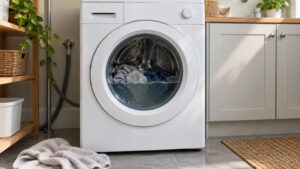
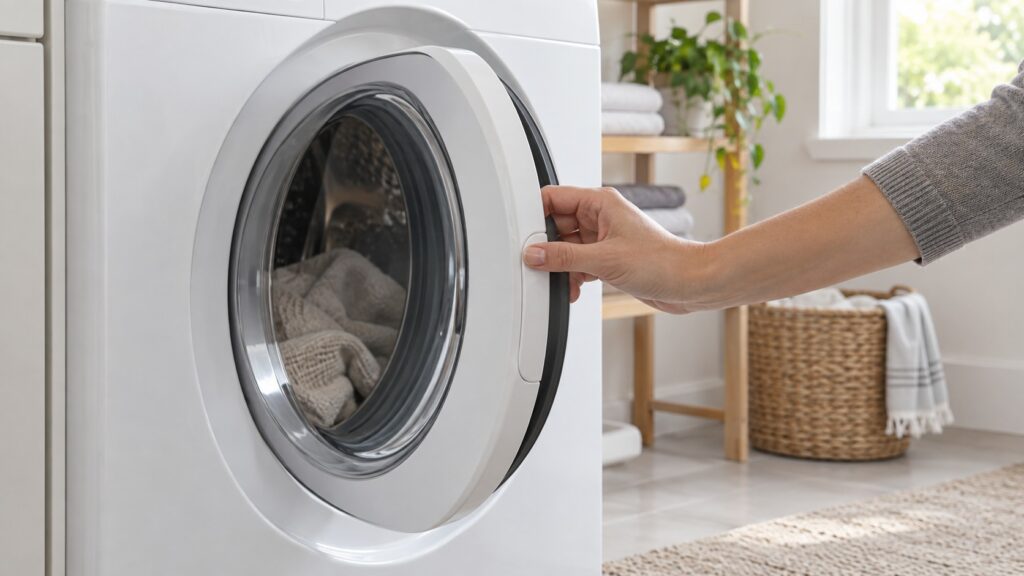
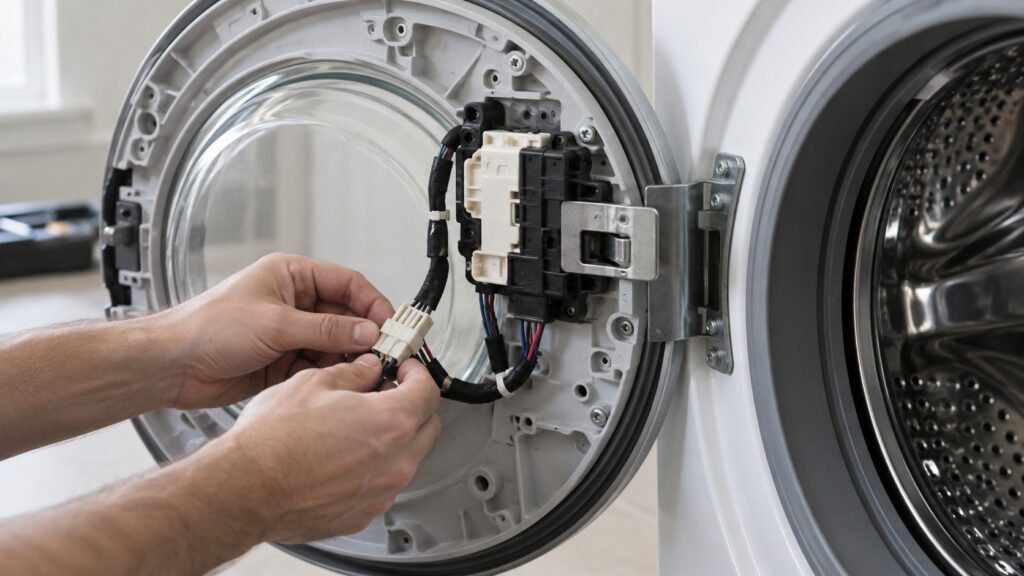
When an Asko washer door will not open, the machine is almost never broken in the way it feels. The door lock is an electrically held interlock, and it stays shut until the control board is satisfied that the drum has stopped, the water is out, and the lock itself has reported its position back. Four different codes describe the two halves of that conversation: E2 and E23 on the current WM75/PMCU platform, L6 on the W6022 panel, and F6 on the numbered-LED W6222 and W6342 panels. Each one points at the same small assembly behind the door frame, and each one means something slightly different about it.
Why will an Asko washer door not open after a cycle?
Start with the possibility that nothing has failed. The interlock on an Asko front-loading washer is deliberately slow to release: after the final spin the board waits for the drum to come to a complete stop, and it will not release at all while the water level sensor still reports water in the tub. On a normal machine that wait is a minute or two. If the cycle ended on an unbalanced load and the machine has been trying to redistribute it, the wait can be longer, and the door stays locked for the whole of it.
So the first question is not which part failed but which of two situations you are in. If the drum has water in it, or the display still shows a running program, the lock is behaving correctly and the fault is upstream — in draining or in the spin. If the drum is empty and still, the machine has been idle for ten minutes, and the door is still held, then the lock circuit itself is the subject.
That split matters because the two situations lead to completely different work. A washer that will not drain needs the drain filter and pump looked at, which an owner can usually do; a lock that will not release needs an assembly behind the door frame that an owner should not.
What does E2 mean on an Asko washer?
On the WM75/PMCU platform, E2 is a door lock error: the control energized the lock, waited for the lock to report that it had engaged, and did not get that confirmation. The machine refuses to start, because starting a wash with an unconfirmed door is the one thing the interlock exists to prevent.
Because E2 appears at the beginning of a cycle rather than at the end, it is usually noticed as a washer that will not start rather than as a door problem. The three parts listed for it on our Asko washer E2 page are the door lock solenoid, the lock sensor, and the harness between them and the board. A door that is simply not shut far enough — a sleeve caught in the seal, a load pressing against the glass — produces the same code, which is why closing the door firmly and restarting is a reasonable first move.
How is E23 different from E2 on an Asko washer?
E23 is the mirror image. The cycle ran, the cycle finished, and now the control has asked the lock to release and the lock has not reported that it did. The parts overlap with E2, but the order of suspicion changes: a solenoid that still engages but no longer retracts cleanly, a latch mechanism with a worn or distorted striker, or a board that is not driving the release at all.
The practical difference for you is that E23 leaves laundry inside a machine you cannot open, and E2 does not. That makes E23 the more urgent of the two, and it is worth knowing that on most of these machines the emergency release is inside the same front panel that covers the drain filter. Opening that panel to drain residual water is an ordinary owner task; pulling an emergency release cord is at the edge of one, and forcing the door after it is not.
What do L6 and F6 mean on older Asko panels?
Both are door opening faults, and both come from Asko documentation that gives them no owner-level troubleshooting at all. L6 belongs to the W6022 panel, where the letter-and-number labels are printed beside indicator lights rather than shown on a display. F6 belongs to the numbered-LED W6222 and W6342 panels. In each case the manual’s instruction is to contact service.
That is worth taking at face value rather than reading as caution for its own sake. These panels have no way to show a second, more specific code, so the manufacturer collapses several different lock-circuit failures into one label. A technician reads the actual state of the circuit with a meter; the panel simply cannot.
One more trap belongs here. The same letter-number labels do not carry the same meaning from panel to panel on these machines — L4 is a water intake error on a W6022 but an imbalance notice on a W6324. Before you act on any letter code, confirm which panel you are reading, using our guide to Asko washer code families and the model number on the rating plate.
What can I safely try before calling a technician?
Work through these in order, and stop where the list stops.
- Wait ten minutes with the power on. Many releases are simply delayed. Do not keep pressing the door button; each press restarts the control’s own timing.
- Cut power for two minutes, then restore it. A latched lock fault often clears on restart. If the code returns immediately, it is reporting a live condition.
- Check for water in the drum through the glass. Any visible water means the fault is drainage, not the lock. Our guide to the Asko washer drain filter covers that path, and the filter compartment is also where residual water has to come out before anything else happens.
- Look for a trapped item. Run a finger around the visible part of the door seal. A corner of a towel between seal and glass will hold the latch just far enough out of position to fail confirmation.
- Write down the exact code and the panel type. E2 and E23 come from a text display; L6 and F6 come from indicator labels. The difference tells a technician which platform is in front of them before they arrive.
Stop there. The door lock assembly sits behind the front panel alongside mains wiring, it holds mechanical tension, and on a machine that has not drained there is water immediately behind it. Prying the door, levering the latch, or removing the panel to reach the lock are not owner tasks on this machine.
When does an Asko door fault need a technician?
Any code that survives a power cycle on an empty, still drum is a hardware fault in the lock circuit, and the four codes above all land there. So does a door that opens only sometimes: an intermittent lock sensor throws E2 on one cycle and runs normally on the next for weeks before it stops working entirely.
We are an independent repair company, not a factory service arm, and a door lock is one of the repairs where that is worth saying plainly — it is a small, well-defined part, and replacing it is usually a short visit rather than a reason to consider a new machine. Book Asko washer repair with the code, the panel type and the model number from the rating plate, or schedule a visit online and bring the laundry situation with you — a technician who knows the drum is still loaded plans the visit differently.