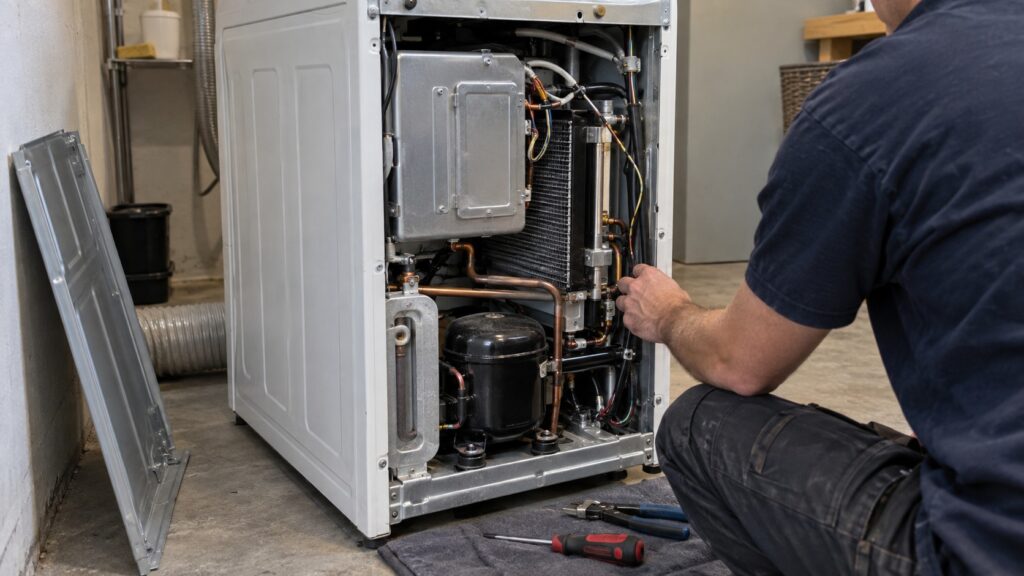
An Asko dryer compressor failure is the one laundry repair where the answer is genuinely not obvious. On a heat pump dryer the compressor and its sealed circuit are the most expensive assembly in the machine, and the labor to replace them is not small either. The decision turns on three things: the age of the machine, whether the failure is really the compressor, and what a comparable replacement costs today. This guide covers how to tell, and how we would frame the choice.
What a compressor failure looks like
The classic presentation is a dryer that runs a full cycle, tumbles normally, sounds normal — and produces clothes that are warm and still damp, or barely warm at all. Nothing errors. The machine is doing everything it can; what it cannot do is move heat.
Supporting signs worth noting before a visit:
- the cycle runs to its maximum time every load, regardless of load size;
- the machine is not noticeably warm at the back or base after a long cycle, where it used to be;
- a clicking every few minutes as something tries to start and stops;
- a fault code relating to the sealed system or to temperature sensing, on models that report one.
Before you accept that diagnosis
Every symptom above is also produced by restricted airflow, which costs almost nothing to fix. Do not authorize a sealed-system repair until these are ruled out:
- Both filters. Door filter and secondary filter, actually clean and actually dry — see our condenser filter guide.
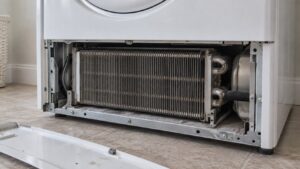
- The evaporator face. A felted fin block starves the loop and stretches cycles for years before anyone looks, as our evaporator care guide describes.
- The water path. A container that is not emptying or a blocked drain line stops the loop condensing.
- The room. A hot, closed laundry closet extends cycles on a perfectly healthy machine.
- The load. A washer that has stopped spinning properly sends soaking laundry to the dryer, which then looks like the faulty appliance.
We check all of these before quoting sealed-system work, and a meaningful share of calls that begin as “the compressor has gone” end at a filter.
The three questions that decide it
How old is the machine? Heat pump dryers are long-lived when maintained, and a well-kept machine of four or five years is worth repairing without much debate. Past ten, you are investing the larger part of a replacement price into the older part of a machine whose bearings, drum seals and control board are the same age.
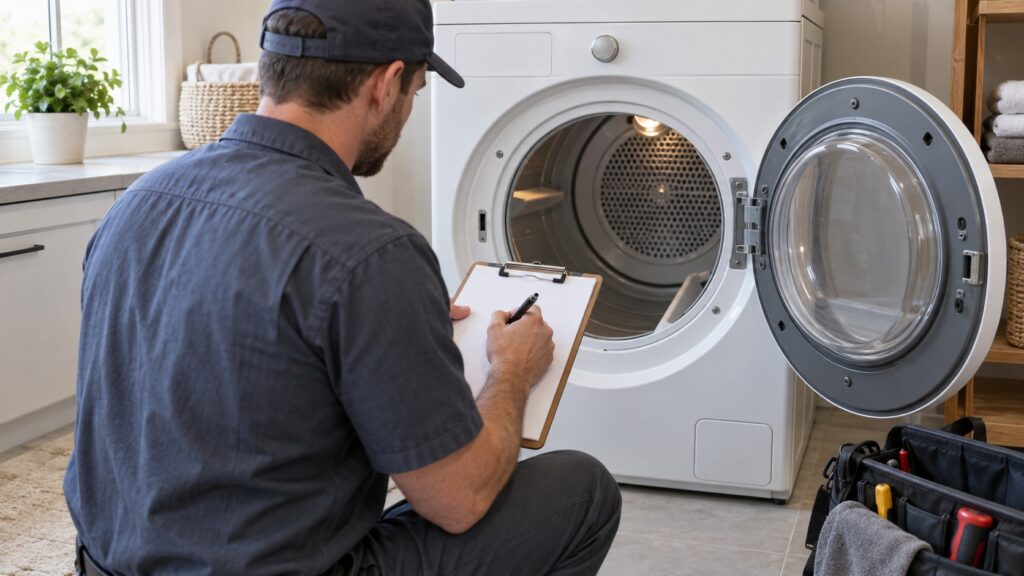
What else is worn? A technician assessing a compressor fault should tell you the state of everything else while the machine is open: drum bearings, belt, door seal, the fan, the condition of the cabinet. A sealed-system repair on a machine that will need bearings next year is a poor investment, and it is fair to ask directly.
What does the replacement cost? Not the price of the cheapest dryer, but of a comparable machine — same capacity, same heat pump technology, same fit. Integrated and stacked installations narrow the field considerably, and a machine that fits an existing alcove and stacking kit has a value that a spec sheet does not show.
The arguments people find persuasive, in both directions
Our general guide on making the repair or replace decision covers the same reasoning across appliance types, and the parts lead time guide matters here: a sealed-system part on back order changes a good repair into a long wait.
Two situations that change the answer
A stacked or integrated installation. When a dryer is stacked on a washer with a matched kit, or built into a run of cabinetry, replacing it is not just buying an appliance. Dimensions, hinge side, control position and the stacking kit itself all have to match, and the field of candidates gets small quickly. A repair that would be marginal on a freestanding machine is often clearly worthwhile here. Our stacking guide covers what has to line up.
A machine under an extended warranty. Sealed systems are frequently covered for longer than the rest of the appliance, and households forget this because the paperwork is filed with the purchase. Check before authorizing anything: the same failure can be a large bill or nothing at all, and the only difference is a document.
There is also a third case worth naming, because it comes up often and it is not a repair question at all. If the household has grown and the machine was always too small, a fault that forces a decision is the moment to size correctly. Repairing an undersized dryer keeps the real problem — two cycles per wash, every time — and the running cost of that exceeds the repair within a couple of years.
What we do on the visit
We verify the airflow side first, then measure the sealed system’s behavior — how temperatures develop through a cycle, whether the compressor starts and holds, what the control is reporting. That measurement is what separates a compressor from a sensor telling the control the wrong thing, and a sensor is an inexpensive repair that presents identically.
If it is the sealed system, you get the estimate, the honest assessment of everything else in the machine, and the lead time for the part before you decide anything. We do not open a sealed circuit on a maybe.
When to call
Call when loads come out damp with both filters clean, when cycles hit maximum time every run, when the machine clicks periodically without heating, when a sealed-system code appears, or when you want the machine assessed before deciding whether to replace it.
We are an independent repair company and not a factory service arm. Pricing starts from a diagnostic visit and we confirm the estimate before any work begins. Asko dryer repair covers heat pumps, fans, sensors, pumps and controls, and you can schedule a visit online.