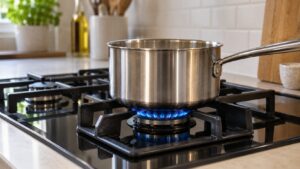
Converting an Asko gas cooktop from natural gas to propane, or the reverse, is an installation job that changes the burner orifices and, on most models, adjusts or replaces the pressure regulator — it is not a setting you switch on the control panel. Skipping a step in that process is one of the most common causes of a weak, yellow flame or a burner that sparks repeatedly without lighting on an otherwise healthy cooktop.
What actually has to change to convert a gas cooktop between natural gas and propane?
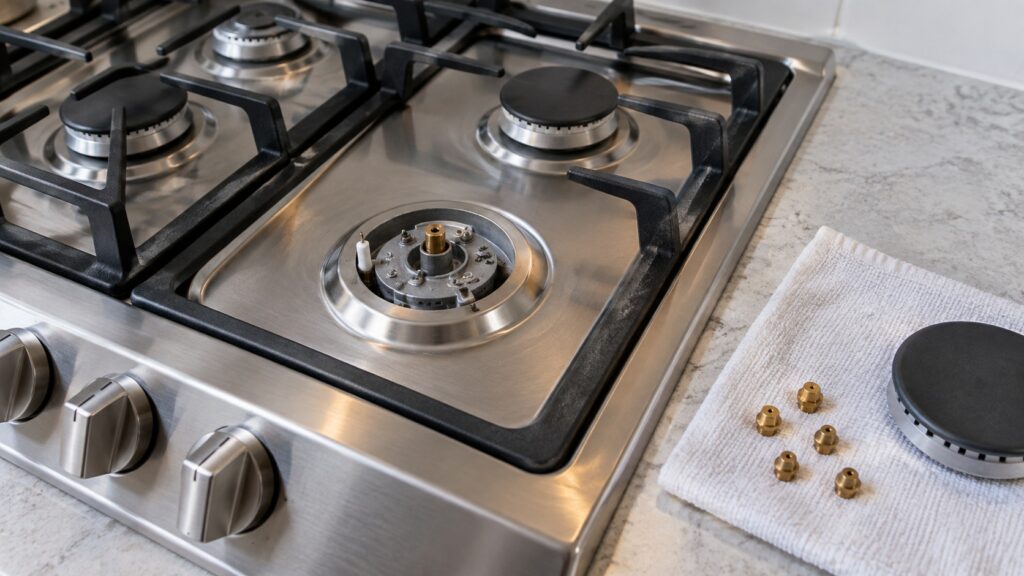
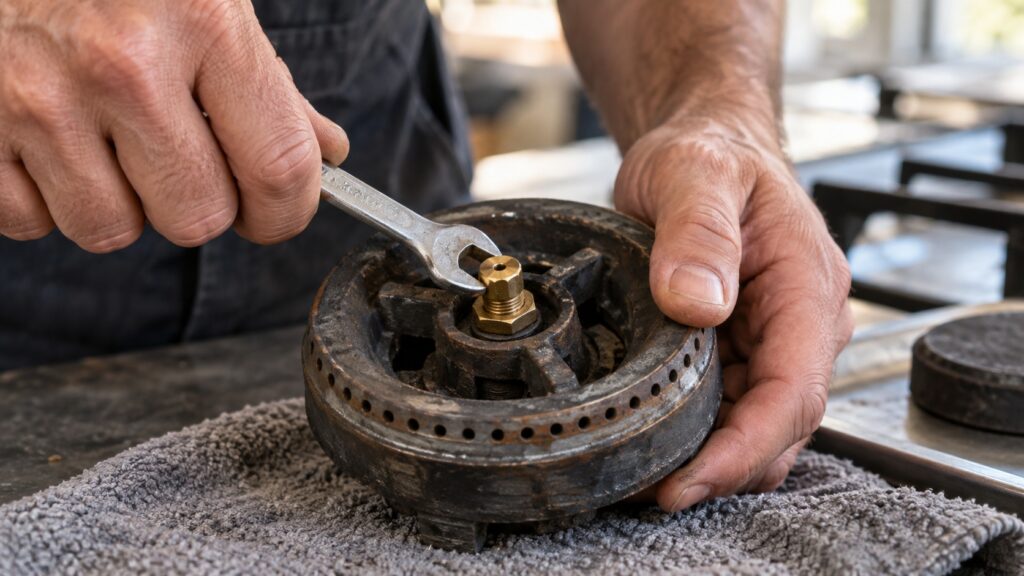
Propane burns at a different volumetric rate than natural gas at the same pressure, so a burner sized correctly for one delivers the wrong amount of fuel on the other. The orifice — a small brass fitting with a precisely sized hole that meters gas into each burner — is the part that compensates for that difference, and it is different for natural gas and propane on nearly every burner size Asko makes. The regulator, which controls the gas pressure delivered to the manifold, is the second piece: propane systems typically run at a different pressure than natural gas, and the regulator needs to be set, or on some models physically swapped, to match.
Neither of these is a control-panel setting or a dial the homeowner can turn. Both require physically removing the burner heads to access the orifices underneath, and working at the gas connection at the back of the cooktop to reach or adjust the regulator.
Why does my cooktop have a weak or yellow flame after a fuel change?
A yellow, lazy, or weak flame after switching fuel types is the clearest sign the orifices were not changed, or the wrong size was installed. Too much gas for the burner’s air mixture produces a yellow flame with visible soot, which is both inefficient and, over time, deposits carbon on the burner head and cookware. Too little gas produces a weak flame that struggles to maintain heat at higher settings and may not sustain at all on low. Our symptom guide on a yellow or weak gas burner flame covers the full range of causes, but a recent or incomplete fuel conversion should be the first thing ruled out, not the last.
A related but separate symptom is a burner that sparks repeatedly but does not light — see our guide to a burner that sparks but won’t light. That points more often at gas actually not reaching the burner in sufficient volume, which can follow from a regulator left at the wrong pressure setting after a fuel change, separate from the orifice sizing issue.
Can I use a universal LP conversion kit instead of an Asko-specific one?
Not reliably. Orifice sizing depends on the specific burner’s BTU rating, and Asko’s burner outputs vary by position and by model — a large burner and a simmer burner on the same cooktop typically use different orifice sizes even within one fuel type. A universal kit sized for a generic mid-range burner can leave a high-output burner under-fueled and a low-output simmer burner over-fueled, producing exactly the yellow-flame or non-lighting symptoms a correct conversion is meant to prevent. The installation manual for the specific model lists the correct orifice part numbers for both natural gas and propane, and that model-specific reference is what a conversion should be checked against.
This is also why a cooktop moved between a home plumbed for natural gas and one running on a propane tank should never simply be reconnected without checking which fuel type it was last set up for — a cooktop still fitted with natural gas orifices connected to a propane supply is a real safety concern, not just a performance issue.
What should happen during a professional gas cooktop conversion?
- Confirm the model and current fuel setup from the rating plate and the orifice markings already installed, before ordering parts.
- Shut off and disconnect the gas supply at the shutoff valve before removing any burner head or working near the manifold.
- Replace the orifices for every burner with the sizes specified for the target fuel in that model’s installation manual — not a subset, and not a universal-kit approximation.
- Set or replace the regulator to the pressure specified for the target fuel, and confirm the connection type at the supply line matches what the new fuel source requires.
- Test every burner at both high and low settings and check for a leak at every reconnected fitting with a soap solution or a proper gas leak detector before considering the job finished.
Stop before attempting this without shutting off gas supply at the source, and do not rely on smell alone to confirm a fitting is sealed. A cooktop that has just been converted and shows any flame irregularity should be shut off and rechecked rather than adjusted while running.
Does converting fuel types affect my Asko cooktop’s warranty or safety compliance?
A conversion done with the correct model-specific parts and following the installation manual’s procedure does not change how the appliance itself performs — it restores the cooktop to the specification it was designed for on the new fuel. What matters for both safety and any labor warranty on the work is that the conversion is done completely and correctly, with every burner’s orifice matched to the target fuel and the regulator set accordingly, rather than partially converted or done with mismatched parts.
We are an independent repair company, not a factory service arm, and we handle gas cooktop fuel conversions as part of installation and repair service using the model-specific parts each cooktop calls for. Book Asko cooktop repair and installation service or schedule a visit if a burner is behaving oddly after a fuel change, a move, or a propane tank swap, and have the model number from the rating plate ready.
An asko gas cooktop propane conversion done with the correct model-specific orifices and a properly set regulator is what restores every burner to its intended performance.