
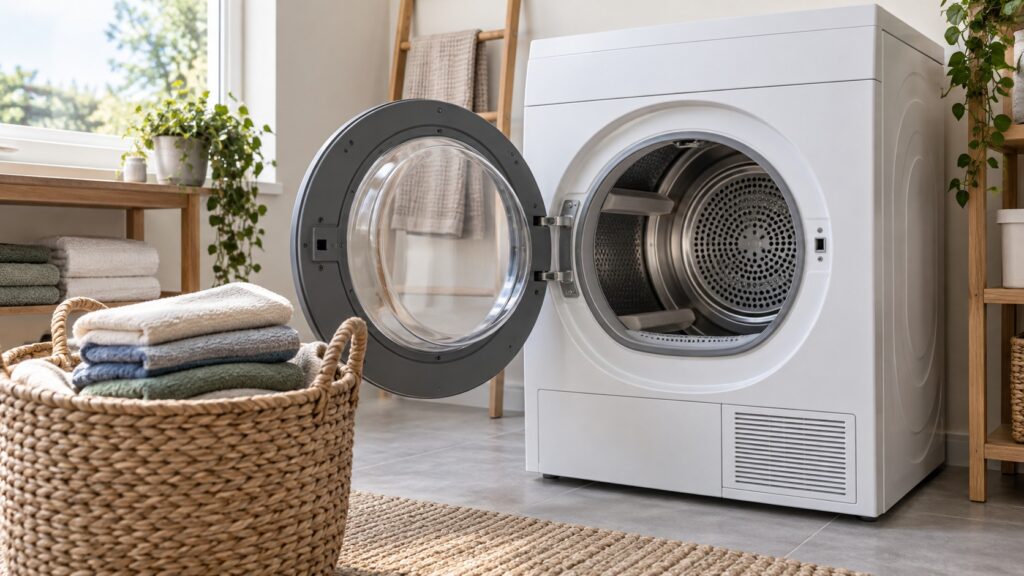
An Asko heat pump dryer runs longer cycles than a conventional vented dryer by design, but a handful of loading and program habits make a real difference between a cycle that finishes in a reasonable time and one that seems to run forever. The heat pump system recovers and reuses heat rather than exhausting it outside, which is more energy-efficient but also more sensitive to how the drum is loaded and which program is selected.
Why does my Asko heat pump dryer take longer than my old dryer?
A heat pump dryer works by pulling moisture out of the warm air inside the drum and condensing it, then reheating that same air and recirculating it, rather than heating fresh air once and exhausting it outside like a vented dryer does. That closed-loop process is what makes a heat pump dryer more efficient, but it also means the air doing the drying work is moving through more steps each cycle, and heavily loaded or poorly sorted laundry slows that process down more noticeably than it would in a vented system. Our dryer cycle duration guide covers the mechanics behind why cycles run as long as they do even under normal conditions.
None of that means a long cycle is unavoidable. The habits below target the specific points in the process where loading and program choice have the most influence.
How full should I load an Asko heat pump dryer for a normal cycle time?
Roughly three-quarters of drum capacity is the practical target for most loads. A heat pump dryer depends on air circulating freely around and through the load to pick up moisture efficiently; pack the drum to its visual limit and that airflow drops substantially, which extends drying time by more than the modest increase in laundry volume would suggest. It is a common instinct to maximize each load to save on total cycles run per week, but on a heat pump system that trade-off backfires — two properly loaded cycles often finish faster in combined time than one overstuffed cycle.
The opposite extreme also costs time in a different way: a very small load has less thermal mass to help transfer heat evenly, and some auto-dry sensing works less precisely on a handful of items than on a properly sized load. A consistent three-quarters fill is the sweet spot for both speed and sensor accuracy.

Does sorting laundry by fabric weight actually shorten the cycle?
Yes, and it is one of the simplest habits with the biggest effect. A mixed load of heavy items — towels, jeans, bathrobes — and lightweight items — dress shirts, synthetics, underwear — dries unevenly because the heavy items hold moisture far longer than the light ones. On a sensor-controlled auto-dry program, the cycle runs until the dryer’s moisture sensor confirms the whole load has reached the target dryness, which in a mixed load means running until the heaviest items finish, well after the lightweight items were already dry and simply tumbling in hot air for no benefit.
Separating loads by weight lets each run its own appropriately sized cycle: a light load on a shorter auto-dry setting, a heavy load on a setting suited to that fabric type. The two separate cycles combined often take less total time than one mixed load run long enough to satisfy the heaviest items in it.
Should I use auto-dry or a timed program for a faster cycle?
Auto-dry, for nearly every routine load. A sensor-based auto-dry program monitors the actual moisture level in the load and stops the cycle once it reaches the target dryness for the selected setting, rather than running a fixed duration regardless of how dry the laundry already is. A timed program is useful for specific situations — drying a single item to a precise, known duration, or a fabric type the sensor reads inconsistently — but for a normal mixed load of regular clothing, a timed program set longer than necessary “to be safe” wastes real time and energy compared to letting the sensor decide. Our cycle duration guide explains how the sensor-based timing actually works.
If an auto-dry cycle seems to consistently run far longer than expected even with a well-sorted, appropriately sized load, that is worth treating as a possible fault rather than normal behavior — see our guide on a dryer that takes too long and our guide specifically on a heat pump unit running unusually long cycles for what points at a maintenance issue rather than a loading habit.
Does the wash cycle before drying affect how long the dryer runs?
Significantly. Every bit of water removed mechanically during the spin cycle is water the dryer does not have to remove thermally, and mechanical extraction is far faster and more energy-efficient than thermal drying. Selecting a higher spin speed on the washer for loads going straight into the dryer — within what the fabric can tolerate — reduces the residual moisture the dryer starts with, which shortens the drying cycle that follows more reliably than any dryer-side setting. This matters most for towels and heavier cottons, which hold disproportionately more water at lower spin speeds than lighter fabrics do.
If cycle times remain unusually long after applying all of the habits above — proper load size, sorted by weight, auto-dry selected, and a reasonable spin speed beforehand — the cause has likely shifted from habits to maintenance. Our heat pump dryer evaporator care guide covers the cleaning routine that keeps the heat exchanger working at full efficiency, since a dirty evaporator slows every cycle regardless of how well the load is prepared.
We are an independent repair company, not a factory service arm, and if cycle times stay abnormally long after both good habits and routine evaporator care, book Asko dryer repair or schedule a visit and we will check the heat pump system itself.
Good loading and program habits address most cases of an asko heat pump dryer long cycles complaint before a service visit is ever needed.