Asko range hood terms describe how a hood moves air, cleans it and fits into a kitchen: ducted or recirculating, grease filter and carbon filter, capture area, boost, run-on and concealed or slide-out. They appear on spec sheets, in manuals and in service calls, and they are not always obvious from the words alone. This glossary explains each in plain English, and where a term depends on the model, it tells you to check the owner’s manual rather than guess.
What do ducted and recirculating mean on a range hood?
A ducted hood sends the air it draws in, with its grease, moisture and odors, outside the house through ductwork to an exterior wall or roof. A recirculating hood, sometimes called ductless, draws the air through a grease filter and a carbon filter and returns it to the kitchen. The ducted type is the more effective at clearing steam and smell, because the air actually leaves. A recirculating hood removes some odor, but a carbon filter does not remove moisture, so visible steam is not something it can clear.
Your model’s manual says whether the hood supports ducted operation, recirculating operation or both. Our guide on ducted versus recirculating hoods goes into the trade-offs.
What are grease filters and carbon filters?
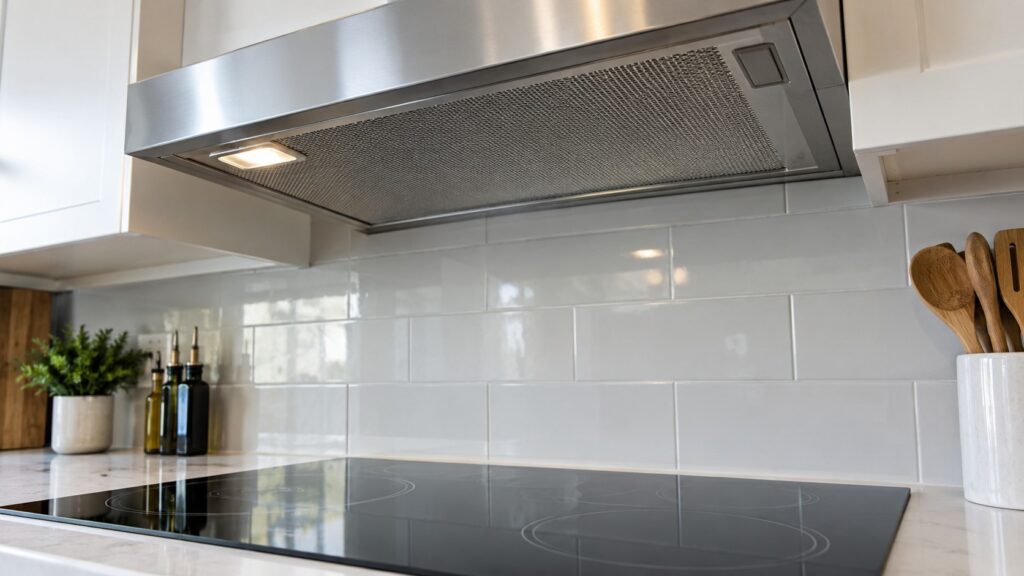
The grease filter is a metal mesh that traps grease before it reaches the fan and ducts. It does not need replacing in the usual way; it needs cleaning, and many metal filters can go through the dishwasher if the manual says so. A saturated grease filter lets less air through and, because grease burns, is a fire consideration as well as a performance one. Our guide to a grease filter cleaning schedule explains how to set a sensible interval.
The carbon filter, also called a charcoal filter, is used only in recirculating mode. It adsorbs odor molecules, and its capacity is finite, so once it is used up, washing does not restore it. It has to be replaced. Our guide on carbon filter replacement explains the signs and how to order the right one.
What do capture area, sizing and airflow mean?
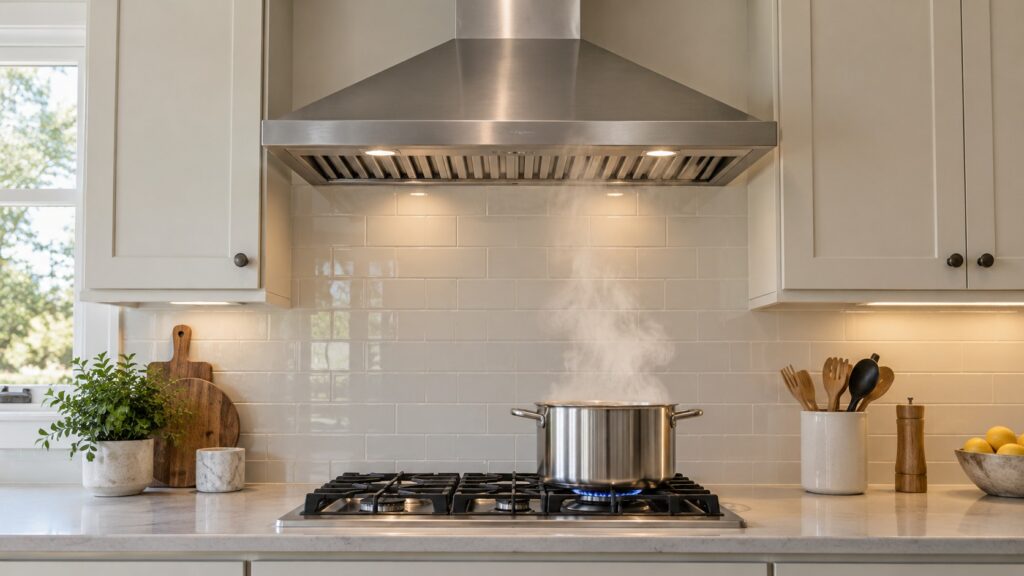
The capture area is the zone under and around the hood where it can intercept rising cooking vapor. A hood works best when the vapor stays inside that area, which is why a hood is usually matched in width to the cooktop beneath it and why cooking on the burners nearer the back helps. Airflow is how much air the hood can move, shown on a spec sheet as a figure for your model; check the figure and the unit on your own model’s sheet.
Sizing is the question of how much hood a particular kitchen needs. A powerful hood in a tightly sealed house may also need a source of replacement air to work as claimed. Our guide to range hood sizing sets out what to consider.
What do boost, speed and run-on mean?
The speed settings control how hard the fan works. Most cooking is handled well on the middle settings, and the highest setting is for searing and smoky cooking. Boost, where a model has it, is a short burst at high power, not a setting to leave on. Run-on, or a timer, keeps the fan going for a while after you switch off the cooktop so that the vapor that is still rising is captured. Whether your hood has these features, and how they are called, depends on the model.
Our article on range hood speed and timing tips explains how to use them. The short version is to switch on early, leave it running a while after cooking and keep the filters clean.
What are concealed, slide-out and wall-mounted hoods?
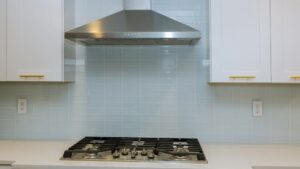
A wall-mounted hood is the familiar canopy fixed to the wall above the cooktop. A concealed hood is built into the cabinetry above the cooktop, and on many models part of it slides or tilts out when you switch it on, which increases the capture area, then retracts. A slide-out hood has an extra motor and a mechanism that a fixed hood does not have, so a hood can have a healthy fan and a sticking panel. Our guide to concealed slide-out hood mechanisms explains the parts and the common faults.
If a panel sticks, do not force it by hand and do not use grease or spray on the slides; ask for a visit.
When do range hood terms matter for repair?
They matter when you describe a fault. Saying that a ducted hood is not clearing steam points to filters, the duct or the fan, whereas saying that a recirculating hood is not clearing smell points to the carbon filter. Saying that a slide-out panel jams points to the mechanism rather than the motor. The more precise the description, the faster a technician can find the cause.
If you smell burning, see smoke, or find water or sparks near the controls, switch off the breaker at the panel while standing on a dry floor and do not use the hood. If grease on the cooktop ignites, cover the pan with a lid, switch off the heat, and do not turn on the hood or pour water. Our Asko range hood repair page explains how a visit works.