

An Asko dishwasher heating element warms the water during the wash and the final rinse, and that heat is what dissolves detergent, softens grease and leaves the dishes hot enough to dry themselves. The exact temperatures, and where the element sits, depend on the model and the program, and they belong to your owner’s manual rather than to a general guide. This article explains the idea so the manual and any fault symptoms make sense, and it explains what the element does not do.
What does the heating element do in a dishwasher?
A dishwasher fills with cool water from the house supply, and a heating element warms that water to the temperature a program calls for. The element sits low in the tub or beneath it, out of reach, and the control board switches it on and off to hold the target. The temperature is a part of the program. A light program will use less heat than an intensive one, and your manual shows how the programs on your model differ.
Programs that are advertised as saving energy often trade temperature for time, running a cooler wash for longer. That is a design choice, not a defect, and it is one reason why a result that looked perfect on an intensive program may look slightly different on an eco one.
Heat helps in two ways. It makes detergent dissolve and work more effectively, and it softens grease so that the water and the spray arms can carry it away. That is why a dishwasher that is not heating well shows up as cloudy glasses, greasy plates and detergent that has not dissolved.
Tablets and powders need warmth to dissolve fully, and a tablet that has left residue in the dispenser or on the door is a hint to check the water temperature the program is meant to reach. Our guide on the detergent dispenser latch covers a related cause, where the dispenser does not open at all.
How does the final rinse relate to drying?
Many Asko dishwashers dry mainly by condensation; your manual says how your model dries. The final rinse is hot on purpose, and its job is to leave the dishes carrying heat rather than to clean them. When the water drains, the hot dishes lose moisture to the cooler steel wall of the tub, where it condenses and runs away. There is no separate drying element on that design. Our guide on how Asko condensation drying works goes through it in detail, and the one on Turbo Combi Drying explains what the higher-tier models add.
This is why the heat of the final rinse matters for drying results. A cooler rinse leaves less heat in the load, and the dishes stay damp. It is also why opening the door early ends the process.
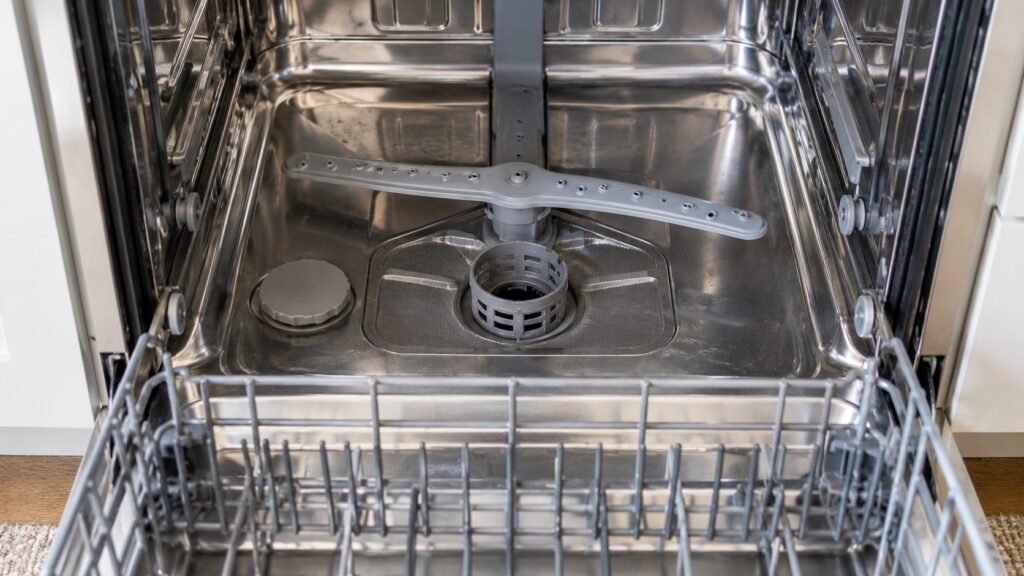
Why does water hardness and the softener matter for heating?
Hard water leaves mineral scale on whatever it heats. In a dishwasher that means the heating element and the tub, and scale reduces how well the element transfers heat, and it can leave a film on glass. Many European-style dishwashers include a built-in water softener that uses regenerating salt, and it is set to your local water hardness; your manual says whether your model has one. Our guides on salt and rinse aid and descaling explain the routine that protects the heating parts.
If your water is hard and you have never checked the softener setting or topped up salt, that is a better first step than suspecting the heater when the results are poor.
How can you tell the heating is not working?
The signs are indirect. Dishes come out cloudy or greasy, detergent is left in the dispenser or on the dishes, the load is cooler than usual when you open the door after the cycle, or the cycle takes noticeably longer than it used to. Some models show a message when the water does not reach temperature, and the message depends on the control platform. Our guide on Asko dishwasher error code families explains how to find the right table for yours.
Do not rely on a single cycle. A very cold incoming water supply, a very full load and an eco program can all lengthen the heating stage without any fault, so compare several cycles before you decide the heating has failed.
What should you check before calling?
Clean the filter, make sure the spray arms turn freely and the jets are clear, check that you are using detergent and rinse aid, and look at salt and the softener if your model has one. Our dishwasher filter cleaning guide covers the most common culprit. If the results are still poor, the water is not heating or a message points at the heater, stop there.
The element, its wiring and the thermostat or sensor are not owner parts. Do not try to reach them, and never run the dishwasher with the access panels off. If you see water in the base, smell something burning or notice sparks, switch off the breaker at the panel while standing on a dry floor, and shut the water valve. Our Asko dishwasher repair page explains how a visit works.