
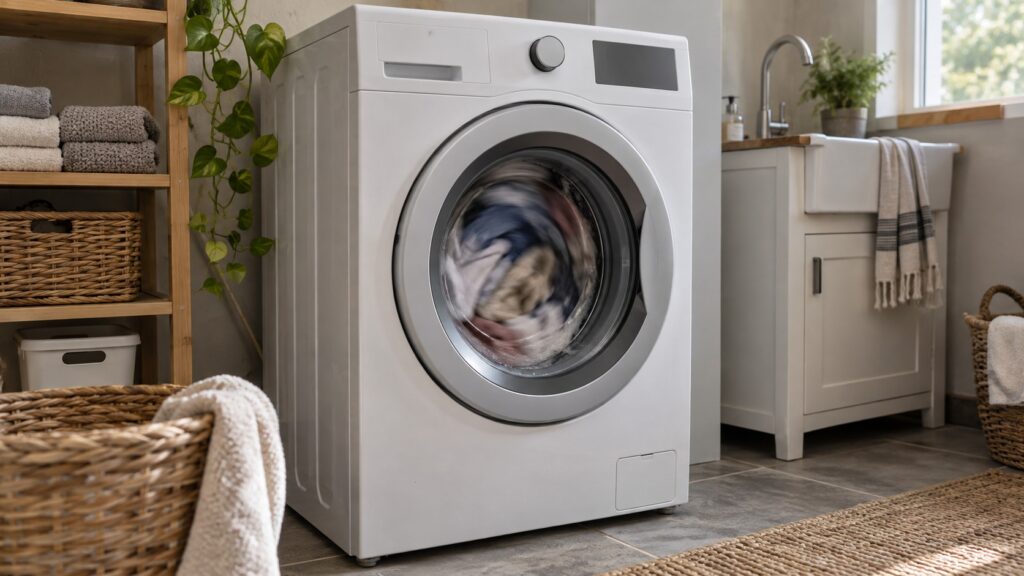
An Asko washing machine unbalanced warning is, most of the time, not a fault at all. It is the machine telling you it stopped the spin on purpose. The control watches how far the drum wanders as it accelerates, and if the load is bunched to one side it will slow down, tumble to redistribute, and try again. Only after several failed attempts does it give up and either end the cycle wet or raise a label. On a W6324 panel that label is L4 — and on a W6022 panel the same L4 means a water intake error instead, which is the single most expensive misreading on these machines.
What does an unbalanced warning mean on an Asko washer?
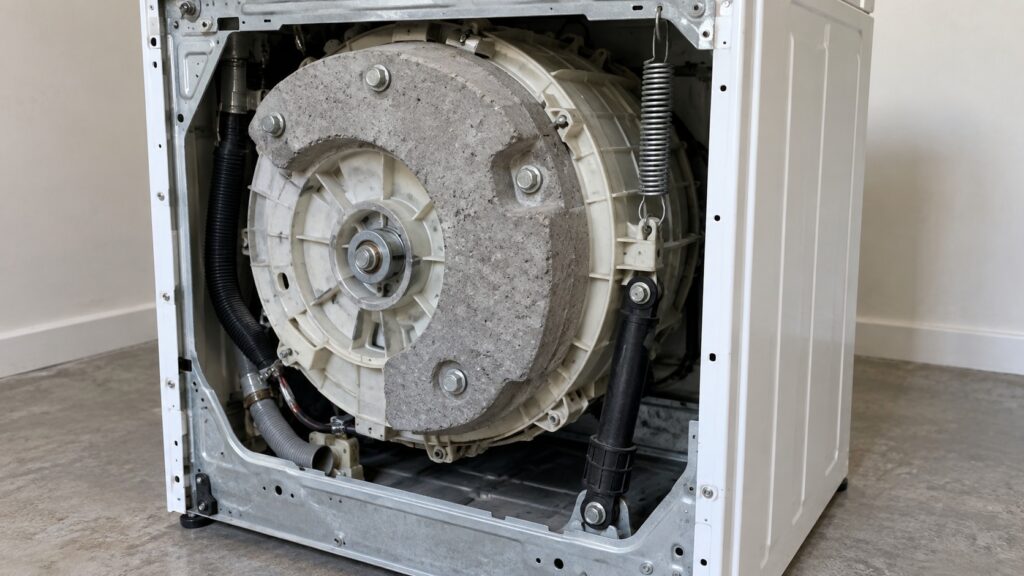
It means the drum could not be brought up to spin speed with the weight distributed evenly enough to be safe. A front-loading drum at full spin carries a large amount of energy, and an off-center load turns that into movement of the whole cabinet. The suspension — springs above, dampers below, and a heavy counterweight cast into the tub — absorbs a certain amount of it. The control’s job is to make sure it never has to absorb more.
Two load patterns cause nearly all of it. The first is one heavy item on its own: a bath mat, a single pair of jeans, a mattress protector. It cannot spread out, so it stays where it lands. The second is the opposite, a bulky item with light ones around it, where the bulky item soaks up water and the light ones do not. A duvet cover is the classic, because smaller items migrate inside it during the wash and the whole mass ends up in one place.
Neither is a machine problem, and both produce exactly the symptom people search for when they type asko washing machine unbalanced into a search box: a cycle that takes far longer than it should and ends with laundry too wet to fold.
Why does L4 mean two different things on two Asko panels?
Because the letter-number labels on these panels are positions in a list, not names for faults, and the list is different on different machines. On the W6324 panel, L4 is an imbalance notice that the documentation says needs no action. On the W6022 panel, L4 is a water intake error involving the inlet valve and its filter screen. The same is true further down the list: L1 is a door fault on one and an overflow problem on the other; L2 and L3 swap the drain and fill sides between the two panels.
The consequence is direct. If you read a generic code table and act on it, you can spend an afternoon on an inlet valve for a machine that was only telling you the towels were bunched. Confirm the panel before the code — the model number on the rating plate decides it, and our guide to Asko washer code families explains the five groups these labels fall into. The detail for this specific label is on our Asko washer L4 page.
Why does my Asko washer stop before the fast spin?
Because the redistribution attempts are built into the program and each one takes time. The machine fills slightly, tumbles at low speed to break up the load, drains, and tries again. Three or four of those cycles can add twenty minutes or more to a program, which is why an unbalanced load usually gets noticed as a cycle that will not end rather than as a spin that did not happen.
If it happens on every load rather than occasionally, stop thinking about laundry and look at the installation. A machine that is not level rocks under load, and rocking is read as imbalance. So is a machine standing on a floor that flexes, or one still carrying its transit bolts after a move — that last one is rare but unmistakable, because the machine will be violently loud from the first cycle.
Check the feet with a spirit level across the top, front to back and side to side, and confirm each foot is in firm contact with the floor rather than one corner hanging. Adjust, then lock the feet. This is the highest-yield check on the whole page and needs nothing but a wrench.
When is it the motor rather than the load?
E12 on the WM75/PMCU platform is a motor or motor control error: the drum drive is not responding as the control expects. It names three things — the drive motor, the motor control board, and the drive belt or coupling — and none of them are about how the laundry was arranged.
Tell it apart by what the drum does. An imbalance stop involves repeated attempts: you hear the machine speed up, slow down, tumble, and try again. A drive fault does not get that far. The drum either does not turn at all, or turns during the wash and refuses to accelerate at all for the spin, with no redistribution attempts in between. A burning smell, a squeal, or a drum that turns by hand with no resistance at all belongs to the same family.
Worn suspension sits between the two. Dampers lose their resistance gradually, and a machine that has started walking across the floor on loads it used to handle is reporting mechanical wear through the imbalance system rather than a loading mistake. Our guide to Asko washer construction covers what is carrying the drum and why these machines are built the way they are.
What can I do about an unbalanced load myself?
- Open the door and redistribute by hand. Pull everything away from the drum wall, shake out anything that has rolled into a rope, and restart on a spin-only program.
- Never wash one heavy item alone. Add two or three medium towels to give the drum something to balance against.
- Keep small and large items apart. Socks migrating inside a duvet cover create the exact mass distribution the control refuses to spin.
- Fill the drum properly. Both extremes cause this: a third-full drum is as prone to it as an overfilled one. Our guide to washer capacity and spin speed covers matching load size and speed.
- Level the machine and lock the feet. Then repeat one of the loads that failed, and see whether the behavior follows the machine or the laundry.
Stop there. The suspension springs and dampers are under load even with the machine idle, the counterweight is heavy enough to cause injury if it shifts, and reaching them means opening a cabinet that also contains mains wiring and the water circuit.
When does an imbalance problem need a technician?
Book service when a properly leveled machine fails to spin ordinary mixed loads, when the cabinet moves far enough to hit a wall or a neighboring cabinet, when you hear a knock or a heavy thud as the drum accelerates, or when E12 appears at all. A machine that has begun to walk is also wearing out its own hoses and its drain connection, so leaving it is not a neutral choice.
We are an independent repair company, not a factory service arm, and dampers, springs and drive components on these machines are serviceable parts. Book Asko washer repair or schedule a visit, and mention whether the machine is level and what was in the drum when it failed — with that, a technician arrives knowing whether to look at laundry habits or at the suspension.