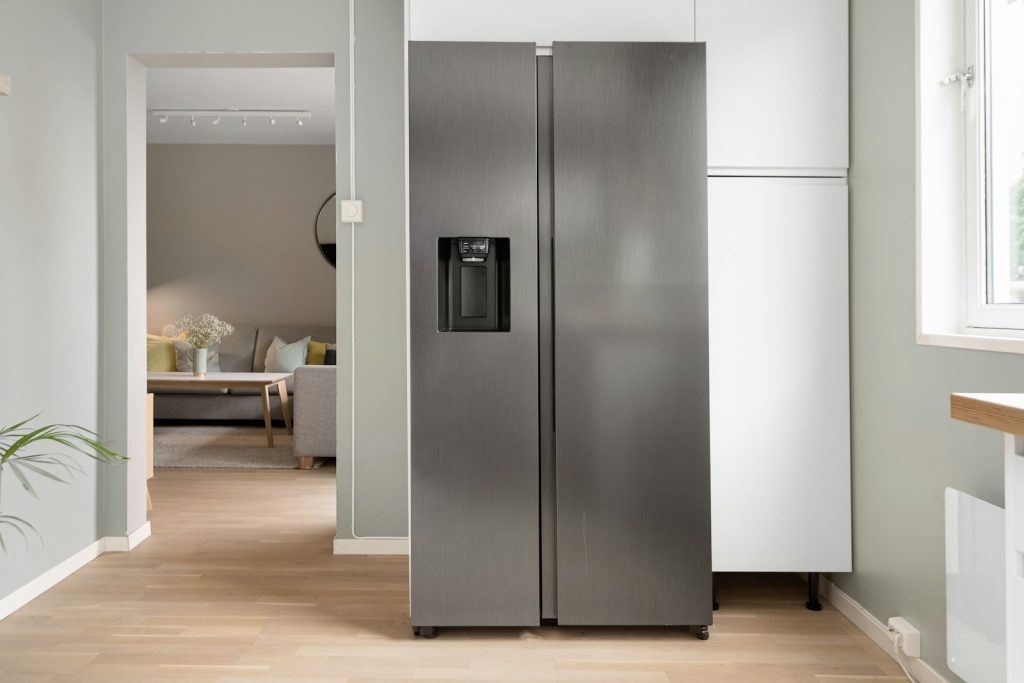
Anyone comparing Asko refrigeration models will notice the letter N showing up in model numbers such as RFN2826S, RWFN2826S, and RFN31831EI – and on Asko’s combined fridge-freezer nomenclature that N is understood to signal an asko no-frost refrigerator, meaning the cabinet manages defrost automatically rather than relying on the owner to do it by hand.
How the frost-free system actually works
Instead of an exposed cooling plate that ices over the way an older manual-defrost unit does, an asko no-frost refrigerator hides its evaporator coil behind an interior wall panel and uses a small fan to circulate cold air throughout the cabinet. Because the evaporator sits out of direct contact with humid cabinet air, frost collects there rather than on food packaging or shelving, and a heater cycles on automatically several times a day to melt that frost before it can build into a problem, sending the meltwater down the defrost drain.
What owners notice day to day
The practical upside is that shelves, drawers, and stored food stay free of the ice buildup that plagues older manual-defrost designs, and there is no need to periodically empty the cabinet and let it thaw. The system runs invisibly in the background, which is exactly the point of an asko no-frost refrigerator – it should require no owner intervention under normal conditions.
Where the system can develop problems
Because the whole design depends on a working fan, a working defrost heater, and a clear drain path, a problem in any one of those three parts undermines the “no frost” promise. A failed defrost heater lets frost accumulate on the hidden evaporator until it eventually restricts airflow and the cabinet starts running warm. A stalled circulation fan stops cold air reaching the far corners of the cabinet, producing uneven cooling even if the compressor itself is healthy. And a blocked defrost drain, covered in our separate guide, lets meltwater back up into the cabinet instead of draining away.
Distinguishing a frost-free problem from a compressor failure
Frost appearing on the rear interior wall, rather than on food or shelves, is the telltale sign that something in the no-frost circulation has failed rather than the compressor or sealed system – a genuinely failing compressor tends to produce a uniformly warm cabinet with no localised frost at all. That distinction is useful to describe accurately when you call for service, since it points a technician toward the fan-and-heater assembly rather than the sealed system from the start.
Comparing an asko no-frost refrigerator against an older manual-defrost design
Owners who have previously used an older manual-defrost appliance sometimes wonder whether an asko no-frost refrigerator is worth the added mechanical complexity of a fan and heater assembly compared with a simpler exposed-coil design. In practice, the trade-off favors No-Frost for nearly every household: the convenience of never manually defrosting outweighs the small added complexity, and the parts involved – fan, heater, drain – are individually inexpensive and well understood by technicians, so the added complexity does not translate into meaningfully higher repair costs over the appliance’s life. The one genuine downside is that a problem in the frost-management system can be less obvious at first than a manual-defrost unit simply icing over visibly, which is why understanding the rear-wall-frost symptom pattern described in our related guide is worth knowing before a small problem grows into a larger one.
How long the frost-free system typically lasts before needing service
The fan, heater, and drain components that make an Asko refrigerator frost-free are mechanical and electrical parts with their own service life, and while there is no fixed replacement schedule published for them, owners generally see their first fan or heater-related service need somewhere in the appliance’s second decade of use rather than in the first few years, assuming normal household use and the routine drain maintenance described in our other guides. A unit that develops a frost-management problem unusually early – within the first few years – is worth having checked for an installation-related cause, such as a wiring issue introduced during setup, rather than assuming it is simply normal wear arriving ahead of schedule.
Servicing a No-Frost Asko fridge
Because there is no published error-code system for Asko refrigeration, diagnosing an asko no-frost refrigerator relies on exactly this kind of symptom pattern rather than a code lookup. Our experienced, independent technicians are familiar with the fan, heater, and drain layout across Asko’s RFN-prefixed models. See our guide on the defrost drain, browse model reference pages for your specific SKU, or schedule a visit at /schedule/. Asko’s own product information is published at global.asko.com.