
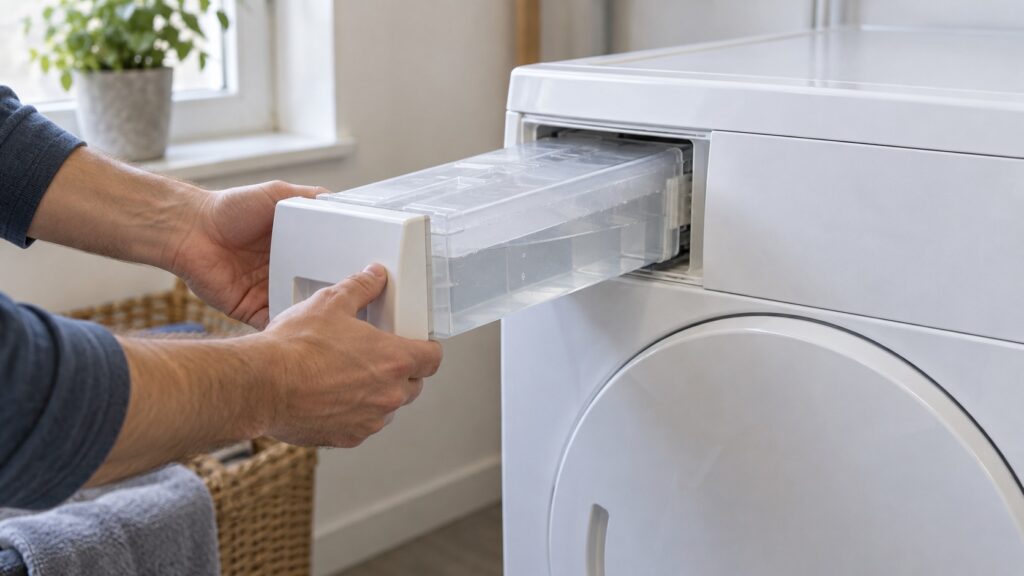
An Asko dryer water tank full warning is one symptom with four different names, and which name you see depends entirely on which control platform is in the machine. The condensate tank is monitored by a single float microswitch. When that switch opens, the TD70.1 Type A panel shows L4, the TD70.1 Type B panel shows F10, the TD70.2 and TD70.3 panels show S1, and the T411VD steam and heat-pump platform does not use this family of labels at all — its closest relative, ERROR_3, is a condensate pump failure rather than a full tank. Reading the label without knowing the panel is how owners end up replacing the wrong part.
Why does my Asko dryer say the tank is full when I just emptied it?
Because the machine is not measuring the water. It is reading one microswitch that a float pushes when the level rises, and it has no way to tell the difference between a tank that is genuinely full and a switch that is stuck, wet, or no longer making contact. A tank you emptied ten minutes ago that still reports full is therefore a switch story, not a water story.
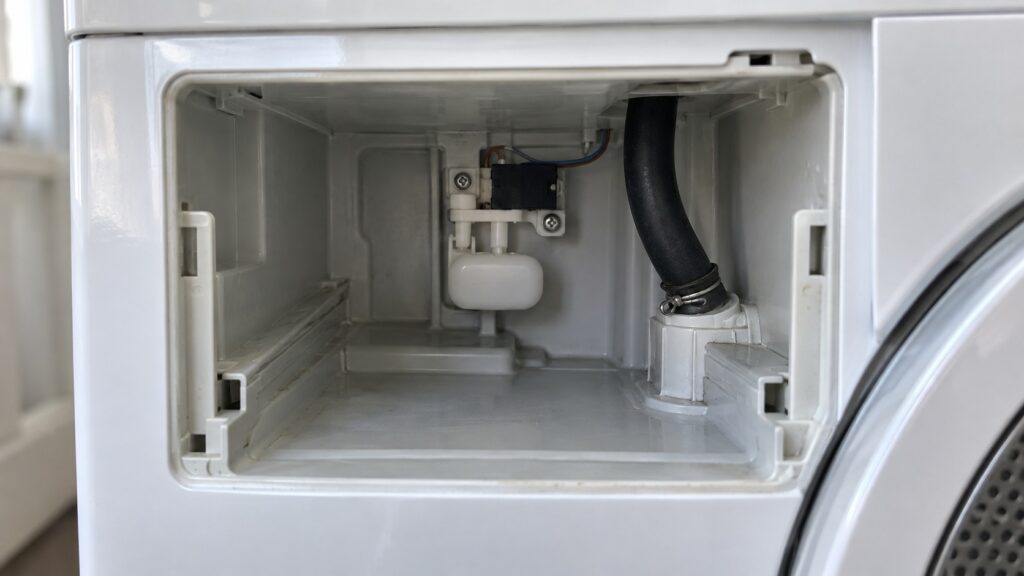
Three things produce that reading on a tank you know is empty. The tank may not be seated all the way home, so the float arm never returns to its rest position. Lint carried over from a torn filter screen can hold the float partway up. And the switch itself can fail, usually after years of condensation sitting around it, which is exactly the environment it lives in.
There is a fourth case worth separating out. On machines plumbed to a household drain, the tank stops being the destination for condensate at all, and a full-tank code on a plumbed dryer points at the drain hose run rather than at the tank: a hose lifted too high, kinked behind the cabinet, or pushed into a standpipe far enough to siphon.
Which code means a full tank on my Asko dryer?
All of L4, F10 and S1 do, on different panels. They are not a sequence and they do not appear together; each belongs to one generation of control. That is the single most useful thing to know before searching a bare code, because a table written for one panel will give you a confident and wrong answer for another.
The way to settle it is to identify the platform first and read the code second. Our guide to Asko dryer platform identification walks through telling TD70, T411VD and the analog T208V family apart, and the model and Art. No. fields on the rating plate are what decide it. The detail pages for each label — for instance our Asko dryer S1 page — list the affected components for that platform specifically.
What does ERROR_3 mean on a T411VD Asko dryer?
ERROR_3 on the T411VD steam and heat-pump platform is a pump failure: the condensate pump that lifts water from the sump up into the tank is not doing it. The symptom an owner notices is usually the opposite of a full tank — the tank stays dry while the cycle behaves badly, or water appears where it should not.
It belongs in this guide because owners reach it by the same route. You open the tank expecting water, find none, and conclude the machine is not producing condensate, when in fact it is producing condensate and failing to move it. The parts listed for ERROR_3 are the pump, its wiring, and the drain path, and none of them are owner-accessible on this platform.
Why does the water tank fill faster than it used to?
A tank that needs emptying more than once in a single cycle is worth treating as its own symptom rather than as a busy laundry week. On a condenser or heat-pump dryer the volume of water collected is roughly the volume of water that left the laundry, so a sudden increase usually means the loads changed — a switch to heavier fabrics, or clothes going in wetter because the washer’s final spin has weakened.
When the loads have not changed, look at the condenser. A partly blocked condenser makes the machine run longer and cycle more air through the same water-bearing path, and a cold room will condense more of it. Our guides to the Asko dryer condenser filter and the every-load lint routine cover both of the filters involved, and a dryer that has been running long cycles with a saturated condenser is also the one most likely to trip the 200-minute codes in the table above.
What can I check myself before calling?
- Empty the tank fully and reseat it. Push it home until it stops. A tank left even a fraction of an inch proud is the most common cause of a code on an empty tank.
- Look into the tank recess with a flashlight. The float and its switch sit at the back of that space. Lint packed around the float holds it up mechanically.
- Rinse the tank and let it drain. Fine lint turns to a paste that coats the float arm and slows its return.
- If the dryer is plumbed to a drain, follow the hose. Check for kinks behind the cabinet and confirm the hose is not pushed deeper into the standpipe than the installation allows.
- Note whether the code appears at the start or at the end of a cycle. At the start it is almost always the switch or the seating; partway through a cycle it is more likely to be a genuine full tank on a long program.
Stop before removing panels. The condensate pump, the sump and the switch harness sit inside the cabinet alongside mains wiring and, on heat-pump models, a sealed refrigerant circuit that must not be opened outside a workshop.
When does a tank code need a technician?
Book service when the code survives a reseated, empty, clean tank; when it appears on a machine plumbed to a drain with a clear hose run; or when the tank stays dry through a full cycle, which is the ERROR_3 picture rather than the full-tank one. An intermittent code that clears for a week and comes back is the same conversation — microswitches fail slowly.
We are an independent repair company, not a factory service arm, and a tank microswitch is a small part with a short visit attached, so it is worth diagnosing rather than living with. Book Asko dryer repair or schedule a visit with the panel type, the exact label on the display and the model and Art. No. from the rating plate to hand.