
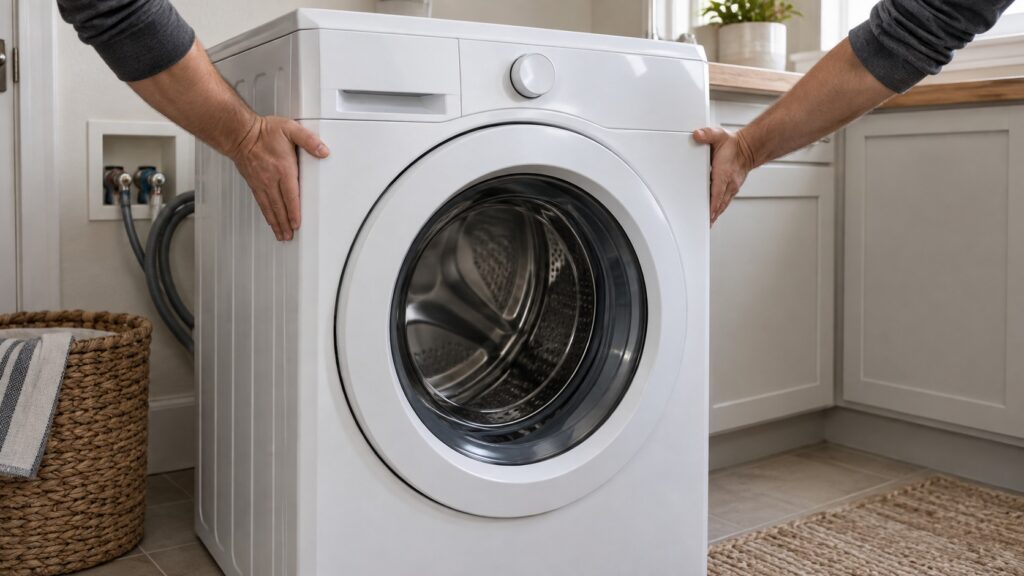
An Asko washer installation has five parts that must be done in the right order: pick a firm floor, remove the transit bolts, connect the water hoses, secure the drain hose, and level the machine on its feet before the first cycle. The front-load washers sold in the US, from the W2084 and W3 up to the W4114, W5 and W7 models, are heavy, spin at up to 1400 rpm and carry a transport lock on the drum. Skipping the transit bolts or the leveling is the most common reason a new Asko washer shakes, bangs or throws an unbalance warning on its first spin.
What should you check before the washer goes in?
Look at the floor first. A washer spinning a wet load at 1400 rpm puts a lot of force into the floor, and a bouncy floor will make even a perfectly leveled washer shake. A concrete slab or a well-supported subfloor is best, and an upstairs laundry room is worth stiffening if the floor flexes. Do not install a washer on carpet, since the pile blocks the airflow underneath and lets the machine settle unevenly. Check the doorway, the stairs and the final spot, and leave a few inches behind the machine so the hoses can curve without kinking.
Read the rating plate, which lists the model, the serial number and the article number. Our Asko rating plate guide shows where to find it and why you want it saved. Take a photo of it before the washer goes into a tight spot, because the plate sits above the door opening and is easy to hide once installed.
Why do you have to remove the transit bolts?
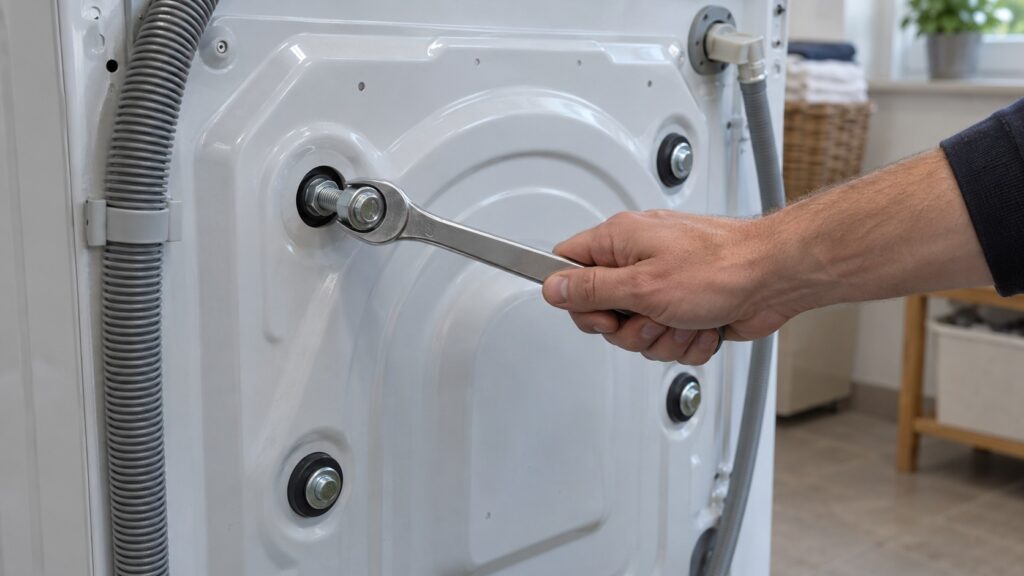
A front-load washer is shipped with its drum locked so it cannot swing and be damaged in transit. The lock is usually a set of transit bolts or braces at the rear, and each one must come out before the washer is used. Run a washer with the bolts in and the drum cannot move on its suspension, so the machine will shake violently, make a loud noise and can damage the bearings and the suspension. Follow the manual for the exact count and location on your model, remove every one, fit the plastic caps if they are supplied and store the bolts together.
Keep those bolts. When you move house, they go back in before the washer is lifted or transported. Our guide to Asko Quattro Construction explains the suspension that the bolts protect.
How do you connect the water and drain?
Use the hoses supplied with the machine, and connect each to its tap as the manual describes. Fit them hand-tight, make sure the small filter screen is in place where the hose meets the washer, and open the taps slowly. Check each joint with a dry paper towel and look again after the first fill, because a small weep will rot a floor if no one sees it. Do not kink or crush the hoses when the machine is pushed back, and replace any hose that is swollen or cracked.
The drain hose has to be secured so that it cannot slip out and cannot siphon. Hook it over a standpipe or into a laundry tub at the height your manual gives, and do not push it so deep that it seals the standpipe. A kinked or low drain hose can leave water in the machine or send it back into the drum. If the washer drains slowly later, start with the drain filter cleaning guide.
How do you level the washer?
Place a bubble level on top and check front to back and side to side. Turn the threaded feet one at a time until the machine is level, then push down on each top corner. If it rocks diagonally, one foot is light. When the machine sits solid, tighten the lock nuts on the feet so the vibration of future spins cannot turn them. This single step does more to quiet the washer than anything else, and it should be repeated after the machine is moved or the floor settles.
A level washer on a firm floor will still thump if the load is unbalanced, for example a single heavy towel. For that, our guide to unbalanced spin explains what the machine is doing. If you plan to put a dryer on top, the stacking rules are separate: see Asko washer and dryer stacking.
What should you do on the first cycle?
Plug the washer straight into a grounded outlet, not an extension cord. Run the first cycle empty, with a small amount of detergent made for front-load washers, and stay nearby. Watch both taps and hose ends for the first few minutes, listen to the fill and the drain, and stand by for the first high-speed spin to check for walking or banging. Look under and behind the machine when it finishes. Any wet spot or bang means stop and recheck, not carry on.
If something is wrong that you cannot fix, Asko washer repair can check the inlet valves, the pump and the suspension, and our program tips can help once it runs well.