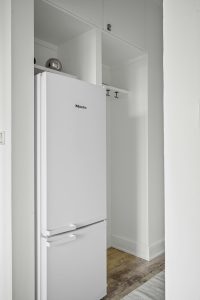
Models like the RFN2826S and RWFN2826S are an asko combined fridge-freezer – a single appliance body split into a fresh-food compartment held near 37 to 40 degrees Fahrenheit and a freezer compartment held at 0 degrees Fahrenheit or below, both served by one compressor and one refrigerant circuit rather than two independent cooling systems.
How one compressor serves two temperatures
The compressor circulates refrigerant through separate evaporator sections tuned for each compartment’s target temperature, and a system of dampers and fans directs cold air between the two zones in a controlled ratio. This is more efficient than running two separate compressors, but it also means the two compartments are not fully independent of each other the way they would be in two standalone appliances.
Why one side can affect the other
Because an asko combined fridge-freezer shares a single refrigerant circuit, a problem that affects airflow distribution – a stuck or misaligned damper, for instance – can cause one compartment to run too cold while the other runs too warm at the same time, since the total cooling capacity is being split unevenly rather than lost outright. This “fridge warm, freezer fine” or “freezer warm, fridge fine” pattern is a useful clue that points toward the air-distribution damper rather than the compressor itself.
What a genuine compressor or sealed-system problem looks like instead
By contrast, a real compressor or sealed-system failure tends to affect both compartments together, since the whole shared circuit has lost its cooling capacity rather than just having it misdirected. If both the fresh-food and freezer sides are running warm simultaneously, that points toward the compressor or refrigerant circuit rather than the internal air-distribution system, and any refrigerant-related repair requires a technician certified under EPA Section 608.
Servicing the two compartments together
Because the two compartments share a common system, a technician diagnosing an asko combined fridge-freezer checks both sides together rather than treating a symptom in one compartment as unrelated to the other. Door seal condition, temperature settings, and airflow checks are run on each compartment individually, but the underlying compressor and refrigerant diagnosis considers the unit as one connected system.
Real asko combined fridge-freezer models worth knowing
Beyond the RFN2826S and RWFN2826S already mentioned, Asko’s combined fridge-freezer lineup includes models such as the RBC576DNC1, a built-in integrated combo, and freestanding combo variants like the RFC586KNBS1 and RFC2867KNBS1 across different series generations. All of these share the same fundamental single-compressor, shared-refrigerant-circuit design described above regardless of whether they are built-in or freestanding, or which series generation they belong to – the underlying engineering principle stays constant even as cabinet size, finish, and energy class vary between individual SKUs.
What to check first on an asko combined fridge-freezer showing uneven temperatures
Start by confirming both compartments’ individual temperature settings are actually correct before assuming a damper or compressor failure, since a setting accidentally changed on just one side is a simple, common cause that mimics a more serious shared-system problem. Next, check that nothing is blocking the internal air passage between the two compartments, since food or packaging pushed against the connecting vent can restrict the shared airflow an asko combined fridge-freezer depends on just as effectively as a mechanical damper problem would.
How the two compartments are typically arranged
Most combined units place the fresh-food compartment above the freezer section, though some configurations reverse this layout depending on the specific model and series. The arrangement does not change how the shared compressor and damper system works internally, but it is worth knowing which compartment sits where on your specific unit before describing a symptom to a technician, since “the bottom section” means something different depending on the model.
Energy class ratings across combined units
Asko’s European combined fridge-freezer lineup is rated on the EU energy class scale, ranging from roughly class B to class D across the SKUs documented in Asko’s own regional catalogs, with the lower-lettered classes representing more efficient units. This rating system does not translate directly to US Energy Star labeling, so comparing a European energy class figure against a domestic appliance’s rating is not a like-for-like comparison.
Getting a combined unit serviced
If your combined fridge-freezer is showing an uneven pattern between the two sides, our experienced, independent technicians know how to trace whether the cause sits in the shared compressor or in a single compartment’s local airflow. See our guide on rear wall frost for a related symptom, browse model reference pages to confirm your exact SKU, or book a visit at /schedule/. Asko’s own combined refrigeration lineup is documented at global.asko.com.