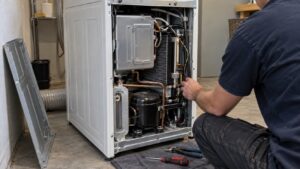
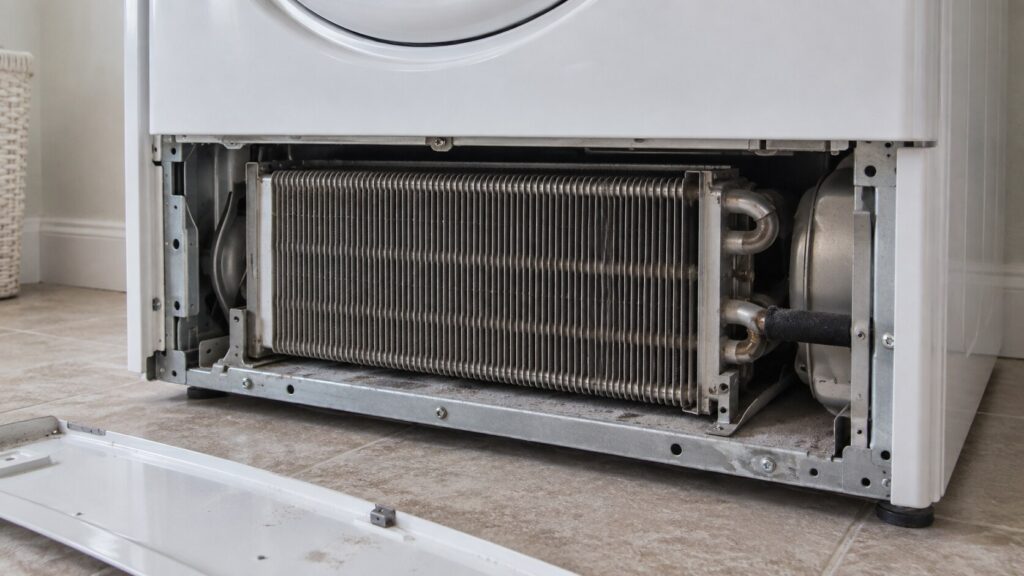
An Asko heat pump dryer has a component no vented or condenser dryer has: an evaporator, a dense block of fins sitting in the air path. Everything the drum releases passes through it, and everything the lint filters miss ends up on it. Keeping that block clear is the difference between a machine that holds its cycle time for a decade and one that creeps from ninety minutes to three hours and gets blamed for failing.
Why the evaporator collects what it collects
A heat pump dryer moves the same air around a closed loop. The loop passes hot, wet air from the drum across a cold surface, condenses the moisture out of it, reheats the now-dry air and sends it back. The cold surface is the evaporator, and it works precisely because it has a large surface area — dozens of thin aluminum fins packed close together.
That geometry is also a superb filter. Fine lint that slips past the door filter arrives on a wet, cold surface and sticks. Over months it builds into a felt mat across the face of the block. Air still passes, so nothing fails; it just passes less freely, and every cycle takes a little longer than the last.
The two filters, and why one is not enough
The door filter catches the visible lint. Clean it after every load — not every few loads. A partly loaded filter does not stop the machine; it lets fine lint through to the evaporator, which is exactly what you are trying to prevent. Our lint filter routine covers the habit.
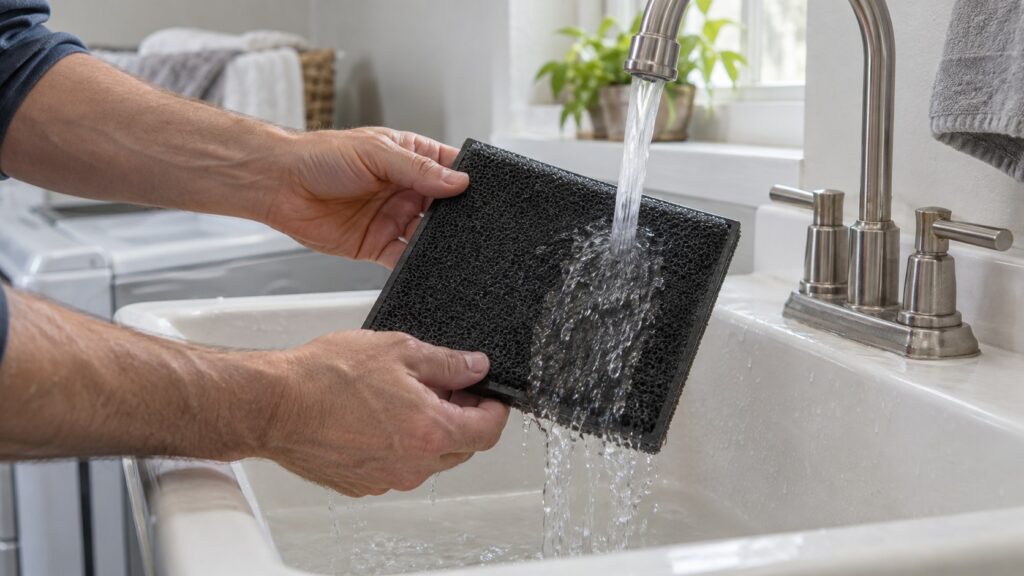
The secondary filter, behind the base panel on most models, is the last defense. It needs rinsing under a tap, and then it needs to be completely dry before it goes back — a damp foam element pressed back into place is a mold source and restricts air on its own. Our guide on the condenser filter goes through the access.
Together they are why a well-kept heat pump dryer rarely needs anyone near the evaporator. Neglect either and the evaporator does their job instead.
Inspecting the fins without damaging them
Open the base panel with the machine unplugged and look at the face of the block. Clean fins look like a comb: you can see between them. A machine that needs attention looks felted, gray and continuous.
If there is a visible mat, lift it off gently — fingers, or a soft brush used along the fins rather than across them. A vacuum held near the face, not pressed against it, removes what is loose. That is the whole of the user-serviceable part.
What not to do matters more than what to do:
- never poke between fins with anything rigid; a bent fin closes the channel behind it for good;
- never use water under pressure, and never a household cleaner — both drive lint deeper and can carry it into the sealed system’s airflow;
- never run the dryer with the base panel off to “see it working”; the loop only works sealed.
Deep cleaning of a felted block is a technician’s job and takes specialist tools. It is also a much shorter visit than the repair people usually call about by the time they get there.
Reading cycle time as a maintenance signal
Cycle time on a heat pump dryer is the best diagnostic you have, and it is free. Note roughly how long a familiar load takes when the machine is new. The same load, the same program, the same room — that becomes your baseline.
Our guide on what decides cycle duration covers the normal variation before you start suspecting anything.
What a neglected evaporator actually costs
None of this is about tidiness. A restricted evaporator changes the physics of the loop: less air across the cold face means less moisture condensed per minute, so the machine runs longer to reach the same dryness. Running longer means the compressor runs longer, and a compressor is the one part on this machine whose replacement is usually weighed against a new appliance.
There is a second cost that shows up in the laundry rather than the bill. A dryer fighting for airflow holds damp air in the drum for longer, and loads start to come out smelling stale even though they are dry. People change detergent, then the machine, when what was needed was a filter and ten minutes.
The room, which is part of the machine
A heat pump dryer rejects heat into the room it stands in. In a laundry closet with the door closed, it slowly raises the temperature of its own intake air until the cycle stretches. Nothing is faulty. Leave the door open, or provide a vent, and the same load finishes on time.
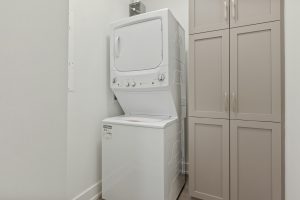
The same logic applies to stacking. If a dryer is stacked over a washer in a tight alcove, check the clearances in our stacking guide — the appliance needs air around it, not just in front of it.
When to call
Call when cycle times stay long after both filters are clean, when the clothes come out cool at the end, when the machine reports repeated faults, when water appears under it, or when the evaporator face is felted and you would rather not work near it.
We are an independent repair company and not a factory service arm. Pricing starts from a diagnostic visit and we confirm the estimate before any work begins. Asko dryer repair covers heat pumps, fans, sensors, pumps and controls, and you can schedule a visit online.