
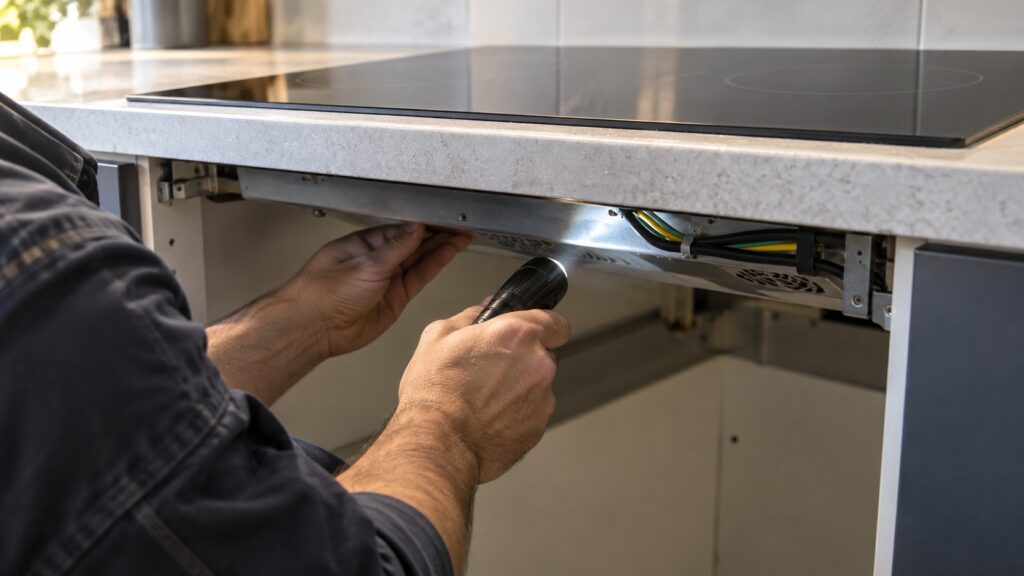
An Asko induction cooktop repair or replace decision depends first on which part has failed. A code that points to airflow or ambient heat is usually a no-cost fix, a failed cooling fan or a single zone is often a reasonable repair, and a defective generator or a cracked glass surface is where replacement starts to be worth pricing. Age matters, but the diagnosis matters more, so read the exact code before you decide anything.
Which Asko induction cooktop faults are cheap to fix?
The cheapest faults are the ones that are not faults at all. FA on the F-series induction family is an airflow protection, and the manual’s stated fix is to make sure the venting holes under the cooking plate are open. Items stored in a drawer directly beneath the cooktop are a common cause, and clearing the space and resetting the code often ends the problem. Our page on Asko cooktop FA describes it.
FC and F0 to F6 belong to one group in the manual, with a shared cause: the ambient temperature is not good. The published fix is to switch off all heat sources near the cooking plate. A hot oven directly below, or a pot boiling dry at the edge, can raise the temperature enough to trip the protection. Let the cooktop cool and see whether the code returns. A code that never comes back was a protection doing its job, and no repair is needed.
Which faults usually justify a repair?
A single zone that will not heat while the others work usually points to a coil, a connection or the part of the electronics that drives that zone, not to the whole cooktop. A cooling fan that is noisy or stalled can be replaced, and replacing it can prevent the overheating protections from tripping. A touch panel that has stopped responding on a cooktop that is otherwise sound may be repairable, though the control board has to be matched to the model.
In each of these cases the rest of the cooktop is intact, and the glass, the frame and the other zones have years left. Our guide to Asko induction fault code families helps you see which group a code belongs to, and our FA, FC and FAN guide goes into each.
When does a defective generator change the decision?
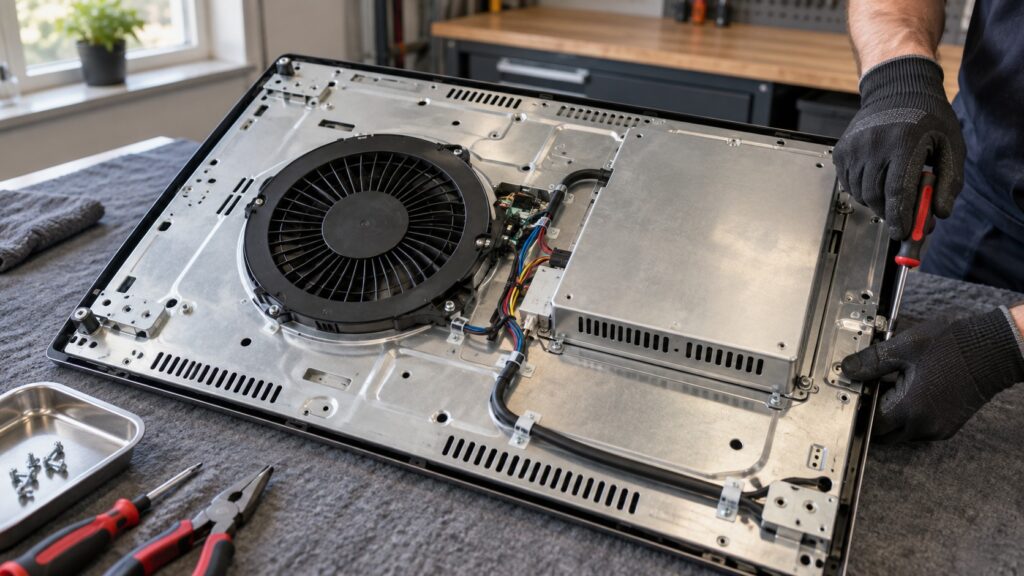
FAN shares the cause of F00 on this family: a defective generator. The manual directs you to the service department and offers no reset or cleared vent that resolves it. The generator is the electronics that drive the coils, and it is the most significant part of an induction cooktop. Repair is sometimes possible, but the cost of the part, the labor and the age of the cooktop all enter the decision.
Despite the name, FAN is not automatically the cooling fan. Treat it as a generator-level fault that needs a proper diagnosis before you spend anything. If a technician confirms the generator, ask for a quote for the repair and compare it with a comparable new cooktop. A part swap is usually far cheaper than a new unit, but a generator on an older cooktop with other wear may tip the balance toward replacing.
What about a cracked glass surface?
Stop using the cooktop at once. A crack in the glass lets liquids reach the electronics beneath and can create an electrical hazard. Switch the cooktop off at the breaker and do not cook on it. Depending on the model, a technician may be able to replace the glass top, but on many cooktops the glass, the coils and the frame are a single assembly, which makes replacement of the whole unit the more realistic route.
If you are replacing it, the opening matters. A replacement must fit the existing cutout, or you will need countertop work. Our guide to Asko cooktop cutout and clearances explains the dimensions and clearances to check. A cooktop from another brand with a different size may mean widening the opening, so measure before you shop.
How do you decide, step by step?
Write down the model number, the exact code, the cooktop’s age and when the problem began. Check the cheap causes first: the space under the cooktop, the heat nearby and the control lock. If the code persists, get a diagnosis. Then compare the repair quote with a new cooktop, and weigh in the age of the cooktop and whether anything else is failing. Our general guide to the Asko repair or replace decision offers a framework for any appliance.
As a rule of thumb, repair when the fault is a single part on a sound cooktop, and replace when a major part fails on an old unit or the glass is broken. Our Asko cooktop repair page explains the visit.
One last point on timing: do not wait on a cooktop that is behaving strangely. A zone that cuts out mid-cooking, a code that returns every evening or a panel that responds only when it feels like it can get worse, and a small repair today is easier to justify than a large one after the electronics have been stressed for months. Keep a short note of when each symptom appears, because that history helps the diagnosis and the decision.