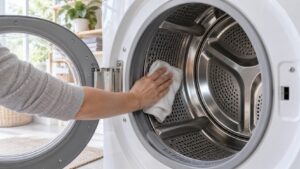
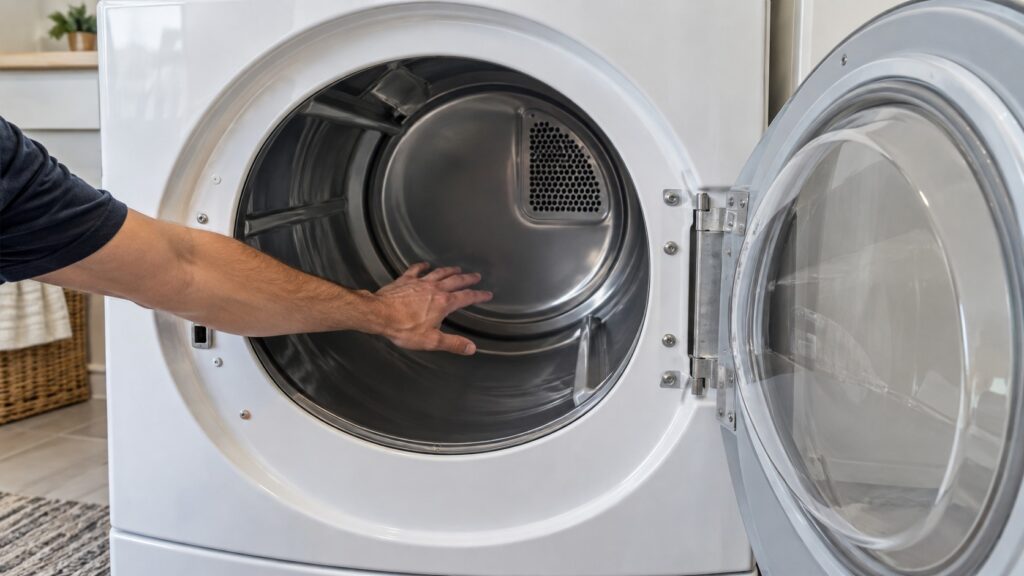
Asko dryer thermal protection is the usual reason a dryer that tumbles keeps coming out cold. The drum turns, the load stays damp and no error appears, because the dryer has limited its own heat after sensing something wrong, most often a restricted filter, a blocked vent or heat that cannot escape. Clear the airflow first, then think about the heating parts. Our symptom page on an Asko dryer not heating explains why this complaint is not tied to one code.
Why does an Asko dryer tumble but not heat?
Because the motor and the heater are separate circuits. The drum turns whenever the motor runs, but the heat comes from its own part and is governed by its own sensors and safety devices. If the dryer senses that air is not moving freely or that parts are getting too hot, it limits the heat and keeps tumbling. To the owner the result looks like a dryer that works but does not dry: clothes come out cold, a cycle that used to take an hour runs much longer and nothing flashes on the display.
The cause also depends on which Asko dryer you own. The page for this symptom explains that the complaint can occur on the TD70 platform, the T411VD platform or an older analog T208V dryer that has no codes at all. If you are not sure which you have, our guide to Asko dryer platform identification shows how to tell from the rating plate and the panel.
What airflow problems trigger thermal protection?
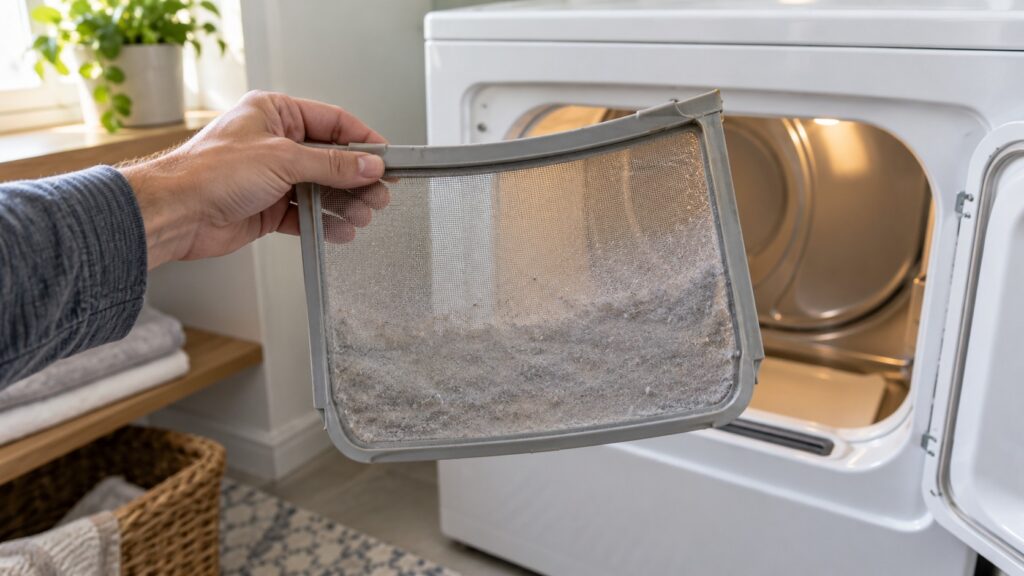
Airflow is the largest single factor. A lint filter coated with fine lint or a film of softener residue restricts the air, and the dryer overheats and cuts back. On condenser and heat pump models the condenser filter and the heat exchanger have to stay clear as well, and a full water tank or a blocked drain can stop the cycle or reduce drying. Clean the lint filter, rinse it under water and let it dry fully, since a damp filter blocks air almost as well as a dirty one.
Then check the path outside the dryer. A crushed or overlong vent, or a blocked exterior flap, traps hot, moist air. Our guides to Asko dryer lint filter routine, Asko dryer condenser filter cleaning and Asko dryer venting walk through each.
What does the 200-minute limit have to do with it?
On the Asko dryer platform there is a maximum program time of 200 minutes. When a cycle exceeds it, the control stops and resets the program. Different control boards label the same safety ceiling differently: it appears as J1 on the TD70.3 panel, as L3 on TD70.1 Type A, as F29 on Type B and as S2 on TD70.2. The page for the J1 problem explains it in detail.
The point for troubleshooting is that a dryer that keeps running without ever finishing may be hitting this limit, which is a symptom of something upstream, such as poor airflow or weak heat, and not a fault in the timer itself. Read our Asko dryer J1 page if you see it. A cycle that regularly nears the limit is a sign to check the filters and vent before you suspect the heater. Our guide to Asko dryer cycle duration explains normal run times.
How is a heat pump dryer different?
A heat pump dryer does not use a conventional heater. It moves heat around a sealed circuit, warming the air with a compressor and a pair of heat exchangers and collecting the moisture as water. That makes it economical, but it also means that the evaporator and the condenser have to stay clean, and the cycles run longer than on a vented dryer. A heat pump dryer that seems to have no heat may simply be doing its job slowly, or it may be limited by a clogged exchanger.
Our guide to Asko heat pump dryer evaporator care covers cleaning that part safely, and our guide on the Asko dryer compressor explains when the sealed circuit is at fault. Do not open the sealed circuit yourself; that work belongs to a technician.
When should a technician take over?
After the filters, the condenser, the water tank and the vent are clean and the load is a sensible size, a dryer that still does not heat has a problem in the heating circuit. That could be the heater, a thermal device that has opened, a sensor or the control, and testing those means opening the cabinet. These parts carry mains power and hot surfaces, so they are technician jobs.
When you call, give the model, the age, whether any code appeared and what you have already cleaned. Our Asko dryer repair page explains the visit. A part swap is usually far cheaper than replacing a dryer, but a repeated overheating event is a reason to find the airflow cause first, because a new part will trip again if the vent is still blocked.
A last habit worth adopting is to look at the load, too. An overstuffed drum slows airflow through the clothes and makes the dryer run long, so dry sheets and towels in smaller batches, and spin the wash at a high speed first so less water reaches the dryer. Both steps shorten the cycle and keep the heat from running into its limits.