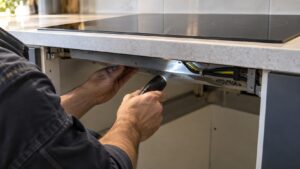

An Asko induction cooktop only heats when it detects a compatible pan sitting directly over an active zone, and that detection is a physical process, not a guess. The coil beneath the glass generates a rapidly alternating magnetic field, and it is the interaction between that field and a ferromagnetic pan base that lets the cooktop confirm cookware is present before sending any real power to the zone. Understand that mechanism and most “zone will not heat” moments turn out to be about the pan, not the appliance.
How does an Asko induction cooktop know a pan is there?
Underneath the glass surface, each zone has a coil of wire that carries alternating current at a frequency well above household power. That current generates a magnetic field that oscillates rapidly around the coil. On its own, that field passes through non-magnetic materials — glass, air, aluminum, copper — without doing much of anything. A magnetic material placed in that field behaves differently: it distorts the field and draws current, which the cooktop’s electronics can detect as a change in load on the coil. That change is the signal the control uses to confirm a compatible pan is present.
Once detection confirms a magnetic base is sitting over the coil, the cooktop increases power to that field, and the resulting eddy currents inside the pan’s own base generate heat directly in the metal. The glass surface itself stays comparatively cool because it never contacts the actual heat source — the pan base is the heating element, not the cooktop.
Why does the zone not detect my cookware even though it is on the burner?
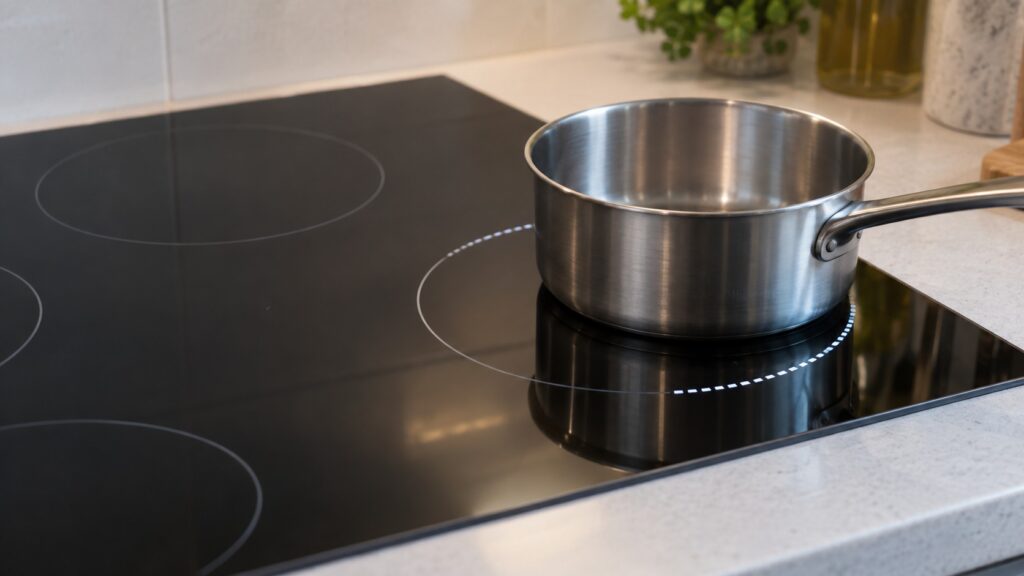
Three conditions cause an otherwise normal pan to read as absent. First, the base is not magnetic — a quick check is whether a refrigerator magnet grips the underside of the pan; if it does not, the cooktop will not detect it either, regardless of how the pan performs on gas or electric coil. Second, the pan’s contact diameter is smaller than the zone’s minimum, which matters for small saucepans and single-egg pans placed on a standard-size zone rather than a small or flexible zone. Third, the pan is positioned off-center or straddling the edge of the coil, which reduces the field interaction below the detection threshold even with fully magnetic cookware.
A pan that has worked fine for months and suddenly stops registering is a different situation and usually points at the cooktop rather than the cookware — our symptom guide covers what to check when a zone stops detecting a pan that previously worked normally.
Does pan size actually matter, or just the material?
Both. Material determines whether detection can happen at all; size determines whether it happens reliably on a given zone. Each zone’s coil has a diameter, and Asko’s minimum detectable base size is smaller than that coil diameter but not dramatically so — a narrow-bottomed pan, a wok with a rounded base that only makes point contact, or a very small saucepan can all fall under that minimum even with a fully magnetic base. This is also why induction manufacturers, including Asko, publish a minimum pan diameter for each zone size in their cookware guidance rather than relying on a single blanket figure for the whole cooktop.
Flex zones and bridge zones change this calculation. Combining two adjacent zones into one larger area, as covered in our bridge induction guide, extends the usable detection area for oversized cookware like a griddle or a large stockpot base that would not sit fully within one standard zone’s coil.
Can I test whether my cookware is induction-compatible before buying an Asko cooktop?
Yes, and it takes seconds. Hold a standard refrigerator magnet to the underside of the pan being considered. A magnet that grips firmly to the base indicates a ferromagnetic layer strong enough for induction detection. A magnet that does not grip at all — common with pure aluminum, copper-bottomed cookware without a steel layer, and most glass or ceramic bakeware — will not work on any induction cooktop, not just an Asko unit. Our induction-compatible cookware guide covers the full range of materials and hybrid-base designs sold specifically for induction use.
A magnet that grips weakly or only at the very edge of the base is worth treating with caution — it may register inconsistently, heating unevenly or dropping detection mid-cook on some zones even though it technically qualifies.
What does it mean if only part of the pan heats unevenly?
Uneven heating on an induction zone that has correctly detected the pan usually traces back to base flatness rather than the detection system itself. A warped or slightly domed pan base makes inconsistent contact across the coil area, so parts of the base couple with the field better than others. This is a cookware issue, not a cooktop fault, and it tends to get worse with age as thin-based pans warp further from repeated heating and cooling cycles.
If detection itself is failing intermittently rather than heating being merely uneven — the zone indicator flickers on and off, or the cooktop beeps and cancels the zone repeatedly with a pan that passes the magnet test and sits centered — that points toward the cooktop’s own sensor or control board rather than the cookware, and is worth a professional look.
We are an independent repair company, not a factory service arm, and our technicians can confirm whether an intermittent detection fault is a cookware issue or a cooktop issue on-site. Book Asko cooktop repair or schedule a visit if a zone that used to detect cookware reliably has started failing to.
Understanding how asko induction pan detection works before assuming a fault saves an unnecessary service call for what is often just the wrong pan.