The Asko induction cooktop terms you meet in the manual and on the display come down to a short list: the cooking zone, the generator that drives it, pan detection, power levels, the control lock, the cooling fan and the protective cutbacks that reduce power when a cooktop gets too hot or too hemmed in. Knowing what each word means turns a confusing message into a simple instruction, whether that is to move a pan, clear the space under the cooktop or call for service.
What is a zone and what is the generator on an Asko induction cooktop?
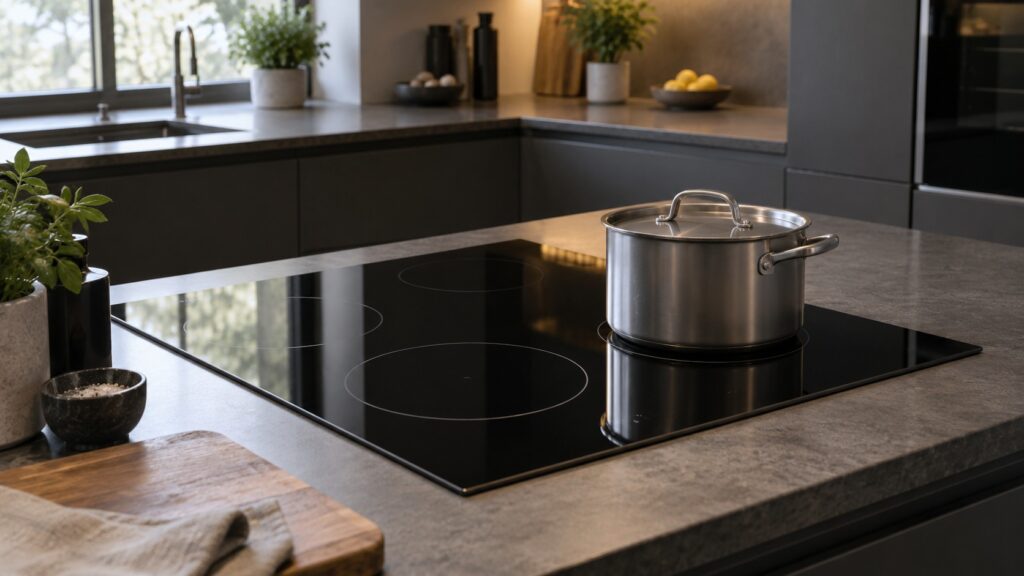
A zone is a cooking area marked on the glass, and under it sits a flat copper coil. The generator is the electronics that turn household current into the high-frequency current the coils need, and it is the heart of the cooktop. When the cooktop works, the generator energizes a coil, the coil creates a magnetic field, and the field heats the pan itself rather than the glass. That is why the glass stays much cooler than the pan on an induction cooktop, and why an empty zone stays cold.
Several Asko induction models are built around an F-series generator family, including boards such as the one on the HI1655M. When a code mentions the generator, it refers to this electronics unit, and a generator fault is a service matter, not an owner repair. Our guide to Asko induction cooktop fault code families shows how the codes group.
What do pan detection and power levels mean?
Pan detection is the cooktop checking that a suitable pan is on the zone before it sends power. If the pan is missing, too small or made of a material that does not work with induction, the zone will not heat, and the display may flash. This is a safety and efficiency feature, not a fault. Our explanation of Asko induction pan detection covers how the cooktop decides, and the induction-compatible cookware guide tells you which pans work.
Power levels are the numbered steps on the touch control, from a low setting for keeping food warm to a high setting for boiling. Many induction cooktops also offer a boost for short bursts of extra power, and the cooktop may share power between zones that sit on the same supply, so using two large zones at full output at once can lower one of them. The exact behavior depends on the model, so check your manual.
What does the control lock do?
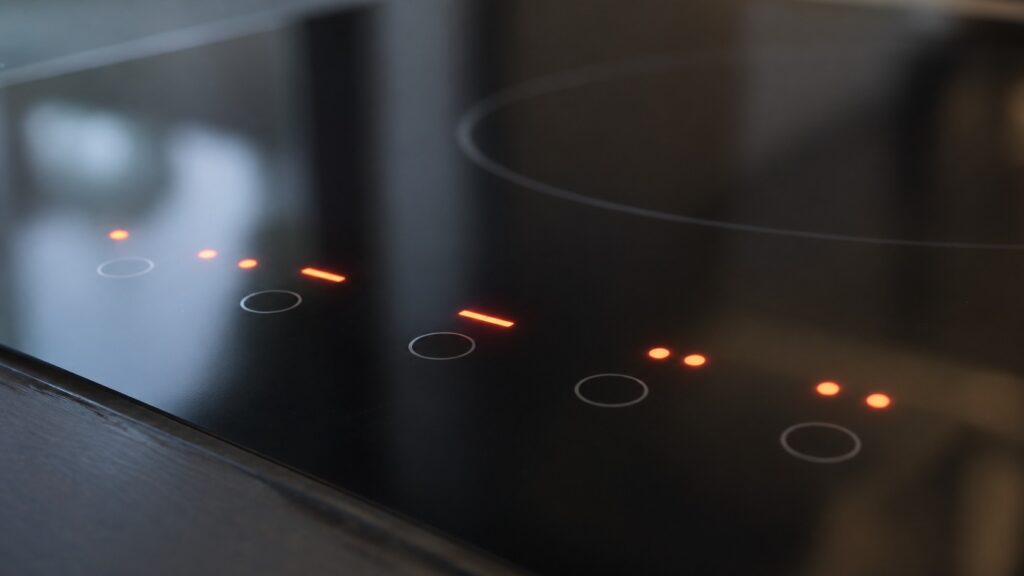
The control lock, often called the child lock, makes the touch controls ignore presses so a child, a pet or a wipe-down cannot switch a zone on. A lock symbol shows on the panel while it is active, and you release it by pressing the lock key for the time your manual gives. It is one of the most frequent reasons an owner thinks a cooktop has died, because the glass is lit but nothing responds.
If the lock will not clear, a wet or dirty panel may be confusing the sensors, so dry the glass and try again. Our guide to the Asko cooktop child lock and control lock walks through the steps and what to do when it does not release.
What do the protective codes FA, FC and FAN mean?
On the F-series induction family, the display uses short codes to tell you which protection has acted. FA is an airflow problem: the manual’s stated cause is that air circulation is not good, and the fix is to make sure the venting holes under the cooking plate are open. FC belongs to the same group as F0 to F6, where the stated cause is that the ambient temperature is not good, and the published fix is to switch off all heat sources near the cooking plate.
FAN is different. It shares the cause of F00, a defective generator, and the manual points to the service department, not to a reset or a cleared vent. Despite the name, FAN is not automatically a cooling fan fault. You can read each on its own page: FA, FC and FAN. Our guide to Asko cooktop fault codes FA, FC and FAN goes deeper.
Why does the cooling fan run after I stop cooking?
The generator makes heat as it works, so induction cooktops include a cooling fan that pushes air through the electronics and then keeps running for a while after the zones are switched off, until the electronics have cooled. A fan that runs on is normal. A fan that runs constantly with nothing on, or one that is noisy, is a different matter and is covered in our guide to Asko induction cooktop ventilation and overheating.
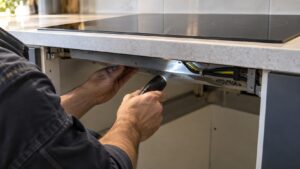
The ventilation openings under the cooktop are as important as the fan. Items stored in a drawer directly beneath the cooktop can block airflow, which is exactly the situation the FA code describes. Keep the space under the cooktop clear, and follow the installation instructions for the clearance below the unit.